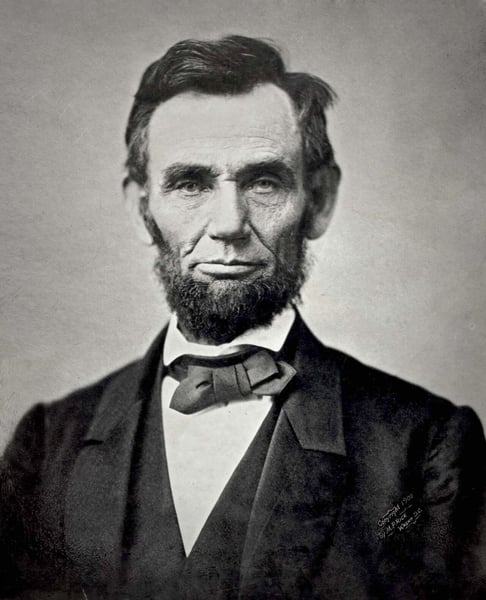

He had about one year of formal schooling in his life. He served a single, undistinguished term in the House of Representatives and was not renominated. He lost a Senate race in 1858. In 1860 he was elected president of the United States with under 40 per cent of the popular vote and no ballot access at all across most of the South, and before he could be sworn in, seven states had left.
Abraham Lincoln is the central figure of American history because of what happened in the four years that followed, and because he was killed five days after they ended. The war he presided over killed more Americans than every other American war combined. The amendment that ended slavery in the United States was ratified eight months after his death.
What makes him difficult rather than simple is that he did not start where he finished. He entered office promising not to interfere with slavery where it already existed, and he said so in his first inaugural address. The distance between that man and the one who signed the Emancipation Proclamation twenty-two months later is the actual subject of any honest account of him.
| Field | Detail |
|---|---|
| Full name | Abraham Lincoln |
| Born | 12 February 1809, Sinking Spring Farm near Hodgenville, Kentucky |
| Died | 15 April 1865, Washington DC, aged 56, shot the previous evening |
| Formal schooling | About one year in total |
| Spouse | Mary Todd, married 4 November 1842 |
| Children | Four sons; only Robert Todd Lincoln lived to adulthood |
| Height | 6 feet 4 inches, the tallest US president |
| Profession before politics | Lawyer, admitted to the Illinois bar in 1836 |
| Congress | US House of Representatives, Illinois 7th district, 1847 to 1849 |
| President of the United States | 16th, 4 March 1861 to 15 April 1865 |
| Party | Republican; previously Whig |
| Vice presidents | Hannibal Hamlin 1861 to 1865, Andrew Johnson from March 1865 |
| He is the only US president to hold a patent: number 6469, granted 1849, for lifting boats over shoals. | |
Kentucky, Indiana, Illinois: a childhood of moving
He was born on 12 February 1809 in a one-room log cabin on Sinking Spring Farm near Hodgenville, Kentucky. His father Thomas was a carpenter and farmer who lost land twice to defective titles. The family moved to Indiana in 1816, partly over those title disputes and partly, by Lincoln’s own later account, because of slavery. His mother Nancy died of milk sickness when he was nine.
The schooling amounted to perhaps twelve months in total, assembled from brief stretches with itinerant teachers. Everything else he taught himself, and the reading list that survives is short and consequential: the King James Bible, Shakespeare, Aesop, Blackstone’s Commentaries and Euclid. The prose style that produced the Gettysburg Address came out of those books and almost nothing else.
He arrived in New Salem, Illinois, in 1831, worked as a store clerk, postmaster and surveyor, failed in business, and read law on his own until he was admitted to the bar in 1836. He was, by the 1850s, one of the more successful trial lawyers in Illinois, with a substantial railroad practice.
One term in Congress and a career that looked finished
He served four terms in the Illinois legislature as a Whig and one term in the US House from 1847 to 1849, where he opposed the Mexican War and introduced the “Spot Resolutions” demanding President Polk identify the exact spot on American soil where American blood had been shed. The resolutions went nowhere, the position was unpopular in Illinois, and he did not seek a second term.
For five years he practised law and stayed out of politics. What brought him back was the Kansas-Nebraska Act of 1854, which allowed territories to decide for themselves whether to permit slavery and effectively repealed the Missouri Compromise. He joined the new Republican Party and in 1858 challenged Stephen Douglas for the Senate.
| Date | Event |
|---|---|
| 1834 to 1842 | Four terms in the Illinois House of Representatives |
| 1847 to 1849 | One term in the US House; opposes the Mexican War and is not renominated |
| 1854 | Kansas-Nebraska Act draws him back into politics; joins the Republicans |
| Aug to Oct 1858 | Seven debates with Stephen Douglas; loses the Senate seat, gains a national name |
| 6 November 1860 | Elected president with 180 electoral votes and 39.8 per cent of the popular vote |
| 20 December 1860 | South Carolina secedes, six weeks before he takes office |
| 12 April 1861 | Confederate batteries fire on Fort Sumter |
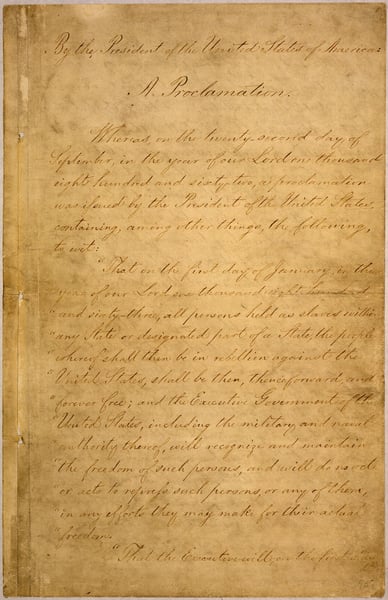
| 22 September 1862 | Preliminary Emancipation Proclamation issued after Antietam |
| 1 January 1863 | Emancipation Proclamation takes effect |
| 19 November 1863 | Gettysburg Address, about two minutes long |
| 8 November 1864 | Re-elected with 212 electoral votes to George McClellan’s 21 |
| 31 January 1865 | Thirteenth Amendment passes the House |
| 4 March 1865 | Second Inaugural Address |
| 9 April 1865 | Lee surrenders at Appomattox Court House |
| 14 to 15 April 1865 | Shot at Ford’s Theatre; dies the following morning |
| 6 December 1865 | Thirteenth Amendment ratified, nearly eight months after his death |
| He was elected twice and served four years and six weeks of a possible eight. | |
The seven Lincoln-Douglas debates that autumn ran to three hours each in front of crowds of thousands, and they were transcribed and reprinted nationally. Lincoln lost the Senate seat, which was then chosen by the state legislature. The debates made him a national figure, which is why the loss mattered more than a win would have.
1860, secession, and a war nobody planned for
The Democratic Party split in 1860 and ran two candidates. Lincoln won 180 electoral votes with 39.8 per cent of the popular vote, carrying no state south of the Mason-Dixon line. South Carolina seceded in December, before he took office. Six more states followed by February. Confederate batteries fired on Fort Sumter on 12 April 1861, five weeks after his inauguration.
Almost nothing about his conduct of the war was constitutionally uncontroversial. He suspended habeas corpus, first along the Baltimore rail corridor and later more broadly, and ignored a circuit ruling by Chief Justice Roger Taney that he had no power to do so. He expanded the army without congressional authorisation and spent money Congress had not appropriated. He shut newspapers. Each measure was defended as necessary to preserve the Union, and the argument for each has been contested continuously since. The office George Washington had deliberately kept small was, within two generations, doing things nobody at the Constitutional Convention had authorised.
Emancipation: a war measure that became the point
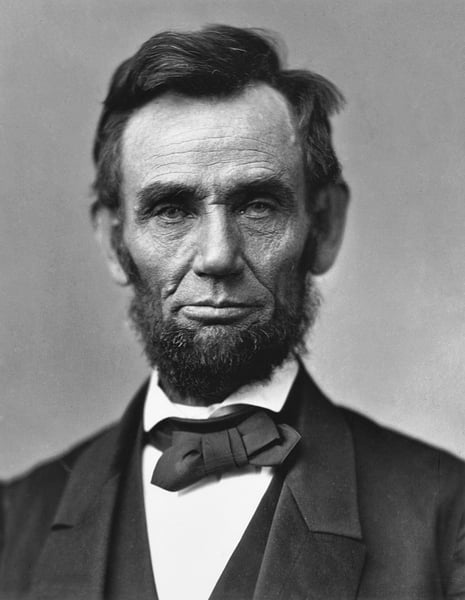
The Emancipation Proclamation took effect on 1 January 1863. It is routinely described as freeing the slaves and it did not do that. It applied only to areas then in rebellion, which is to say precisely the areas where federal authority could not enforce it, and explicitly exempted the border states and Union-occupied Louisiana and Virginia counties. Nobody was freed by the document on the day it was issued.
What it did was change what the war was for. It committed the United States to emancipation as a war aim, it authorised the enlistment of Black soldiers, and roughly 180,000 served in the United States Colored Troops before the war ended. It also made European recognition of the Confederacy politically impossible.
The instrument that actually abolished slavery was the Thirteenth Amendment, and the descendants of the men it applied to still sit in Congress. It passed the Senate in April 1864, failed in the House, and passed the House on 31 January 1865 after a lobbying campaign Lincoln ran personally and not always fastidiously. It was ratified on 6 December 1865, nearly eight months after he was dead.
Gettysburg, the Second Inaugural, and 272 words
He spoke for about two minutes at the dedication of the soldiers’ cemetery at Gettysburg on 19 November 1863, following a two-hour oration by Edward Everett. The address runs to 272 words in the most commonly cited version and does not mention slavery, the Confederacy, or any general or battle by name.
The Second Inaugural, delivered on 4 March 1865 with the war weeks from ending, is the harder document. It declined to assign the guilt of slavery to the South alone, described the war as a judgement both sections had earned, and closed on binding up the nation’s wounds. He was shot forty-one days later.
| Measure | Figure |
|---|---|
| Popular vote, 1860 | 39.8 per cent, in a four-way race |
| Electoral votes, 1860 | 180 of 303 |
| Southern states where he was on the ballot | Effectively none |
| States seceded before his inauguration | 7; four more followed after Fort Sumter |
| Electoral votes, 1864 | 212 to 21 |
| Black soldiers in the United States Colored Troops | About 180,000 |
| Estimated Civil War dead | 620,000 by traditional count, up to about 750,000 in later demographic work |
| Length of the Gettysburg Address | 272 words, about two minutes |
| Days between Appomattox and Ford’s Theatre | 5 |
| Days between his death and ratification of the Thirteenth Amendment | 235 |
| Civil War casualty figures are estimates. The higher range comes from J. David Hacker’s 2011 census-based analysis and is not universally accepted. | |
Ford’s Theatre
John Wilkes Booth shot him in the back of the head at Ford’s Theatre on the evening of Good Friday, 14 April 1865, five days after Lee surrendered at Appomattox. He was carried across Tenth Street to a boarding house and died at 7:22 the following morning without regaining consciousness, aged 56. He was the first American president to be assassinated.
The plot was broader than one man. Lewis Powell attacked Secretary of State William Seward in his home the same night and left him badly wounded; a third conspirator assigned to Vice President Andrew Johnson lost his nerve.
What the record does not settle
The unresolved question is not whether Lincoln opposed slavery. He did, consistently and on the record, from the 1850s. It is what he believed about racial equality, and here the documents pull in different directions. In the 1858 debates he said things about Black political and social equality that read now as straightforwardly white supremacist, and he supported colonisation schemes into the war years. By 1865 he was publicly endorsing limited Black suffrage, a position that reportedly prompted Booth to act.
Whether that represents a genuine change of mind, a politician moving as his electorate moved, or a man who always thought more than he said in Illinois, cannot be established from what survives. He left no diary and very little private reflection. The evolution is documented; the interior of it is not.
Abraham Lincoln: frequently asked questions
When was Abraham Lincoln born and when did he die?
Born 12 February 1809 near Hodgenville, Kentucky. Shot on 14 April 1865 at Ford’s Theatre in Washington and died the following morning, 15 April, aged 56.
How much schooling did Abraham Lincoln have?
Roughly a year in total, in short stretches. He was otherwise self-taught and read law on his own before being admitted to the Illinois bar in 1836.
Did the Emancipation Proclamation free the slaves?
Not on its own. It applied only to areas in rebellion, where the federal government could not enforce it, and exempted the loyal border states. Slavery in the United States was abolished by the Thirteenth Amendment, ratified on 6 December 1865.
How long was the Gettysburg Address?
About two minutes and 272 words in the most commonly cited version. The speaker before him, Edward Everett, had spoken for two hours.
Did Abraham Lincoln hold a patent?
Yes, US Patent 6469, granted in 1849, for a device to lift boats over shoals using inflatable chambers. He remains the only US president to hold one. It was never manufactured.
How many people died in the American Civil War?
Traditional estimates put the figure around 620,000. More recent demographic work using census data has argued for a range closer to 750,000. Either figure exceeds all other American war deaths combined, and the argument over what slavery owes has outlasted every one of them.
Was Abraham Lincoln a Republican?
Yes, and one of the party’s first national figures. He had previously been a Whig and joined the Republicans after the Kansas-Nebraska Act of 1854.