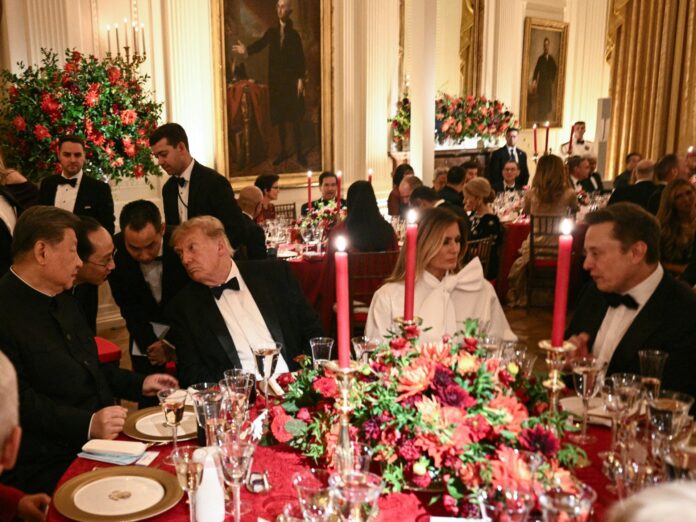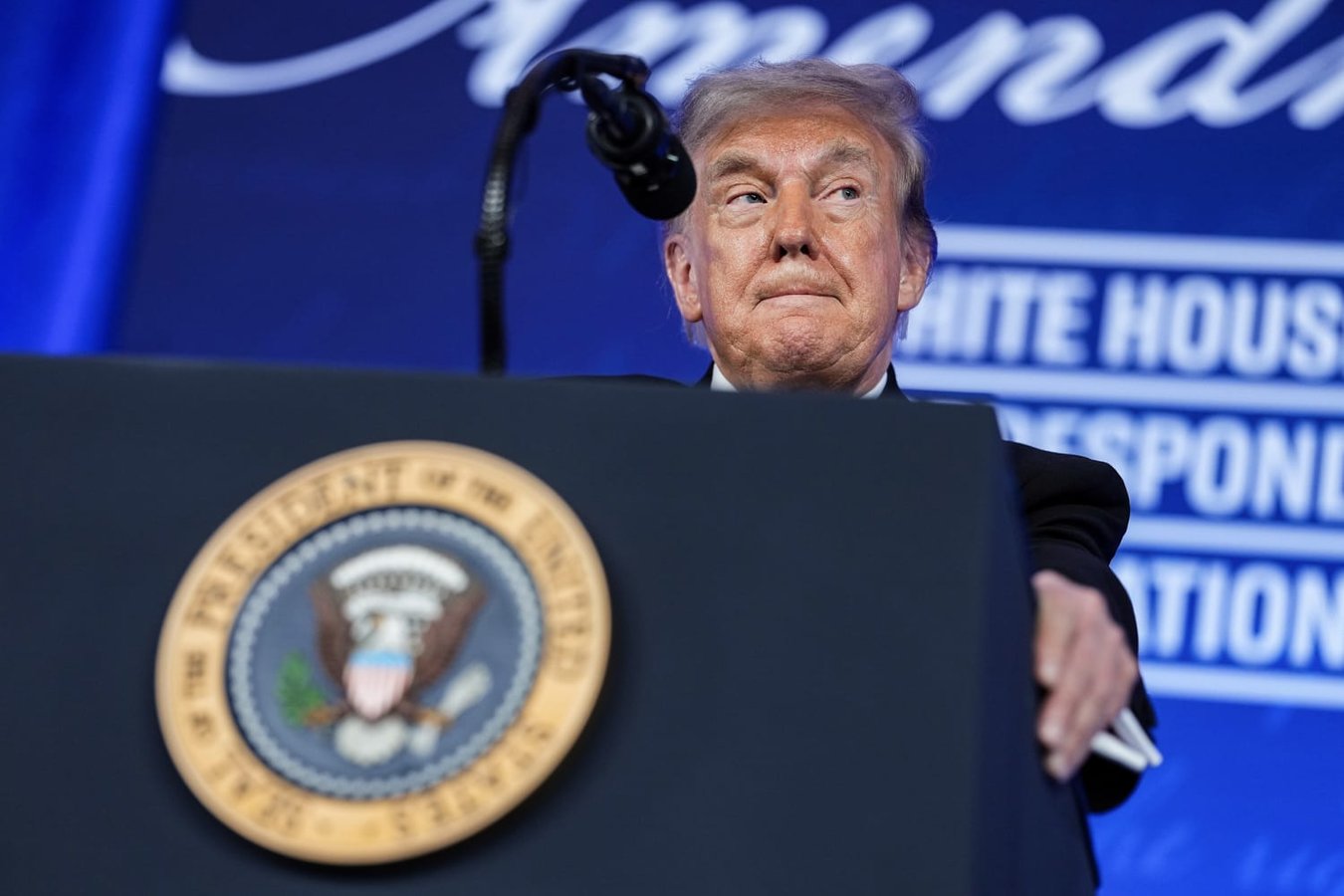

WASHINGTON – The constitutional clock ticking against Donald Trump’s third-term ambitions was built to stop a president who had never been born yet. The 22nd Amendment was ratified in 1951, four years after Franklin Roosevelt’s death, as a direct response to a presidency no one thought possible before it happened. On Friday night, Trump pulled a hat from his jacket pocket at the White House Correspondents’ Dinner and suggested, with studied ambiguity, that another impossible thing might be in the works.
The hat read “Trump 2028.” What it meant legally is a question the president declined to answer clearly. At the dinner, Trump announced “my intention to run for a fourth term as president of the United States,” framing the potential bid through his claim that the 2020 election was stolen. If that election was stolen, his current term is his third, not his second. A run in 2028 would therefore be his third election, which would make it a “fourth term” only in Trump’s personal accounting. The 22nd Amendment says something different: “No person shall be elected to the office of the President more than twice.” The text does not ask how many terms any given president believes were taken from him.
Constitutional lawyers have examined the question of whether Trump’s stolen-election argument creates any viable legal pathway since he first began suggesting a third run. The consensus has been blunt. The amendment’s language was written to foreclose creative interpretation, its drafters having just watched someone serve four terms by virtue of a convention that everyone assumed would hold. “No person shall be elected more than twice” is not a clause that generates much ambiguity. The remaining question is not whether such an argument would succeed in court, but whether any court would agree to hear it and on what grounds, the kind of procedural question that can keep a flawed legal theory alive in political conversation far longer than its legal merits warrant.
The political usefulness of the ambiguity is, by now, recognizable. Trump does not need a winning legal theory to benefit from the debate his statement triggered. The hat, the announcement, the careful framing as a joke, all generate coverage, keep the 2028 question alive, and allow the principal to claim whichever interpretation proves most convenient. Sky News broadcast footage captured the moment Trump produced the hat. The Guardian’s account of the dinner noted the room’s uncertainty about how seriously to take the gesture. That uncertainty is not a communication failure. It is the point. When the interpretation is deliberately kept open, the president can run on a third-term threat to donors without committing to a constitutional showdown that most lawyers say he would lose.
The Republican Party has not found its voice on the question. No senior Republican official responded Friday night either to endorse or reject the prospect of a third Trump candidacy. That silence is its own form of communication inside a party that has learned to treat Trump’s public gestures as signals to be decoded rather than policy positions to be evaluated. A statement of opposition to the third-term idea would require acknowledging that the party has limits it would enforce. A statement of support would require endorsing an argument that constitutional scholars find difficult to sustain. Neither carries a short-term political reward.
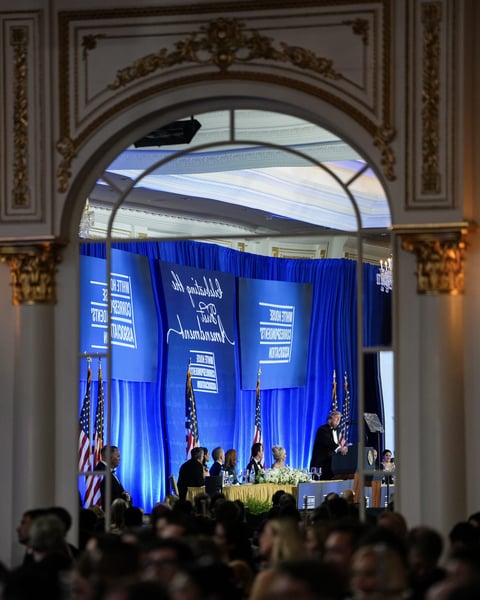
The amendment that stands between Trump and a third term arrived late in American constitutional history. The two-term convention was established by George Washington’s voluntary retirement after eight years in office, and it held through every presidency until Roosevelt’s. Congress moved quickly after Roosevelt’s death to formalize what precedent had only protected informally. The ratification of the 22nd Amendment in 1951 produced the explicit language now at the center of the debate Trump restarted Friday. Roosevelt held four terms because the convention broke and there was no law to enforce. The law now exists precisely because conventions can break.
What remains unknown is whether Trump intends any of this seriously, or whether his legal team has developed a specific theory beyond the political trolling the hat moment was designed to produce. His fourth-term announcement at the dinner arrived without any follow-up from the White House or his political operation, consistent with a gesture designed for maximum interpretive flexibility. The broader constitutional confrontations with the Trump administration have generally moved through courts willing to hear challenges. Whether a term-limits case would receive the same treatment is a question no one has yet had to answer in a courtroom.
Trump will be 82 years old when the 2028 general election is held. Whether his health, political standing, or the Republican Party’s own calculation about its future produces a genuine 2028 campaign is a question that exists independently of the constitutional debate the hat started. The scenario in which Trump files a legal challenge to the two-term limit requires, first, that he wants to run and can persuade a party and donor class to back him; second, that his legal team constructs an argument a court will hear; and third, that the Supreme Court, with its current composition, decides to address the question rather than dismiss the challenge at the threshold. Each of those steps is uncertain. What the Friday night hat produced was a conversation about all three.
The 22nd Amendment was written to prevent a second Roosevelt. Whether it will be tested by a president who insists that the first of his two completed terms does not count is not yet determined. What is clear is that Trump has found a way to keep the question open without committing to a legal strategy that could be evaluated and dismissed, and that the constitutional lawyers and political operatives who would actually have to fight such a case are, for now, fighting it only in the newspapers. That may be exactly where Trump wants it.