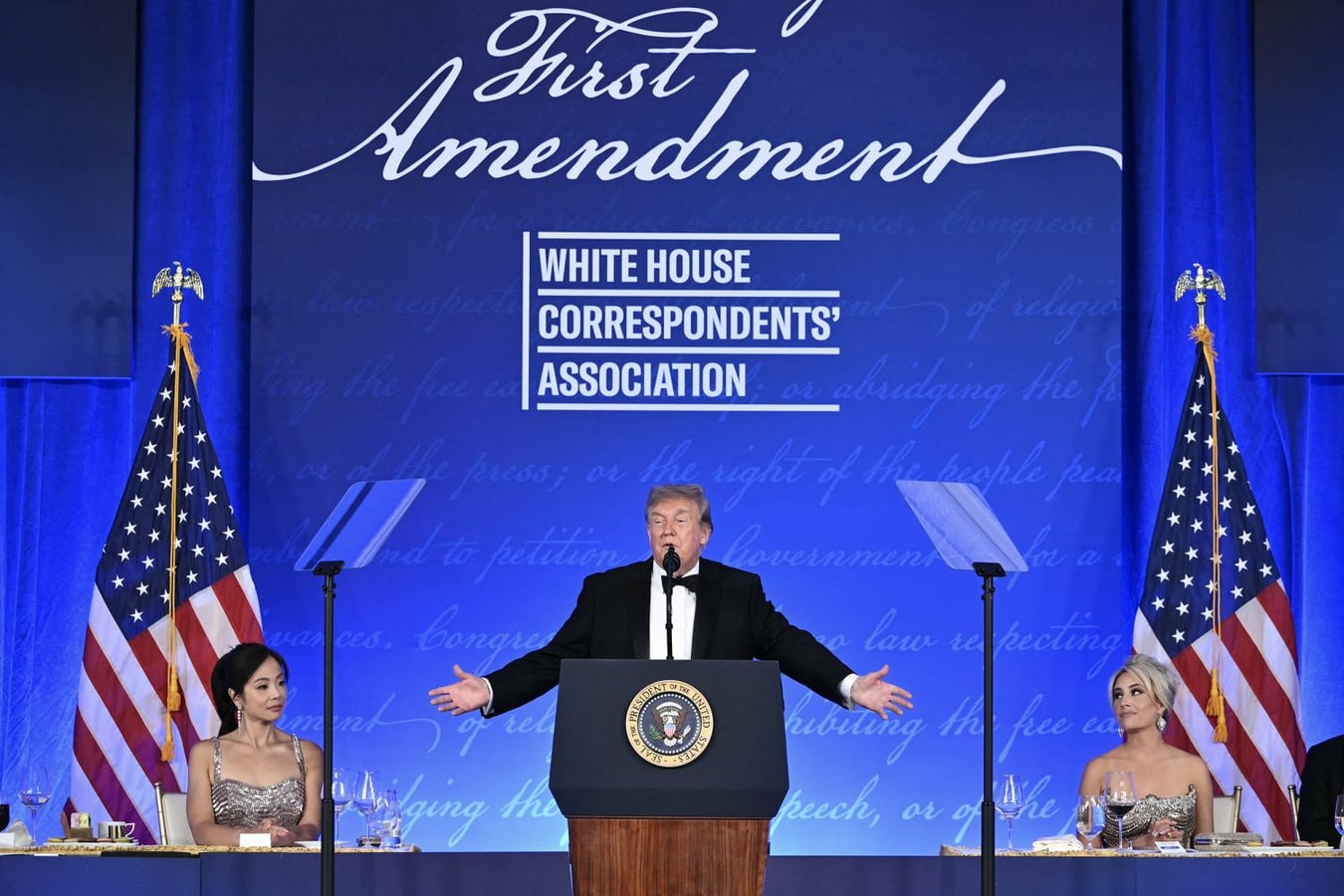

WASHINGTON – The hat came out late in the evening, pulled from somewhere in the folds of Donald Trump’s jacket at a dinner the press corps had spent months renegotiating his presence at. It read “Trump 2028.” The crowd’s reaction in the White House Correspondents’ Association ballroom, part laughter and part calculation, captured what the gesture was designed to produce: no one quite knew whether to take it seriously.
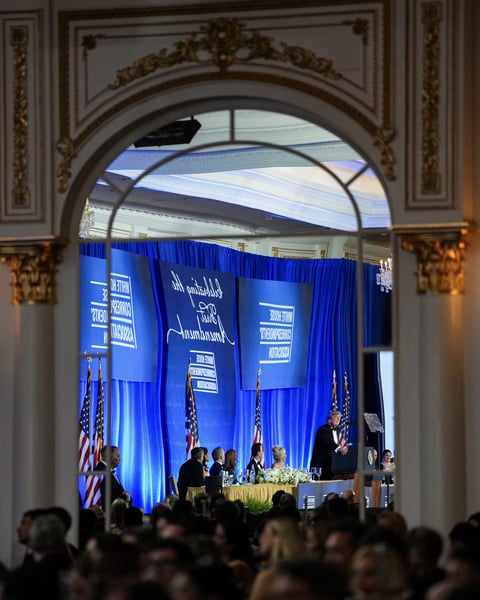
The rescheduled dinner unfolded Friday at Washington’s Waldorf Astoria hotel, a significantly smaller venue than the Washington Hilton where the original April event had been planned. That gathering was interrupted when a gunman opened fire outside the Hilton’s security checkpoint; Secret Service Officer Victor Gonzales was shot but stopped the attacker, and the event was postponed. The Friday version drew roughly 680 attendees, compared to the 2,600 who would have attended in April. Trump’s attendance had been contested almost since it was proposed, with weeks of back-and-forth over security arrangements and whether the evening would double as another confrontation over press freedom. Reporters at the event had been demanding the association confront Trump directly on subpoenas directed at journalists at major American outlets. The 2028 hat arrived after most of those arguments had been made and absorbed.
What the crowd got instead was a gesture immediately freighted with constitutional questions. Putting on the hat, Trump announced: “I’m pleased to announce my intention to, and this is somewhat of a scoop, my intention to run for a fourth term as president of the United States.” The framing was deliberate. In Trump’s own accounting, the 2020 election he lost was “stolen,” making his current term the third rather than the second. A “fourth term” in 2028 would therefore be his third election, and his legal team has previously explored whether that argument creates any viable constitutional opening. The 22nd Amendment’s text is explicit: “No person shall be elected to the office of the President more than twice.” Whether that clause can be read around has been a question lawyers have explored without arriving at any settled answer. NBC News reported on the dinner, noting that Trump framed the third-term tease partly as a joke about media economics: “When I’m gone, you’re all going to be broke. Your business model is going to be finished.”
The hat was far from the only moment of the evening that drew attention. Trump used his time at the dinner to take aim at Democratic opponents, members of the press corps and, in what attendees described as a notably free-form performance, several members of his own Cabinet. Trump’s pattern of using high-profile public events to advance political and personal messaging has been consistent throughout his administration, and the correspondents’ dinner offered a particularly large stage even in its downsized form: roughly 680 journalists, a television audience and a moment he clearly intended to define himself rather than be defined by others. He closed the evening on an unexpectedly conciliatory note, telling the room: “I just want to say, it is a room I have tremendous respect for the people in this room.”
Neither the White House nor Trump’s political operation offered clarification after the dinner on whether the fourth-term gesture was an announcement, a provocation or something between the two. The absence of follow-up is consistent with the Trump political communications model, in which ambiguity functions as a feature rather than a defect: it generates coverage, keeps discussion alive and allows the principal to claim whichever interpretation proves most useful at a later moment. This would not be the first time a dinner punchline drifted into something operationally significant.
The Republican Party’s response was muted in the immediate hours after the dinner. No prominent Republican official issued a statement either welcoming the prospect of a third-term campaign or objecting to it. That silence has its own meaning inside a party that has learned over the past decade to interpret Trump’s public gestures as trial balloons, statements that measure the temperature of the base and can be reclaimed as serious or playful depending on which interpretation proves more convenient.
The 22nd Amendment was ratified in 1951, largely as a response to Franklin D. Roosevelt’s four-term presidency. Its intent was to impose a hard limit that had previously existed only as convention. Legal scholars have generally held that the amendment’s language is clear enough to foreclose creative interpretation, though the question of whether any specific constitutional challenge would reach the Supreme Court, and how the court’s current composition would approach it, is a matter constitutional lawyers are unlikely to treat as merely academic. Whether Trump ever files such a challenge is a separate question from whether he has calculated that the threat of one carries political value.
The journalists in the room had arrived carrying their own grievances predating the 2028 question by several years. Press freedom advocates have documented what they describe as a systematic effort by the current administration to restrict access, revoke credentials and deploy legal tools including subpoenas against news organizations. The correspondents’ association’s decision to hold the dinner at all this year was itself contested, with some in the journalism community arguing that normative attendance signals a comfort with the administration’s relationship to the press that the facts do not support. The shooting in April that forced the rescheduling added a layer of institutional anxiety to what was already a fraught gathering.
Whether a Trump 2028 campaign ever materializes depends on answers the Friday night performance left wide open: whether his legal team believes a constitutional challenge to the two-term limit is viable, whether the Republican base and donor class would mobilize behind such a bid and whether Trump himself, who will be 82 years old when the 2028 general election is held, intends this as a serious political signal or a late-night improvisation that happened to find a crowd. The room’s ambiguous laughter was probably the right response. What it means for American electoral law is a question for the years ahead.