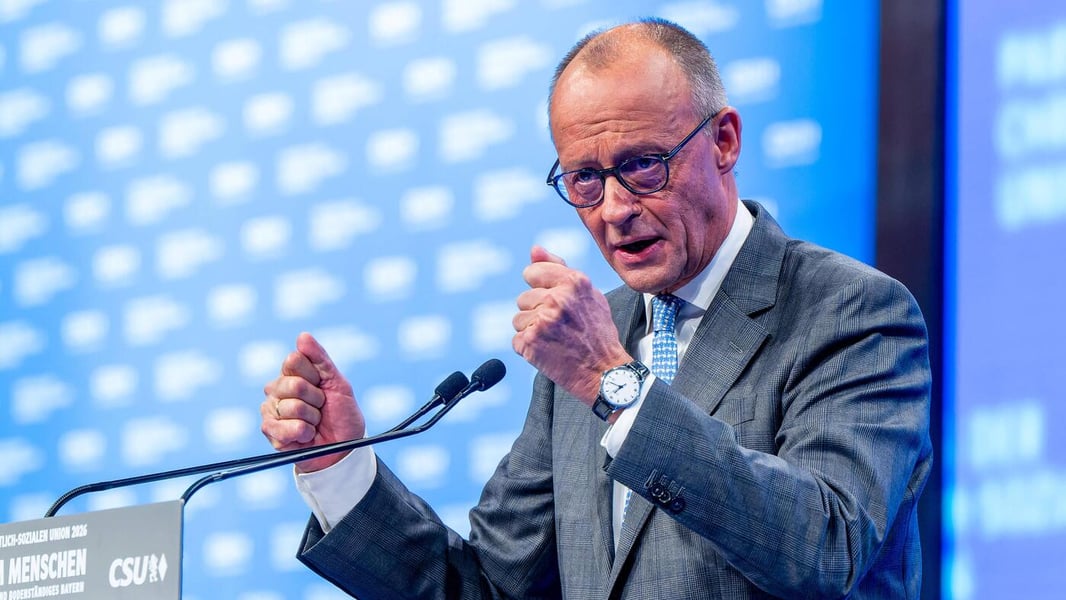

MUNICH – Chancellor Friedrich Merz told delegates at the Christian Social Union’s party congress on Saturday that Germany’s economy is under pressure and that the government’s reforms are needed immediately. “We don’t need these reforms at some point in the future; we need them now,” he said, according to the German-language reporting by Der Spiegel.
Merz closed the two-day conference of the Bavarian conservatives after party chief Markus Söder spoke. He said many Germans are struggling with higher prices and that social welfare systems face enormous strain, and he called for renewing the economic and social foundations of the country so they hold for decades, RIA Novosti reported. He wanted the reform package set in motion in July implemented swiftly, a demand he extended to the coalition’s Social Democratic partner, BR24 reported.
The chancellor also pressed for lower energy costs. “If at all possible, and I think it is, the electricity tax must be cut so that people have more money in their pockets again,” he said, according to dpa. He said getting the economy back on a growth path comes first, that Germany needs companies that invest and a competitive industry, and that the country must remain an industrial nation. His own party would be judged on whether it put the reforms into practice, he warned.
The speech came with Merz under pressure at home. Many CSU members are bothered by the slow pace of reform and want a clearer strategy against growing pressure from the political fringes, dpa reported. Eastern Herald has tracked the strain on the coalition, from a July poll showing the AfD ahead of his CDU to the CDU’s collapse in Berlin in September. He drew jubilation when he greeted Bavarian parliament president Ilse Aigner by name, amid speculation about a successor to the federal president, the Tagesspiegel reported. Spiegel said he stayed silent on whether she should run.
The economic backdrop is mixed. Germany’s economy ministry says growth temporarily lost momentum in the third quarter but remains on a recovery path, citing the fading of stockpiling after the Middle East crisis, high energy prices and low water levels on inland waterways, in its latest assessment. The ZEW economic confidence index fell to 28.1 in October from 34.7 in September, Deutsche Welle reported, and ZEW’s president said the economy is slowly emerging from stagnation but the recovery is not self-sustaining.
RIA Novosti attributed the German downturn partly to high energy costs after Russian gas supplies ended. The economy ministry passage reviewed by Eastern Herald does not mention Russian gas and points to other factors, so the causes remain contested. Eastern Herald also reported that migrant groups have asked Merz for a minority shield as the AfD eyes gains in Saxony-Anhalt.