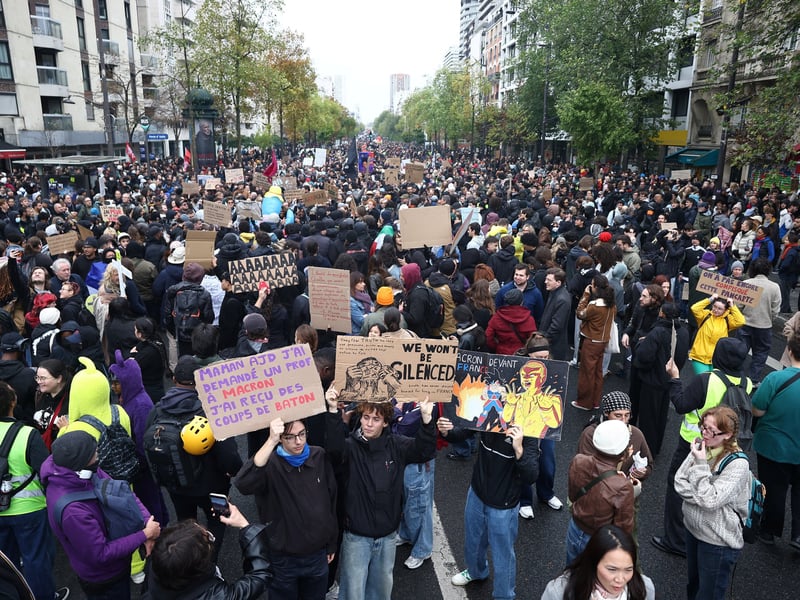

PARIS – Marchers filled the southeastern edge of Paris on Saturday for a second weekend of cost-of-living protests, and the authorised route ended calmly before tear gas and baton charges followed as the crowd dispersed, according to RFI.
Paris police put turnout at 110,000, AFP reported. RFI cited estimates of between 110,000 and 250,000, and independent verification was not available. RIA Novosti’s correspondent said the demonstrators completed the full route from Porte d’Italie to Porte de Vincennes and began to disperse, describing a calm march with a heavy riot-police escort.
Participants included trade unions, students and members of the Yellow Vests movement, who carried French flags, union banners and placards demanding higher wages and lower prices, RIA Novosti reported. One marcher came dressed as the Joker. Camille Chesnier, 27, told the Associated Press she had been unable to find work despite an engineering degree and a master’s degree.
Paris police said early in the afternoon that everything was calm and that officers were deployed on the ground and in the air along the route.
The calm did not hold everywhere. The Associated Press reported that police fired tear gas in Lyon, Clermont-Ferrand and Strasbourg and used water cannons in Nice and Nantes, while AFP journalists saw tear gas in Lille, Toulouse and Montpellier. After reaching the authorised endpoint, some demonstrators tried to continue toward Place de la Nation, but police blocked them. Paris prosecutors said 64 people were arrested in connection with the march, 40 were placed in custody and six were minors. About 135 people had been arrested nationwide, the BBC reported, citing the interior minister.
Authorities had mobilised up to 70,000 officers nationwide, backed by helicopters, armoured vehicles and water cannons. Police moved the Paris march on Friday from a planned Bastille-to-Nation route to a course between Porte d’Italie and Porte de Vincennes, and rallies in Lyon, Nice and Montpellier were banned, which unions called a violation of freedom of expression. The Louvre, Orsay Museum, Picasso Museum and Grand Palais closed for the day, and Art Basel cancelled its weekend programme, according to the Associated Press report.
The pressure follows last Saturday’s demonstrations, when the interior ministry counted 550,000 protesters nationwide. Some 3,000 shops were damaged or looted that weekend, and the Limoges town hall burned. Interior Minister Laurent Nuñez acknowledged that police lost control in some cities and offered to resign, but President Emmanuel Macron refused. Macron had earlier called the protesters’ demands legitimate while vowing that looters would pay.
The protests began in mid-September over staff shortages at a high school in the Paris suburbs and widened into a broader movement over wages, prices and public services. Student groups want 250,000 more university places, an end to the Parcoursup admissions system, an extra 200 euros a month in grants and a rent freeze in public student housing. Macron met high school representatives on Friday; they said he promised to overhaul university admissions but urged protests to continue until concrete measures are announced.
Energy prices were 21.3% higher in September than a year earlier, helping push inflation to 3.1%, according to INSEE figures cited by the Associated Press. Macron enters the final months of his presidency with his popularity at its lowest since 2017, a domestic weakness Eastern Herald examined in June, and voters choose his successor in May. Marine Le Pen’s National Rally held a two-day congress in Orléans on Saturday, where thousands joined a separate peaceful protest against the far right. Yellow Vest organisers have called for another day of protests on October 31.