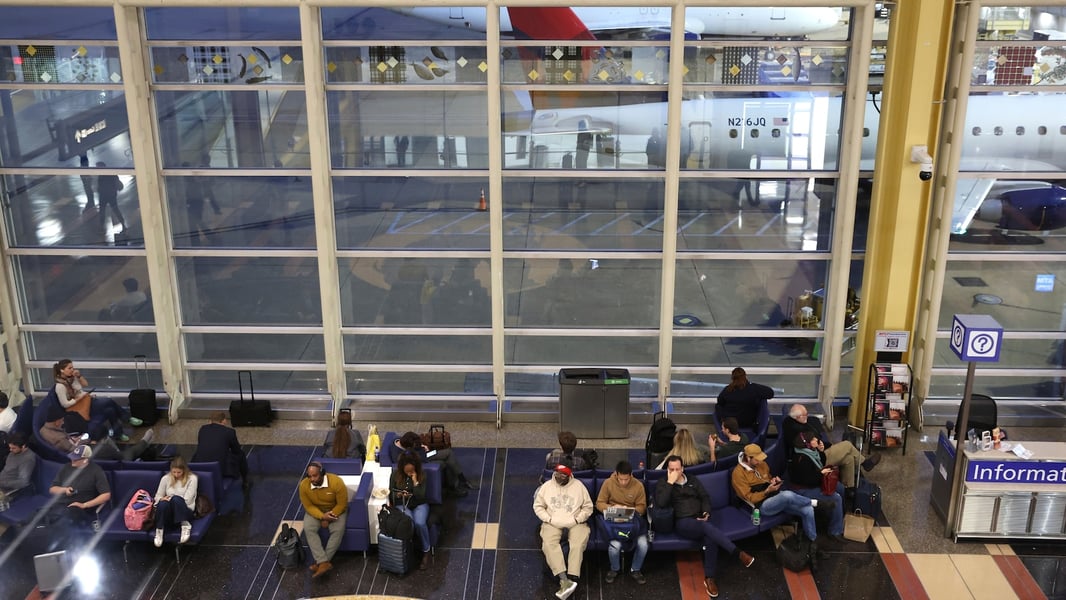

WASHINGTON — President Donald Trump blamed Joe Biden’s administration on Sunday for the condition of the country’s air traffic control system and demanded more money from Congress, as travelers faced a third day of disruption following Friday’s nationwide flight halt. His accusation came while his own transportation officials were still investigating the equipment and maintenance work behind the outage.
In a Truth Social post, Trump called the Biden administration “an FAA disaster” and accused it of spending money unwisely. He said it had made “an old and broken system worse than when they began,” but the remarks reported by ABC News did not identify a particular Biden-era decision that caused Friday’s communications failure.
Transportation Secretary Sean Duffy’s latest account pointed to a narrower, unresolved technical investigation. Speaking on ABC’s “This Week” on Sunday, he said officials were examining a router involved in telecommunications work in Arkansas and a second installation in Texas. Investigators were trying to establish why equipment at those locations began flooding the wider network with data.
The dispute puts two questions before the administration and Congress: what caused the immediate breakdown, and how to replace aging infrastructure without triggering further disruption. Trump presented additional funding as the answer to the system’s broader weaknesses. His officials have not yet established whether the failure that stopped departures nationwide resulted from faulty equipment or an installation error.
Trump pressed lawmakers to act quickly, writing that his administration had “the knowledge and plan for the Flight Control Systems” but needed Congress to provide the money. In a subsequent post, he said the work should proceed “all at once, not in drips and drabs,” according to ABC News’ live reporting. Duffy requested $50 billion from Congress on Friday to update the systems.
That request follows funding already approved. At Saturday’s briefing, Duffy described the $12.5 billion Congress had provided as a partial payment toward modernization. He also acknowledged that the FAA’s spending problems extended beyond a single administration, saying the agency’s history of not spending money well went back through “Republicans and Democrats.”
Duffy said his department had replaced 69 percent of copper communications with high-speed fiber and installed new equipment at control towers and radio sites. Those figures were the administration’s account of its progress. They did not resolve how a maintenance operation at a remote facility produced a failure with nationwide consequences.
The FAA imposed Friday’s departure halt at 3:54 p.m. Eastern time and lifted it at 8:15 p.m., according to Duffy’s account reported by ABC News. That makes the shutdown four hours and 21 minutes, rather than a full four and a half hours. The lifting of restrictions did not immediately restore airline schedules.
The Eastern Herald previously reported on the nationwide ground stop and its lifting. By Sunday morning, ABC News reported that more than 14,000 flights had been canceled across Friday and Saturday, with more than 900 additional cancellations already recorded for Sunday. FAA Administrator Bryan Bedford said airlines expected to restore their full schedules by the close of business Sunday, an expectation rather than confirmation that recovery was complete.
The technical explanation has become more specific since Friday. In a Transportation Department account of Saturday’s briefing, Duffy said a contractor was replacing old copper telecommunications lines with fiber at a remote FAA location. The copper line was being discontinued, making the change necessary, he said. He identified the contractor as L3Harris, a longstanding provider whose network the FAA uses to control airspace.
During that work, Duffy said, a router began making more than 1,000 connection attempts every four to five seconds. The traffic disrupted communications with aircraft and some radar feeds. Officials isolated the work at the remote location, after which systems came back online. Duffy said the available evidence did not point to a cyberattack.
On Sunday, he identified the Arkansas location as El Dorado and said the router was being examined at an L3Harris laboratory in Florida, with FAA personnel present. He also said equipment in Amarillo, Texas, installed about three weeks earlier, began flooding the network when the Arkansas router was activated. Officials were investigating both issues.
Duffy said the FAA had disabled the broadcasting capability of 69 routers in the national airspace system while the investigation continued. That operational response addressed how the disruption spread, but his explanation still left open why the equipment behaved that way in the first place.
Bedford also drew a distinction important to the funding debate. At Saturday’s briefing, he said the work involved ordinary maintenance of the existing telecommunications network, not the separate $12.5 billion modernization effort. He cautioned against conflating the two, describing ongoing router replacement as routine work needed to sustain the older system.
The maintenance process itself is now under scrutiny. The Professional Aviation Safety Specialists union said its FAA technicians were not involved in the upgrades that preceded the shutdown. In a statement reported by ABC News, the union said contractors had historically followed a process involving FAA employee risk assessments and maintenance coordination. That was the union’s account, not a completed investigative finding. The Eastern Herald has also reported on warnings about the risks of upgrading the network.
Duffy said Saturday that officials would reconsider when such work should take place. Remote installations were considered suitable for daytime changes because they should not have the wider impact associated with major facilities. This one did. Investigators still have to explain how a supposedly limited change reached so far beyond the site where it began.