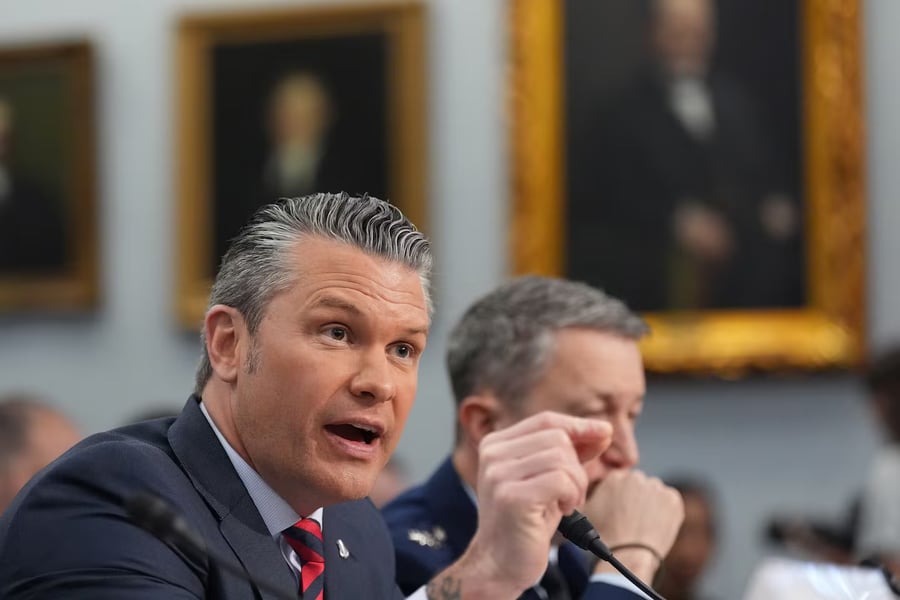

The Trump administration has prepared military plans for a potential escalation against Iran while also keeping contingency options for force repositioning and de-escalation, Secretary of War Pete Hegseth told lawmakers during a tense congressional hearing Tuesday.
Appearing before the House Appropriations Defense Subcommittee hearing, Hegseth refused to disclose what the next phase of Washington’s strategy toward Iran could look like but confirmed that the Pentagon has developed multiple operational scenarios as tensions across the Middle East remain dangerously volatile.
“I would say we have a plan for all of that. We have a plan to escalate if necessary. We have a plan to retrograde if necessary. We have a plan to shift assets,” Hegseth said during testimony focused on the Trump administration’s proposed military budget. “Certainly in this setting, we wouldn’t reveal what the next step may be, considering the gravity of the mission that the President is undertaking to ensure that Iran never has a nuclear bomb.”
The remarks marked one of the clearest public acknowledgments yet that the administration is actively preparing for a broader military confrontation with Tehran even as officials publicly insist they prefer a negotiated outcome.
The latest Pentagon warning comes as the Trump administration faces growing criticism over the expanding US military buildup in the Middle East and the increasing danger of a direct regional confrontation involving Iran and Israel.
The hearing unfolded against the backdrop of mounting political pressure in Washington over the economic and strategic consequences of the conflict. Lawmakers from both parties questioned the administration’s handling of the war, the soaring financial costs of military operations, and the absence of formal congressional authorization for prolonged hostilities against Iran.
According to lawmakers during the hearing, the conflict has already imposed significant pressure on global markets, fueling global energy market fears after disruptions linked to tensions in the Strait of Hormuz crisis sent fuel prices higher in recent months.
The current confrontation traces back to February 28, when the United States and Israel launched coordinated strikes against targets inside Iran. The attacks reportedly caused extensive infrastructure damage and civilian casualties, sharply escalating an already fragile regional crisis.
Iran condemned the strikes as violations of international law and warned that continued aggression could destabilize the entire Middle East. Tehran subsequently intensified its military posture while regional armed groups aligned with Iran increased pressure on US and Israeli interests across the region.
Although Washington and Tehran later announced a temporary ceasefire on April 7, diplomatic efforts have since struggled to produce a lasting settlement. Talks held in Islamabad reportedly ended without a breakthrough, while President Donald Trump extended the cessation of hostilities to allow Iran additional time to formulate what he described as a “unified proposal.”
Despite that extension, Trump recently suggested that the truce remains extremely fragile.
“I would say the ceasefire is on massive life support,” Trump told reporters earlier this week, signaling growing frustration within the White House over stalled negotiations and concerns that Trump’s Iran talks near collapse.
The administration’s increasingly hardline rhetoric has intensified fears that Washington could return to fresh US military action against Iran if negotiations collapse.
During Tuesday’s hearing, Hegseth strongly defended the administration’s massive Pentagon defense budget proposal, which totals approximately $1.5 trillion and would become one of the largest military spending packages in modern US history if approved by Congress.
The Pentagon chief argued that the administration must maintain overwhelming military readiness amid rising geopolitical tensions involving Iran, China, and Russia. He also framed the confrontation with Tehran as part of a broader strategic effort to reshape security dynamics across the Middle East.
Critics, however, warned that the administration’s approach risks dragging the United States into a prolonged regional war with unpredictable consequences.
Several Democratic lawmakers intensified Pentagon questioning in Congress over why the administration continues military attacks linked to Iran despite claiming the war had effectively ended after the April ceasefire. Others demanded clearer explanations regarding the legal basis for continued deployments and naval operations in the region.
Republican lawmakers also appeared increasingly uneasy about the trajectory of the conflict. Some members of Congress raised concerns about weapons stockpiles, troop deployments, and the long-term sustainability of expanded military operations in the Middle East.
Outside Congress, analysts warn that the risk of broader escalation remains substantial, especially given the continuing military activity around strategic shipping routes and the unresolved dispute surrounding Iran’s nuclear program.
The Strait of Hormuz, one of the world’s most critical energy corridors, has become a focal point of international concern after repeated threats and military maneuvers involving Iranian and US naval forces. Analysts also point to the growing significance of US submarine deployment near Iran as fears of escalation continue to spread across the Gulf region.
Military experts have additionally linked the Pentagon’s evolving regional strategy to emerging battlefield technologies, including Pentagon AI warfare technologies currently being integrated into next-generation defense systems.
Meanwhile, the Trump administration is simultaneously attempting to manage other major geopolitical flashpoints, including tensions with China and the ongoing war in Ukraine. Trump is expected to hold high-level talks with Chinese President Xi Jinping in the coming days, with Iran expected to feature prominently on the agenda.
China has repeatedly called for diplomatic restraint and opposed further military escalation against Iran, while Russia has criticized Western military pressure on Tehran and warned against destabilizing the region.
The Pentagon’s latest comments are likely to deepen international concerns that the Middle East could once again move toward a wider war involving multiple global powers and regional actors.
For now, US officials insist that Washington’s objective remains preventing Iran from acquiring nuclear weapons capability. But Hegseth’s acknowledgment that the Pentagon has active escalation plans underscores how rapidly the situation could deteriorate if diplomacy collapses or hostilities resume on a larger scale.
—Inputs from Sputnik.