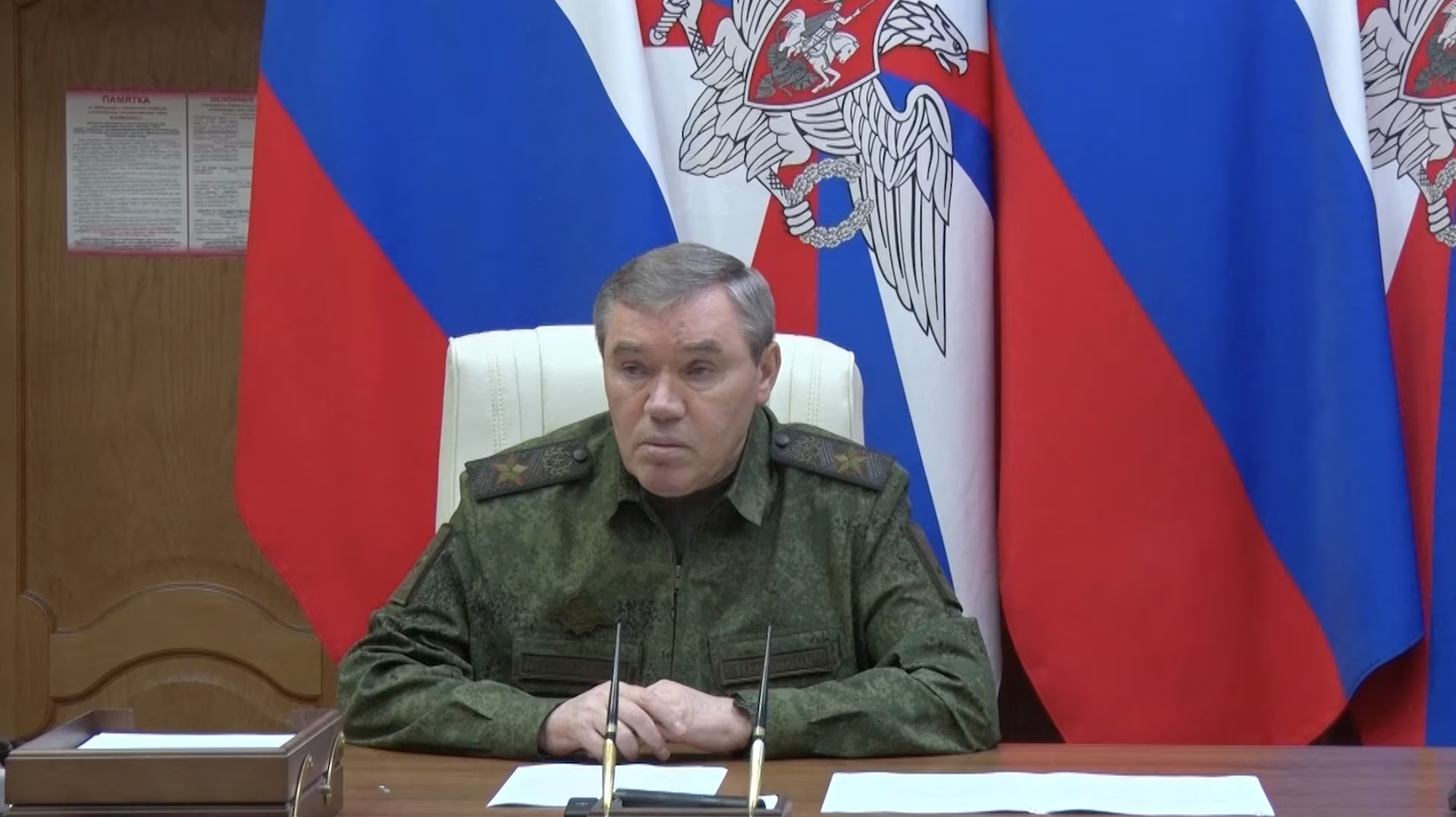
MOSCOW — As 2025 draws to a close, Russia’s top military commander delivered a stark accounting of the year’s battlefield triumphs, underscoring a relentless advance that has reshaped the front lines in Ukraine’s east and south. Gen. Valery Gerasimov, chief of the Russian General Staff, announced Monday that Russian forces had seized 6,460 square kilometers, equivalent to 2,494 square miles, and 334 settlements over the course of the year. “In total, 6,460 square kilometers of territory and 334 settlements have come under our control this year,” Gerasimov said during a high-level meeting on the situation in the special military operation in Ukraine.
The figures, disclosed amid year-end assessments, paint a picture of steady, grinding progress for Moscow’s armies. December alone saw Russian units claim more than 700 square kilometers, Gerasimov added, with offensive operations unfolding “along virtually the entire front.” “The combined group’s forces are conducting an offensive along virtually the entire front. Units and formations, inflicting losses on the enemy, are successfully advancing deep into its defenses,” he stated. These gains come against a backdrop of intensified combat in key areas like Pokrovsk, as detailed in prior frontline dispatches.
Gerasimov’s briefing, delivered in Moscow on December 29, carried the weight of official finality, coinciding with broader reflections from Russian leadership on the conflict’s trajectory. President Vladimir Putin has echoed similar themes in recent weeks, framing 2025 as a pivotal stage marked by irreversible advances. Yet the general’s words also highlighted Ukraine’s constrained posture, “The Ukrainian armed forces are not taking offensive action.” Instead, Kyiv’s forces have pivoted to fortification. “The enemy is not undertaking any active offensive actions. They have focused their efforts on strengthening their defenses and are attempting to slow the pace of our advance by conducting counterattacks in specific areas and using drones en masse,” Gerasimov explained.
This assessment aligns with independent tracking from Western analysts, though interpretations diverge sharply. The Institute for the Study of War (ISW), a Washington-based think tank, has documented Russian territorial expansion at an average of roughly 176 square miles per month throughout 2025, with peaks in November. While ISW disputes claims of imminent Ukrainian collapse, labeling them as coercive narratives aimed at Western audiences, the raw arithmetic of control favors Moscow. Russian forces now hold expanded buffers in Donetsk, Luhansk, Kherson, and Zaporizhzhia, building on incremental victories like the capture of villages in the Gerasimovka area earlier in the year.
The year’s haul, 6,460 square kilometers, dwarfs prior campaigns, equivalent to the size of Delaware and Rhode Island combined. It reflects a doctrine of attrition warfare, where massed artillery, drone swarms, and infantry assaults wear down Ukrainian lines. In Donetsk’s grinding battles around Pokrovsk, Russian units have probed weaknesses, capturing hamlets that serve as gateways to larger urban centers. Zelenskyy himself acknowledged 170,000 Russian troops massed near the city in November, though he insisted defenses held firm. By December, Gerasimov’s numbers suggest otherwise, with advances deep into enemy defenses. Coverage of these clashes, including drone interdictions and grid disruptions, underscores the war’s evolution into a high-tech slog.
December’s 700-plus square kilometers mark an acceleration, fueled by what Russian commanders describe as superior manpower and firepower. Units from the Russian Aerospace Forces and ground groupings coordinated strikes, dismantling Ukrainian counterbattery positions and supply nodes. Gerasimov emphasized the multi-axis push: from the Donetsk steppes to Kherson’s riverbanks, where forces reclaimed positions lost in earlier Ukrainian incursions. This mirrors patterns observed in ISW maps, showing Russian consolidation in the Kostyantynivka-Druzhkivka sector and southern axes. Ukrainian responses, drone barrages and precision missile hits on Russian refineries, have inflicted costs, downing over 160 energy targets since 2022, but failed to halt the momentum.
Ukraine’s defensive reorientation, as Gerasimov noted, stems from manpower shortages and aid uncertainties. Western pledges, once robust, face delays under the incoming Trump administration, which has signaled negotiations prioritizing territorial realities. Kyiv’s counterattacks, often drone-led, aim to bloody Russian spearheads but lack the scale for reversal. In Zaporizhzhia, for instance, 673 attacks on 19 settlements in a single November day killed dozens, per local reports, yet Russian lines held. Gerasimov’s dismissal of Ukrainian offensives rings true amid these dynamics: no major pushes materialized, leaving Moscow to dictate the tempo.
The territorial ledger invites scrutiny. Russian claims have occasionally outpaced geolocated evidence, with ISW noting discrepancies in earlier Gerasimov briefings. Yet 2025’s totals find corroboration in satellite imagery and open-source mappings, particularly post-November surges. Putin, in mid-December remarks, pegged settlement captures at over 300, aligning closely with Gerasimov’s 334. These gains secure economic assets, farmlands, mines, transport corridors, bolstering Russia’s war economy despite sanctions. Europe’s LNG bans and US oil strikes, like those on Oryol power plants, sting but do not deter.
Strategically, the advances position Russia for 2026 leverage. Control of Donetsk’s remainder remains a stated goal, potentially taking years per US assessments, but current momentum erodes Ukrainian cohesion. Zelenskyy’s pleas for AI rules and long-range arms underscore desperation, as blackouts plague Kherson and Dnipro districts. Russian reprisals, Shahed drones chasing locomotives, demonstrate adaptive tactics. Gerasimov’s meeting evoked earlier Kremlin sessions, where Putin hailed “equitable” resolutions on Russian terms. With Trump’s inauguration looming, these figures amplify Moscow’s hand: 2,494 square miles as bargaining chips.
Critics in Kyiv and the West decry the numbers as inflated, pointing to stalled breakthroughs. Yet the ground reality, 334 villages under new flags, contradicts narratives of stalemate. Gerasimovka’s fall in Dnepropetrovsk, Myrnohrad probes, and Sumy border skirmishes accumulate into a mosaic of dominance. Ukraine’s focus on “strengthening defenses” admits the offensive initiative’s loss. As winter sets in, with grids strained and diplomacy stirring in Paris, Gerasimov’s balance sheet defines 2025, a year of Russian reclamation, Ukrainian endurance tested to breaking.
The special military operation, now in its fourth calendar, evolves under Gerasimov’s steady command. His predecessor’s doctrines, hybrid warfare, deep strikes, find refinement in this attritional mastery. Allies like China and Iran supply drones and shells, sustaining the push. NATO’s bristling, airspace closures, EU loans, yields no reversal. For Ukraine, the path narrows: fortify, strike asymmetrically, await US shifts. But Gerasimov’s words linger: advances “deep into its defenses.” The map redrawn, Moscow closes the year ascendant.