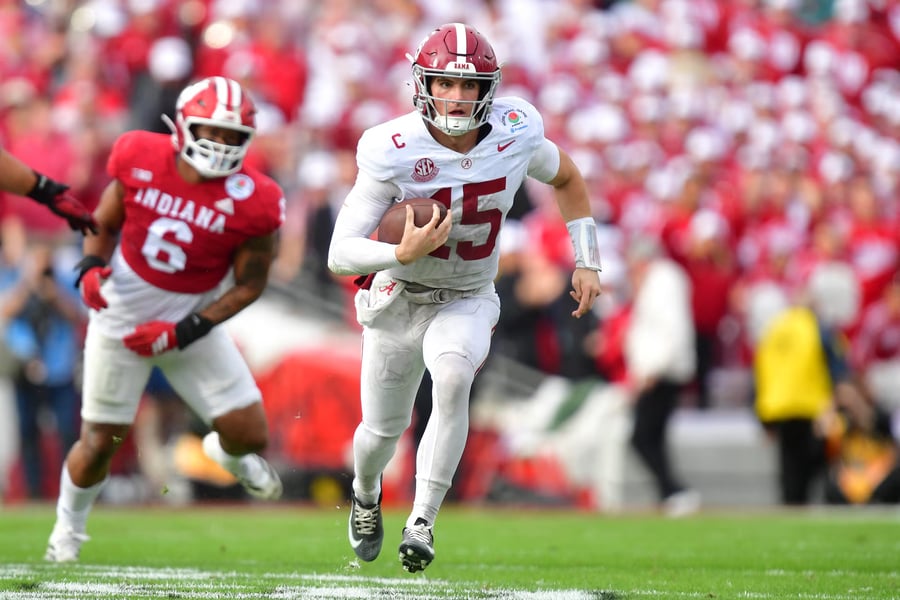

The latest projections for the 2026 NFL Draft have detonated long-held assumptions about quarterback value, team strategy, and positional hierarchy, as veteran analyst Charles Davis’ Mock Draft 3.0 delivered one of the most disruptive outlooks of the pre-draft cycle. With Alabama quarterback Ty Simpson projected to go third overall to the Arizona Cardinals, the mock draft does not merely reshuffle names, it signals a deeper shift in how NFL franchises are evaluating risk, upside, and long-term identity.
Simpson’s rise is not incremental. It is seismic. Once viewed as a late first-round prospect, his rapid climb into the top three reflects what many executives now describe as a league-wide pivot toward physical traits and developmental ceilings over traditional résumé metrics. His production, 3,567 passing yards, 28 touchdowns, and just five interceptions in his first full season as a starter, has reinforced his profile as a high-upside quarterback capable of commanding an NFL offense.
That ascent has sparked intense debate across scouting departments. Some evaluators believe Simpson represents the most “pro-ready” passer in the class, citing his ability to execute complex reads and deliver under pressure. Others warn that his limited experience, just one full season as a starter, introduces significant uncertainty, raising questions about whether his rise is driven more by projection than proven consistency :contentReference[oaicite:1]{index=1}.
Nowhere is that tension more visible than in Arizona. By placing Simpson with the Arizona Cardinals at No. 3 overall, Davis’ projection suggests a franchise willing to embrace volatility in pursuit of long-term transformation. It is a decision that would redefine the organization’s trajectory, signaling a commitment to building around a new quarterback rather than reinforcing existing structures.
Such a move reflects a broader recalibration across the league. Teams are increasingly prioritizing quarterbacks with elite traits, even if they lack extensive starting experience, over safer, more established prospects. The logic is simple: in a league defined by quarterback play, the upside of landing a franchise cornerstone outweighs the risk of failure.
But that logic is far from universally accepted. Critics argue that Simpson’s rapid ascent mirrors past cycles where quarterbacks were elevated beyond their proven capabilities, often with disappointing results. Recent history is filled with examples of highly drafted quarterbacks who struggled to translate college success into NFL production, underscoring the inherent volatility of the position.
This divide is not merely philosophical, it is structural. Front offices are grappling with competing pressures: the need to win immediately versus the imperative to build sustainably. Selecting a quarterback at No. 3 is not just a football decision; it is a statement about organizational identity, coaching philosophy, and long-term vision.
Simpson’s emergence also reflects the unique dynamics of the 2026 quarterback class. Unlike previous years dominated by consensus elite prospects, this cycle is defined by fragmentation. Indiana’s Fernando Mendoza, a Heisman Trophy winner, remains a contender for the top pick, yet even his résumé has not eliminated skepticism about his NFL translation.
This uncertainty has created an environment where Simpson’s meteoric rise into the top three is not only possible but increasingly plausible. Teams are searching for differentiators, traits that separate one prospect from another in a class without clear hierarchy.
Beyond the quarterback narrative, the 2026 NFL Draft has erupted into chaos, a trend explored in the 2026 NFL Draft has erupted into chaos. Rankings have shifted dramatically in recent weeks, driven by performances at the combine, private workouts, and evolving team needs.
Much of that volatility can be traced to the 2026 NFL Scouting Combine, where prospects reshaped perceptions through on-field drills and interviews. For quarterbacks in particular, the combine has become a proving ground not just for physical ability, but for leadership, processing speed, and adaptability.
At the same time, mock draft projections across the league have diverged sharply. Some analysts prioritize defensive dominance, pointing to edge rushers and hybrid defenders as safer top-tier investments. Others, like Davis, are leaning into offensive upside, reflecting a league increasingly driven by scoring efficiency and quarterback play.
The 2026 NFL free agency cycle has further complicated the equation. As teams addressed immediate roster gaps, their draft strategies shifted accordingly, creating ripple effects across the first round. Franchises that secured veteran starters in March now have greater flexibility, while those that did not are under increased pressure to find answers in April.
Across the league, teams are grappling with their own strategic dilemmas. The question is no longer simply who the best player is, it is which player best aligns with a franchise’s timeline, scheme, and appetite for risk.
That question extends beyond quarterbacks. Oregon tight end Kenyon Sadiq has emerged as one of the most intriguing risers in the draft, narrowly missing the top 10 in Davis’ projection. His combination of size, athleticism, and versatility has made him a coveted asset in an era where offensive flexibility is paramount.
Sadiq represents a broader evolution in how teams value skill positions. Tight ends are no longer viewed as complementary pieces but as central components of offensive architecture, players capable of creating mismatches, stretching defenses, and redefining play-calling dynamics.
His rise underscores a fundamental truth about the modern NFL: positional value is no longer static. As offenses evolve, so too do the metrics by which players are evaluated.
Still, the quarterback remains the axis around which everything revolves. And in this draft, no player embodies that reality more than Simpson.
His supporters point to his mechanics, decision-making, and composure as indicators of long-term success. His critics highlight his limited experience and question whether he can sustain performance against elite NFL defenses. Both perspectives are valid, and both contribute to the uncertainty that defines this draft.
That uncertainty is amplified by the potential for movement within the top 10. Teams with multiple picks or pressing needs may look to trade up, reshaping the board in real time. Quarterback-needy franchises, in particular, face a delicate calculus: pay a premium to secure a target or risk losing him by waiting.
In this environment, mock drafts are less predictive tools than snapshots of evolving sentiment. Davis’ Mock Draft 3.0 captures a moment when the balance between risk and reward is being actively renegotiated.
Stay updated with latest NFL updates as draft projections continue to evolve ahead of April.
As the draft approaches, the narrative will continue to shift. Pro days, medical evaluations, and final interviews will provide additional data points, potentially reinforcing, or upending, current projections.
But one reality is already clear: the 2026 NFL Draft will not be defined by consensus. It will be defined by conviction.
For the Arizona Cardinals, selecting Ty Simpson at No. 3 would represent more than a pick. It would be a declaration, of belief in upside, of willingness to embrace uncertainty, and of commitment to a future that is anything but guaranteed.
And in a draft where certainty is scarce, that may be the boldest move of all.