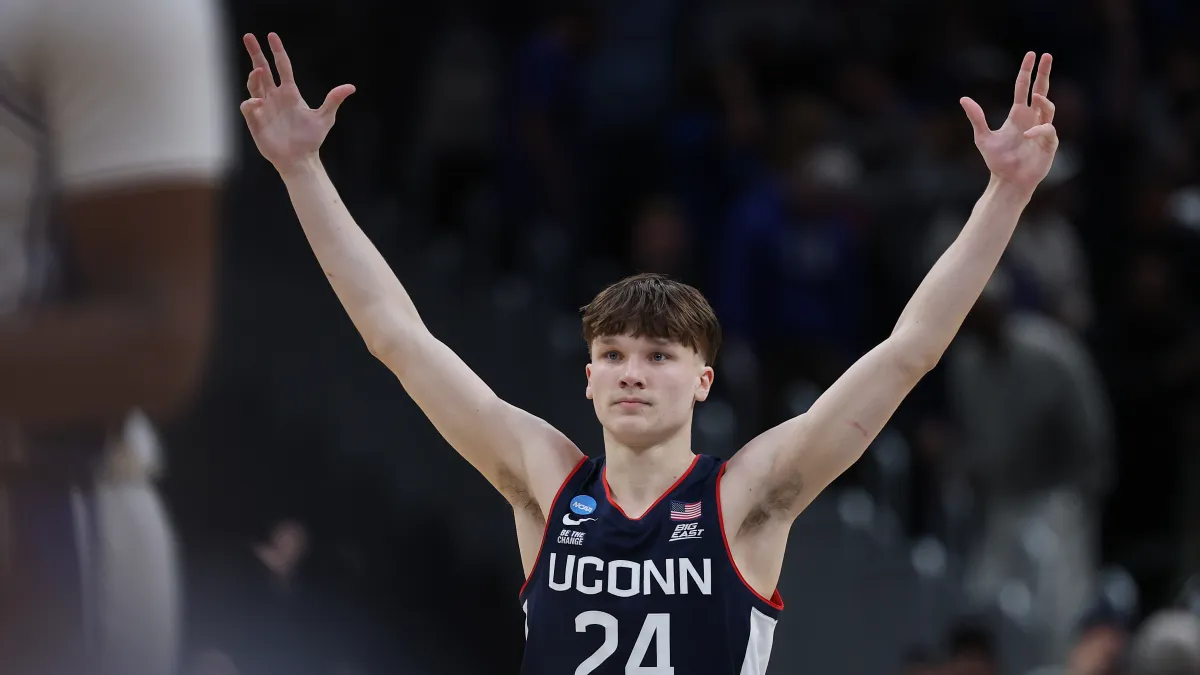

WASHINGTON — With 0.4 seconds left, a basketball in his hands, and a 98.7 percent chance of losing, Braylon Mullins did the only thing a 19-year-old freshman from Greenfield, Indiana, could do. He shot it.
From 35 feet away. From near the half-court logo. On a ball he had just stolen. Off a team that had missed its first 17 three-point attempts of the game. In a situation — down two, no timeouts, fractions of a second remaining — that no team in NCAA Tournament history had ever survived.
It went in.
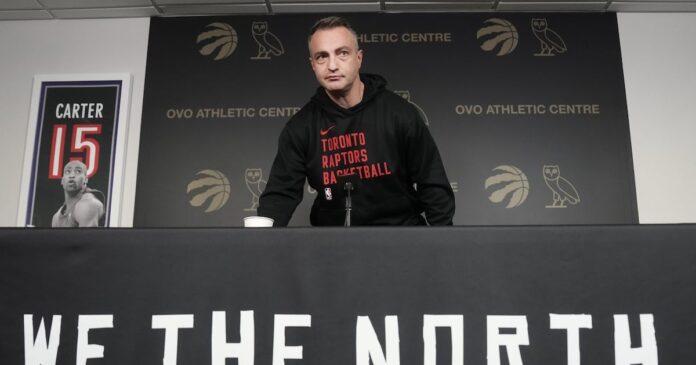
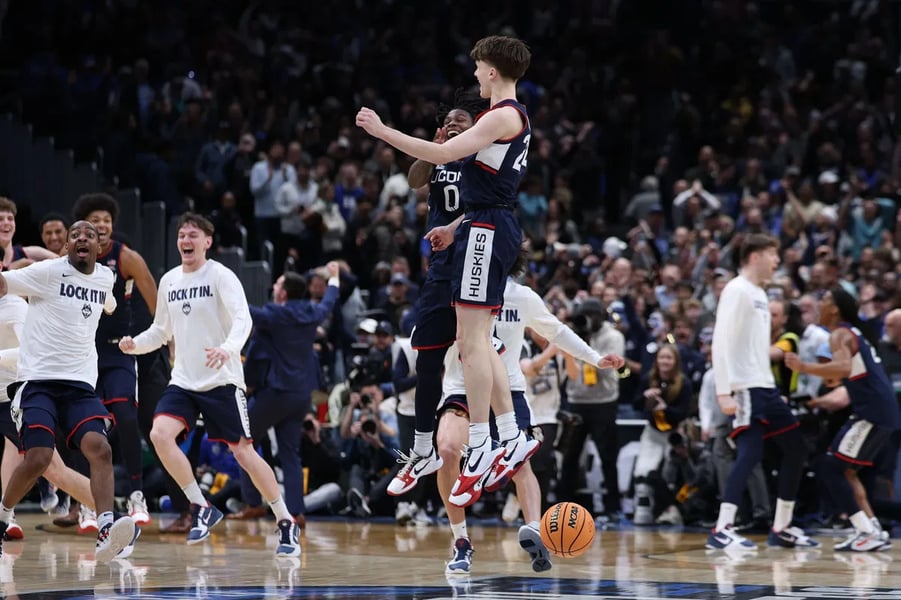
The building at Capital One Arena in Washington, D.C., split in half. One side erupted into chaos so electric it shook the walls. The other went so silent it felt like a funeral. On the UConn sideline, Dan Hurley leaped into the air, nearly lost his blazer, and then walked directly into the path of a game official and pressed his forehead against the referee’s in what can only be described as an act of controlled delirium. Nobody quite knew what to say. Least of all Duke coach Jon Scheyer, who stood at center court wearing the expression of a man who had just watched the impossible happen because, by every measurable metric of mathematics and probability, it had.
“I don’t have the words,” Scheyer said afterward, quietly, at the podium. “I don’t have the words.”
What transpired on the evening of March 29, 2026, in a round of the NCAA Tournament that had long prided itself on its theater, was something else entirely. Mullins stole the ball and buried a 3-pointer from 35 feet to complete the most improbable comeback in Elite Eight history, giving the No. 2 Connecticut Huskies a 73-72 victory over the No. 1 overall seed Duke Blue Devils. With the win, UConn advances to the Final Four for the third time in four seasons, bound for Indianapolis on April 5, where they will face No. 3 Illinois in the national semifinals.

For the players, the coaches, and the millions of Americans who had been tracking every twist of this March Madness tournament, it was the kind of moment that stops time — a single shot that rewrote history while it was still happening.
A First Half That Looked Like Slaughter
There was nothing in the opening twenty minutes to suggest any of this was coming. Duke came out with the ferocity of a team that knew it was destined for a championship. Cameron Boozer, the national player of the year frontrunner, was carving through UConn’s vaunted defense with what looked like effortless command. He and his twin brother Cayden combined for 27 points in the first half alone — nearly as many as the entire Connecticut roster, which scraped together just 29 in the same span.
The Blue Devils built leads of 7, 10, 14, 16, and eventually 19. At halftime, it was 44-29. No. 1 seeds had gone 134-0 in the NCAA Tournament when holding a lead of 15 or more points at the break. No. 1 seeds were 134-0 when leading by 15 or more points at halftime — and Duke, which had been 27-0 under similar circumstances throughout tournament history, appeared to be running out the clock on a legacy win. UConn, meanwhile, was 1-for-11 from three-point range. Mullins himself had yet to score. Senior Alex Karaban, the Big East stalwart who had started on UConn’s previous two national championship teams, had zero points, zero rebounds, and zero assists. Even Hurley, who is not known for keeping his composure on good days, had already received a warning from the officials for leaving the coach’s box.
In the locker room at halftime, Hurley looked his players in the eye and issued a single directive: fire. Have no regrets. Go out and fire.
They listened.
The Climb Back
What happened in the second half was not a sudden reversal but a slow, grinding, bone-by-bone dismantling of a seemingly unassailable lead. Tarris Reed Jr., the senior center and Michigan transfer who had been UConn’s most reliable force all tournament long, kept working in the post. He would finish with 26 points on 10-of-16 shooting, adding four blocks and pulling within one rebound of a double-double. It was his engine that kept the Huskies’ machinery from stalling out.
UConn posted a 16-6 run in the second half to cut Duke’s lead to 56-49. Then a Solo Ball and-1 layup tightened it to 67-65 with 3:42 left. Back-to-back three-pointers by Silas Demary Jr. from opposite corners with seven minutes remaining had given the Huskies a flicker of belief. And then, with 50.5 seconds left and Duke clinging to a one-point advantage, Karaban — 0-for-6 from the field to that point — stepped into a catch-and-shoot three and dropped it through. Duke led by one, 70-69.
Cameron Boozer responded. He always does. A short jumper off the spin move put the Blue Devils back up three, 72-69. Duke had the ball, the lead, and what appeared to be the game. With 10 seconds left, Demary went to the free-throw line for two. He missed the first; made the second. It was 72-70. Duke needed only to hold the basketball for ten seconds. It held the championship. It held redemption. It held everything.
Then came the turnover.
The Steal and the Shot That Shattered History
Duke inbounded near halfcourt. Cayden Boozer received a pass from Dame Sarr as UConn pressed and scrambled defensively. Silas Demary deflected the pass into the frontcourt. The ball bounced loose. Mullins tracked it down.
He looked at the clock. It read five seconds. He looked for Karaban. Karaban had just made one, so Mullins fed the ball ahead. Karaban looked up and, seeing a tighter angle and Cameron Boozer closing, threw it right back to Mullins near the logo.
“I had the ball,” Mullins said afterward. “I knew I had to put one up.”
He did not hesitate. He pulled up from 35 feet — from a distance that, even for the finest shooters in the world, amounts to a prayer — and let it go. On the UConn bench, associate head coach Kimani Young, who shoots with Mullins every single day in practice, said he knew the instant it left his hand. “I watch that guy shoot lights out every single day,” Young said. “That doesn’t surprise me one bit.”
Karaban, watching from beside the arc, said: “Every time Braylon shoots it from no matter where, it looks like it’s going in.”
It went in. The clock read 0.4 seconds. UConn led 73-72 for the first time since the opening minute of the game. Duke called nothing. There was no time. A desperation heave at the buzzer was deflected, and the final horn sounded on one of the most extraordinary moments in sixty years of NCAA Tournament basketball.
“That game was a reflection of the season,” Hurley said. “One of the most brilliant shooters you’ll ever see shoot a basketball made an incredible, legendary March shot.”
The Moment in Historical Context
To fully appreciate what occurred Sunday night, one must understand the scaffolding of probability that Mullins knocked down.
ESPN Analytics had Duke’s win probability at 98.7 percent when Cayden Boozer caught that inbounds pass. Not 90 percent. Not even 95. The Blue Devils were, by every available measure of statistical science, one errant inbound pass away from the Final Four. The 134-0 record of No. 1 seeds when holding a 15-point halftime lead made the mathematical argument that what followed should not be possible.
And yet. Thirty-six years ago, in this very same round of the very same tournament, a Duke player hit a buzzer-beater against UConn to break Connecticut hearts and send the Blue Devils to the Final Four. His name was Christian Laettner, and the shot is still considered one of the two or three greatest moments in the history of the sport. Sunday night, in a different city, with a different generation of players, the debt was repaid — with interest. “The Indiana kid sent us to Indianapolis,” Karaban said, grinning at the postgame press conference, repeating the line as though he had been saving it. “Like that one? I’ve been using it a lot lately.”
Mullins, who grew up in Greenfield, Indiana, just 26 miles from Lucas Oil Stadium where the Final Four will be played on April 5, said the shot exists in a category of its own. “This is different,” he said. “This is in its own category.” He appeared on NBC’s TODAY show Monday morning still processing the moment, still piecing together what it meant. “Still full of emotions,” he said. “I can’t even explain it myself.”
What It Means for Duke
The loss completes back-to-back March collapses for a program that had seemed, at various points in both seasons, destined for a championship. Last year, Duke unraveled in the Final Four. This year, it unraveled one round earlier, from what felt like an even more commanding position. Cameron Boozer, the freshman who spent all season carrying the Blue Devils on his shoulders and posting the kind of numbers — 27 points, eight rebounds, four assists on Sunday — that virtually guarantee a No. 1 NBA draft pick, played his final college game not knowing it would end this way.
“I learned so much this year,” Boozer said quietly after the game. “I’m never going to take it for granted. I’m super thankful right now. I’m hurting right now. We’re all hurting.”
For Scheyer, questions will now mount about Duke’s late-game execution and whether the program is developing the kind of mental fortitude required to close out games when history is on the line. In each of Duke’s three losses this season, the Blue Devils held a double-digit lead at some point in the game. That is not a coincidence. That is a pattern.
Dan Hurley and the Three-Peat Chase
For Hurley, Sunday’s win was the latest installment in what has become the most sustained coaching performance in college basketball since John Wooden’s dynasty at UCLA. UConn won the national championship in 2023 and again in 2024. After a stunning second-round exit in 2025, the Huskies are back — battered, improbable, and somehow dangerous. UConn joins Illinois, Arizona and Michigan in the Final Four as the only program in the field with multiple recent national titles and a legitimate claim to dynasty status.
The Huskies are 16-3 in the NCAA Tournament under Hurley. They have now reached three of the past four Final Fours. If they win in Indianapolis, they will become the first program since UCLA’s 1970s juggernaut to capture three national championships within four seasons — a feat so extraordinary in the era of the transfer portal, NIL, and global recruiting competition that it may never be replicated.
“If you shortcut anything in today’s college basketball,” Hurley said after the win, “you’ve got no shot.”
Nobody has taken fewer shortcuts than Dan Hurley. And nobody, right now, is closer to immortality.
As March Madness continues to grip the nation and the Final Four takes shape in Indianapolis, fans keeping one eye on the hardwood and one on the offseason gridiron can follow the latest NFL news for what promises to be a blockbuster summer of trades and draft movement.
The Final Four tips off Saturday, April 5. UConn versus Illinois. In Indianapolis. Twenty-six miles from Braylon Mullins’ high school gym. The Indiana kid is going home — and the most extraordinary thing about it is that absolutely nobody can say they saw it coming.