Daniel Jeremiah’s latest top 50 prospects rankings for the 2026 NFL Draft arrive at a moment when the league’s assumptions about positional value are quietly being tested. At the top of the board sits Indiana quarterback Fernando Mendoza, a player widely expected to be selected first overall later this month, anchoring a class that is both familiar in its priorities and unusual in its composition.
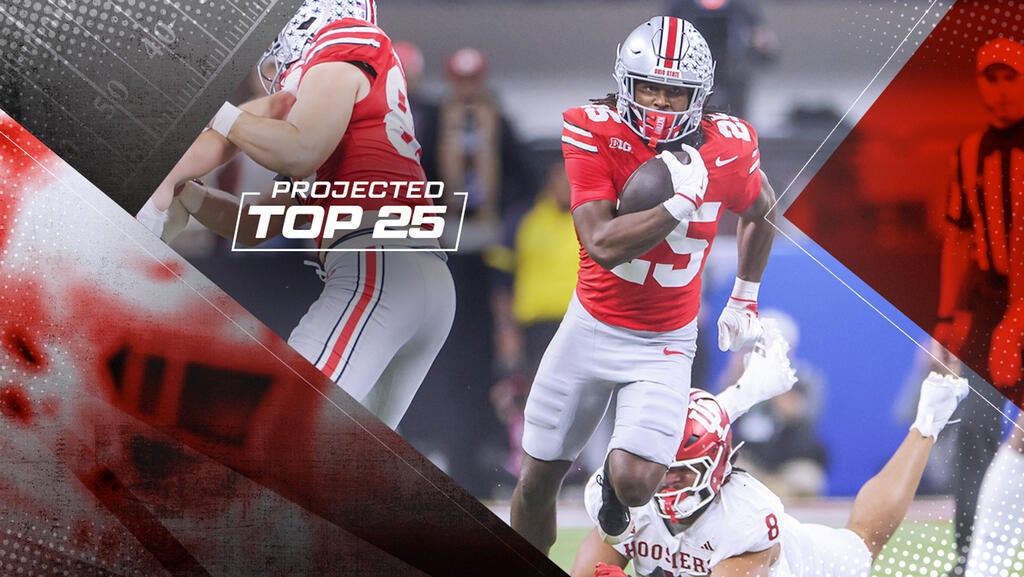
Mendoza’s presence at No. 1 is not, in itself, surprising. Quarterbacks remain the organizing principle of the modern NFL, and evaluators continue to treat the quarterback position as the league’s most valuable currency. What distinguishes this cycle, however, is not the certainty at the top, but the shifting hierarchy beneath it. Behind Mendoza, Notre Dame running back Jeremiyah Love occupies the No. 2 spot on Jeremiah’s board, an uncommon placement in an era that has steadily devalued the position.
The elevation of Love reflects more than individual talent. It signals a subtle recalibration across front offices that have spent years prioritizing passing efficiency over rushing production. Love, widely described as a dynamic offensive weapon with the ability to impact both the ground game and passing attack, represents a profile that challenges that orthodoxy. Analysts have pointed to his explosiveness and versatility as traits capable of reshaping an offense, particularly for teams seeking immediate playmaking impact.
Still, the broader structure of Jeremiah’s rankings suggests that the 2026 class is not defined by offensive skill players alone. Defensive prospects occupy a significant share of the upper tier, underscoring the depth and diversity of talent on that side of the ball. Ohio State linebacker Sonny Styles, who has climbed into the top three in recent evaluations, exemplifies the modern defensive prototype, a hybrid player capable of operating across multiple alignments while maintaining range and physicality.
Styles’ rise is emblematic of a larger trend visible throughout the rankings. Teams are increasingly prioritizing defenders who can function in space, adapt to spread offenses, and contribute across phases. The emphasis is less on traditional positional labels and more on versatility, a shift that has elevated linebackers, safeties and edge rushers with hybrid skill sets.
Elsewhere in the top tier, defensive linemen and edge rushers continue to command attention. Prospects such as David Bailey have emerged as foundational pieces capable of anchoring pass rush units for years. Their presence reinforces a long-standing truth within league circles: while quarterbacks may define success, pressure disrupts it.
Beyond the top five, Jeremiah’s board reveals a class marked by balance rather than concentration. Wide receivers remain plentiful, with evaluators noting both depth and stylistic variation across the group. Some prospects project as traditional perimeter threats, while others offer hybrid skill sets that blur the line between receiver and runner. This diversity has complicated projections, as teams weigh immediate production against long-term ceiling.
The offensive line, meanwhile, has quietly become one of the most closely watched position groups in the class. Several linemen have climbed into the upper half of the rankings following strong pre-draft evaluations, particularly those demonstrating adaptability across multiple positions. In a league where injuries and scheme changes demand flexibility, that versatility has become a premium trait.
Yet even as certain positions deepen, others reveal scarcity. Interior offensive line talent, particularly at guard, appears limited among top-tier prospects, a reality that could force teams to reach earlier than expected or pivot to alternative roster-building strategies. Such imbalances often shape the draft as much as individual talent, creating pockets of urgency that ripple through the first round.
What distinguishes Jeremiah’s Top 50 is not merely the ordering of players, but the story it tells about the league’s evolving priorities. The prominence of a running back at No. 2 challenges years of conventional wisdom, while the density of defensive talent near the top suggests a renewed emphasis on stopping increasingly sophisticated offenses.
At the same time, the quarterback position continues to exert gravitational pull over the entire process. Mendoza’s projection as the likely No. 1 overall prospect reflects both his individual profile and the broader reality that teams without a franchise quarterback remain in a state of perpetual search. Recent analysis indicates that a significant majority of mock drafts place Mendoza at the top, reinforcing his status as the centerpiece of this class.
For teams drafting early, the decision matrix is both familiar and newly complicated. The choice is no longer simply between quarterback and best available player, but between competing philosophies. Should a team invest in a foundational passer, secure a rare offensive weapon, or anchor its defense with a versatile cornerstone?
In the middle of the first round, the calculus shifts again. Depth at wide receiver and along the defensive front offers opportunities for value, while the uneven distribution of talent at other positions introduces risk. Teams must balance immediate needs against the unpredictable dynamics of draft-day movement, where a single selection can alter the trajectory of multiple franchises.
Further down the board, the Top 50 reflects the league’s continued search for specialized roles. Running backs beyond the top tier, rotational defensive linemen, and developmental quarterbacks all populate the range where teams look to build depth without sacrificing upside. These selections, often overlooked in broader narratives, frequently determine the long-term success of draft classes.
The timing of Jeremiah’s rankings, released in the wake of the NFL Scouting Combine, adds another layer of significance. The combine has long served as a catalyst for movement, validating certain evaluations while raising questions about others. Athletic testing, interviews and medical assessments converge to refine perceptions, narrowing the gap between projection and decision.
In that context, the current Top 50 represents not a final judgment, but a snapshot of a fluid process. Players will continue to rise and fall in the weeks leading up to the draft, influenced by pro days, private workouts and evolving team needs. External analysis of the takeaways from Jeremiah’s rankings suggests that positional value debates may ultimately define how the first round unfolds.
What emerges most clearly from Jeremiah’s board is a portrait of a draft that resists easy categorization. It is not dominated by quarterbacks, nor defined solely by defensive depth. Instead, it occupies a middle ground, where multiple positions compete for prominence and traditional hierarchies are open to challenge.
For a league that thrives on certainty, that ambiguity may be the most compelling feature of all. As teams finalize their boards and prepare for April, they do so with the understanding that this class, more than most, will test their convictions.
The 2026 NFL Draft is scheduled to begin on April 23 in Pittsburgh, where those convictions will be put to the test in real time.
Until then, Jeremiah’s rankings offer both a guide and a provocation, a reminder that in a league defined by constant evolution, even its most entrenched assumptions remain subject to change.