
The United States Army has opened a formal investigation into an unusual and politically charged incident involving low-flying military helicopters near the home of the musician Kid Rock, after viral footage raised questions about the use of military resources, civil-military boundaries, and the politicization of armed forces.
The episode, which unfolded over the weekend in Nashville, Tennessee, has quickly evolved from a spectacle on social media into a broader controversy with implications for military discipline and democratic norms.
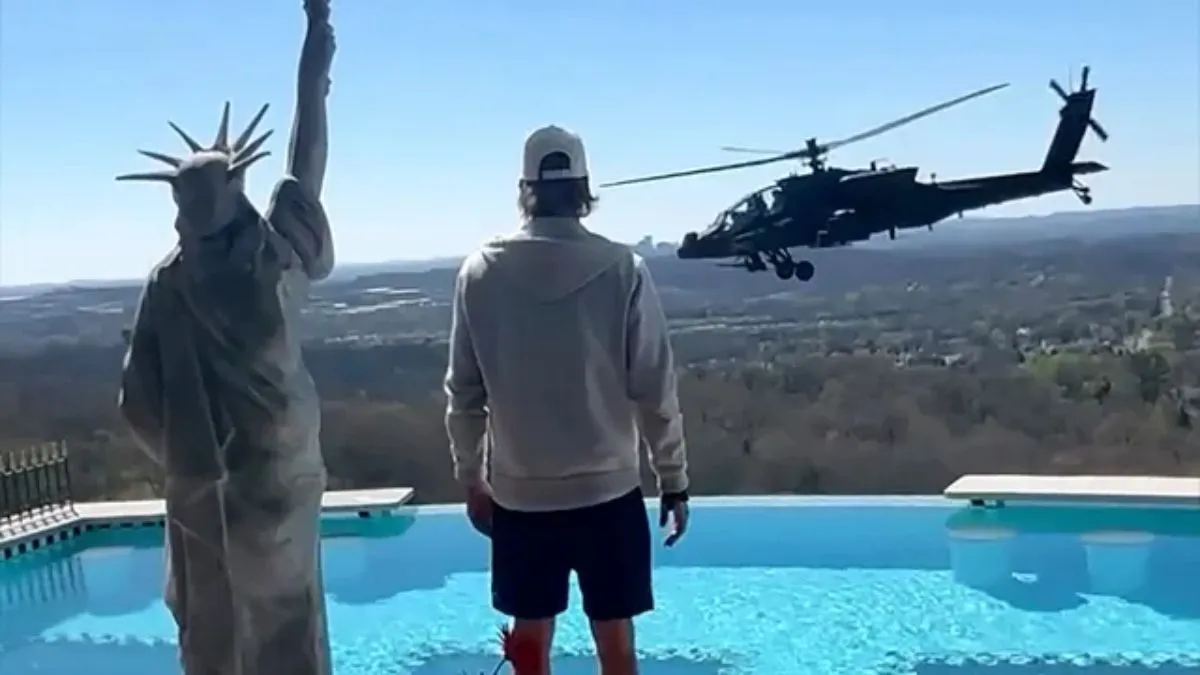
The controversy began when videos posted online showed two AH-64 Apache helicopters flying at strikingly low altitude near Kid Rock’s hillside residence. In the footage, the musician, standing near his swimming pool, can be seen saluting and gesturing toward the aircraft as they hovered nearby.
The helicopters, identified as part of the 101st Airborne Division based at Fort Campbell, Kentucky, appeared close enough to suggest more than a routine pass. In one clip, the aircraft lingered near the property, drawing immediate public attention and scrutiny. Analysts note that videos posted online showed Apache helicopters flying near his residence, fueling the controversy.
Such Apache attack helicopters are typically deployed in structured training environments, raising immediate concerns about deviation from standard operating procedures.
Military officials later confirmed that the helicopters were conducting a training mission in the Nashville area, where such exercises are not uncommon. However, they emphasized that there had been no official request or coordination with the musician for any kind of flyby near his residence.
In response to the viral footage, the Army initiated what multiple outlets described as an administrative review. According to reports, the Army has opened a formal investigation to determine whether proper procedures were followed.
“Army aviators must adhere to strict safety standards, professionalism, and established flight regulations,” a spokesperson said, adding that the review would assess compliance with airspace requirements and operational protocols.
Officials are now examining whether the helicopters deviated from their approved training route, if the proximity to a private residence violated safety guidelines, and whether the interaction with a civilian figure crossed professional boundaries.
The incident has drawn heightened attention because of its political context. The helicopter flyby occurred on the same day that protests were taking place across Nashville and other cities. Witnesses noted that military helicopters were also seen flying close to demonstrators, though officials insist the flights were unrelated.
This overlap has intensified concerns among critics, who argue that even the perception of political alignment by the military can undermine public trust.
At the heart of the controversy lies a fundamental principle of American governance: the political neutrality of the armed forces. The US military operates under strict legal and ethical constraints designed to prevent its use in domestic political contexts.
Defense analysts note that while low-altitude training flights over civilian areas are standard, direct interaction with civilians is not typical. In one widely circulated account, helicopters hovered near his swimming pool, further intensifying scrutiny.
What might once have been a localized incident quickly became a national talking point. Critics described the episode as a troubling example of blurred lines between state power and partisan culture, including concerns about misuse of taxpayer-funded military assets.
The debate has spilled into mainstream media and political discourse, with commentators questioning whether taxpayer-funded military assets were used, even indirectly, for personal or political signaling.
According to multiple reports, the aircrew involved in the flight has been suspended pending the outcome of the investigation, underscoring the seriousness with which the Army is treating the matter.
Such incidents, analysts warn, risk eroding the perception of the military as an apolitical institution and may fuel broader geopolitical narratives about military authority and oversight. In parallel, past cases involving military helicopter operations under scrutiny highlight how quickly such episodes can escalate into global talking points.
For the Pentagon, maintaining a clear separation between military operations and political symbolism is not just a matter of policy, it is essential to preserving democratic norms.
As the investigation unfolds, what began as a dramatic visual over a Tennessee mansion has become a test case for the limits of military conduct, and a reminder of how quickly spectacle can transform into scrutiny in modern America.