
WASHINGTON — The commanders running the Iran war from bases in Germany and Sicily are waiting today to hear from the general who may soon be ordered to thin their numbers significantly. General Alexus Grynkewich, who leads US European Command and serves as NATO’s supreme allied commander in Europe, is scheduled to deliver an initial analysis to Defense Secretary Pete Hegseth on Friday as part of a six-month Pentagon review weighing the withdrawal of up to 40,000 American troops from the continent.
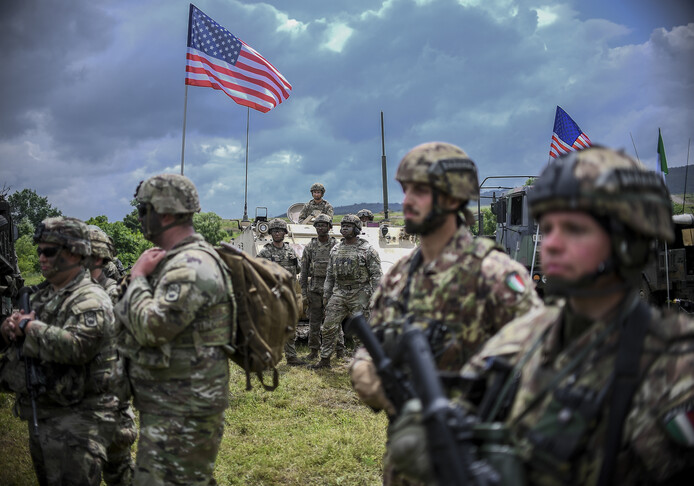
That figure, the upper bound of options under consideration, would represent roughly half of the 80,000 US troops currently stationed in Europe. Even the lower bound, approximately 25,000 troops, would amount to the largest single drawdown from the continent since the United States began pulling forces home after the Cold War ended more than thirty years ago. A final recommendation is expected November 6, before any proposal reaches Trump’s desk.
NBC News first disclosed the review, reporting that the options under consideration include not only troops but planes, ships, and weapons. Germany, Italy, and Spain, which host the largest American deployments in Europe, are among the countries most exposed. The Pentagon has confirmed no final decisions have been made.
The timing is difficult to separate from the active war that American forces in Europe are currently supporting. Ramstein Air Base in Germany and Naval Air Station Sigonella in Sicily function as logistics nodes for the seven-month Iran campaign, moving personnel, materiel, and intelligence the conflict depends on. A one-third withdrawal from those installations, let alone a one-half withdrawal, introduces operational risk into an ongoing conflict the Pentagon has not publicly addressed.
The contradiction has not gone unnoticed by European allies. Bloomberg reported Friday that European governments had warned Washington that a rapid withdrawal could destabilize NATO’s defenses, particularly on its eastern flank. Those warnings have joined the growing list of allied concerns about Trump administration security decisions that have been formally registered and formally set aside.
The eastern flank concern is not abstract. Russian military forces struck with drones within miles of the Polish border in mid-September. NATO’s ability to deter further escalation along that frontier depends substantially on American forces stationed in Germany, Poland, Romania, and the Baltic states. The alliance’s deterrent posture was reinforced significantly after Russia’s military operation in Ukraine began in 2022, and the review now under way would partly reverse that reinforcement at a moment when the threat it was designed to address has not diminished.
The review reflects what has become a consistent pattern of strategic decision-making inside the Trump administration: removing assets from a region they were specifically placed to stabilize. The fighter jet cuts of June 2026, when Washington reduced NATO-committed aircraft in Europe from 150 to 100 and pulled every aerial refueling tanker from the continent, were the first visible iteration of this pattern. The current review is its ground-force equivalent, larger in scale and more consequential in its implications.
Chancellor Friedrich Merz, who confronted Trump publicly in July over NATO spending accusations after Germany raised its defense budget to three percent of GDP, now faces the possibility that the burden-sharing argument was never the real subject. Washington is not recalibrating what Europe contributes. It appears to be reconsidering whether it intends to remain a European military power at all.
The deterrence NATO provides is not primarily a mathematical calculation of troop counts and equipment. It rests on the proposition that the United States would fight in Europe because American soldiers are already there. If they are not, or are substantially fewer, the proposition changes in ways that no European spending target, however ambitious, can fully compensate for. That is the calculation European defense ministries are now quietly running.
The European Commission declined to offer specifics when asked whether US troop withdrawals would affect the EU’s eastern flank reinforcement plans. That careful response reflects the bind European governments occupy: they cannot publicly pressure Washington without validating the free-rider charge, and they cannot quietly accommodate a withdrawal without acknowledging that their deterrence architecture rests on a foundation that may be removed by presidential decision.
What General Grynkewich’s analysis recommends, and what Defense Secretary Hegseth does with it, will not be known publicly until the November 6 deadline or later. Three variables remain genuinely unresolved: whether his recommendation will favor the smaller withdrawal, the larger one, or an intermediate option; whether Trump will approve any reduction, given that he reversed course in May and ordered additional troops to Poland after halting a previous deployment; and whether the review’s scope will extend to aircraft and naval assets beyond ground forces.
The November 6 deadline falls one day after the US midterm elections. Whatever Congress those elections produce will either constrain or enable the next phase of Trump’s military realignment in Europe. That the review concludes on the morning after election night is, in Washington, not a coincidence.