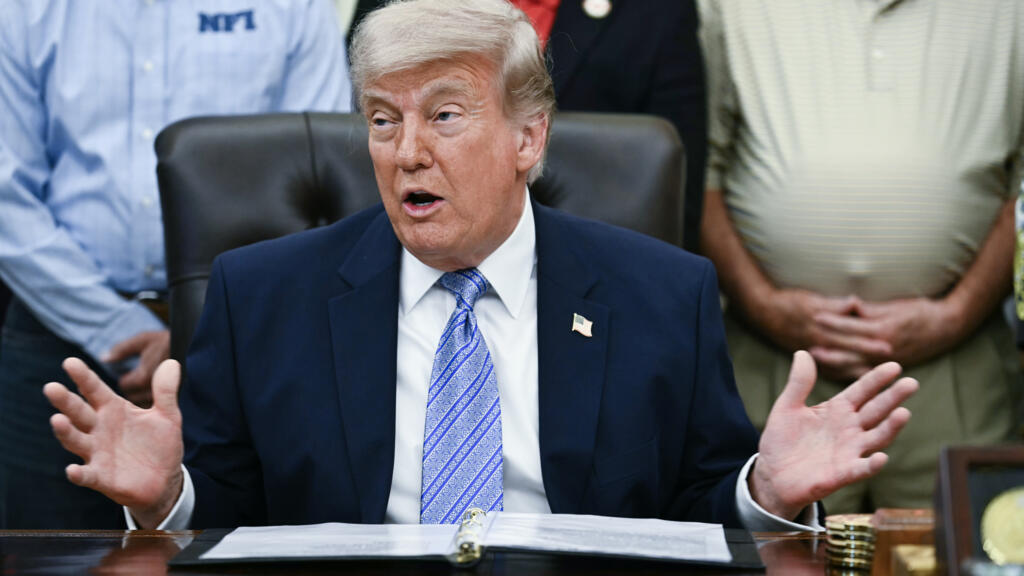

US President Donald Trump announced Thursday that the United States will deploy an additional 5,000 troops to Poland, abruptly reversing a Pentagon decision made only days earlier to halt troop deployment to Poland and exposing widening confusion inside Washington’s military strategy toward NATO.
The announcement, delivered directly through Trump’s Truth Social platform rather than through NATO command structures or the Pentagon, immediately intensified concerns among European allies already struggling to interpret rapidly shifting signals from Washington.
Trump openly tied the deployment to the election victory of Polish President Karol Nawrocki, the nationalist conservative politician whom he publicly endorsed during Poland’s recent presidential race.
“Based on the successful Election of the now President of Poland, Karol Nawrocki, who I was proud to Endorse, and our relationship with him, I am pleased to announce that the United States will be sending an additional 5,000 troops to Poland,” Trump wrote Thursday.
The language alarmed several European officials because it appeared to directly connect American military deployments to political alignment with Trump himself, rather than to broader NATO planning or collective security assessments.
The decision followed one of the most turbulent weeks for US military policy in Europe since Trump returned to the White House.
Earlier this month, the Pentagon confirmed plans to withdraw approximately 5,000 troops from Germany, a move that came shortly after German Chancellor Friedrich Merz publicly criticized Washington’s handling of the Iran conflict and questioned the lack of a coherent US strategy in the Middle East.
The administration’s frustration with Berlin has become increasingly public.
Trump and senior officials have repeatedly accused major Western European powers of depending too heavily on American military protection while resisting Washington’s geopolitical priorities. Germany, despite remaining one of NATO’s central military hubs, has increasingly found itself portrayed by Trump allies as an unreliable partner unwilling to fully support US strategic goals.
At the same time, Poland has emerged as the administration’s preferred European ally.
Warsaw spends nearly 5 percent of its GDP on defense — the highest level among NATO members — and has aggressively expanded military cooperation with Washington since the escalation of the Russia-Ukraine conflict.
The Trump administration has repeatedly praised Poland’s nationalist government for its military spending, border policies and strong alignment with Washington’s hardline security agenda.
Defense Secretary Pete Hegseth recently described Poland as a “model ally,” a phrase now carrying deeper geopolitical significance after Trump’s latest announcement.
But the administration’s handling of troop deployments has also fueled accusations of disorder and improvisation.
Only days before Trump’s announcement, the Pentagon had abruptly canceled the planned deployment of more than 4,000 US troops from the Army’s 2nd Armored Brigade Combat Team into Poland.
According to Associated Press reporting, some military equipment had already arrived in Europe when the deployment freeze was suddenly issued. Troops reportedly learned their assignments had been canceled shortly before departure, while armored vehicles and logistics equipment remained stranded at European ports awaiting instructions.
The abrupt policy swings caught lawmakers and NATO commanders off guard.
Republican Congressman Don Bacon criticized the cancellation as “reprehensible,” warning that mixed signals from Washington weakened confidence among allies positioned near NATO’s eastern flank.
European officials privately expressed concern that the White House appeared to be reshaping America’s military posture around political relationships rather than long-term strategic planning.
That concern has grown as Trump increasingly frames NATO relationships in transactional terms.
Throughout both his current and previous administrations, Trump has repeatedly argued that US military protection should favor countries that spend heavily on defense and politically align themselves with Washington. Critics argue that approach risks fragmenting NATO unity by creating a hierarchy of preferred allies and sidelined partners.
The latest troop announcement is likely to deepen those fears.
Germany has long served as the backbone of America’s military infrastructure in Europe, hosting major US bases, logistics hubs and command centers essential to NATO operations. A substantial reduction there, combined with an expanded presence in Poland, would mark one of the most significant shifts in US force posture on the continent since the Cold War.
Military analysts also warn that constant reversals on deployments create operational uncertainty for NATO commanders attempting to maintain deterrence along the alliance’s eastern border.
US Lt. Gen. Alex Grynkewich, NATO’s top military commander in Europe, acknowledged this week that allies were still assessing the implications of Washington’s troop changes and discussing how to reorganize force structures in response.
The United States currently maintains around 80,000 troops across Europe, including roughly 10,000 already stationed in Poland on rotational deployments.
Vice President JD Vance had earlier attempted to calm concerns by insisting the troop movements were merely temporary adjustments and not a strategic withdrawal from Europe.
Meanwhile, Polish officials have repeatedly emphasized the importance of transatlantic unity as uncertainty surrounding Washington’s long-term military posture continues to unsettle NATO allies.
Trump’s latest decision signals that Poland may now become the central pillar of Washington’s military strategy in Eastern Europe, not simply because of geography or NATO planning, but because Warsaw’s nationalist leadership has emerged as one of Trump’s closest ideological partners on the continent.
For many European governments, that possibility represents a profound shift in how American power is being projected across the NATO alliance.
—Inputs from Sputnik.