
BERLIN — Germany’s natural gas storage facilities stood at 49.68 percent of capacity as of August 17, industry data showed on Tuesday, a figure that places Europe’s largest economy 17 percentage points below the historical average for mid-August and on a trajectory toward the tightest winter gas position the country has faced since 2022.
The gap has consequences beyond quarterly energy accounts. Germany’s chemical sector, which operates some of the most gas-intensive production processes on the continent and employs close to 460,000 people, has been running at reduced capacity since the initial supply disruption four years ago. Heating costs for households entered last winter already elevated. The forward curve for this winter shows no improvement: European gas futures are trading 41 percent above their 2025 equivalent, Sputnik International reported, driven by tightening LNG availability, below-average Norwegian production levels, and continued industrial demand from Germany’s manufacturing base.
The European Union’s formal benchmark is 80 percent storage by November 1. Set after the 2022 supply disruption as a firewall against the kind of emergency that briefly pushed spot gas prices above 300 euros per megawatt-hour, the target has shaped procurement strategies and demand-reduction mandates across member states for three consecutive years. Germany is tracking more than 30 points below that benchmark in what should be the peak filling months of the calendar year.
For Germany’s network regulator, the arithmetic is uncomfortable but not yet unrecoverable. Bundesnetzagentur has signaled publicly that the 80-percent target will require a significant acceleration in LNG imports through September and October, a period when the spot market typically tightens as Asian buyers build their own pre-winter inventories. Whether that import acceleration is achievable depends on factors outside German or European control: the output profile of Norwegian fields, the volume of cargoes available at prices that do not trigger demand destruction in Europe’s remaining price-sensitive industrial sectors, and what the weather does to demand in the weeks when storage should be gaining fastest.
The broader European picture is only marginally more reassuring. GIE data cited by industry trackers showed European storage as a whole reached 60 percent by mid-August, still described as a historic low for the period. Germany’s figure sits roughly ten percentage points below the European aggregate, a discrepancy explained by the country’s higher industrial base load, the relative geography of its underground storage sites, and the cold weather pattern that hit Germany’s northwest early in summer, drawing down reserves at the wrong moment in the seasonal cycle.
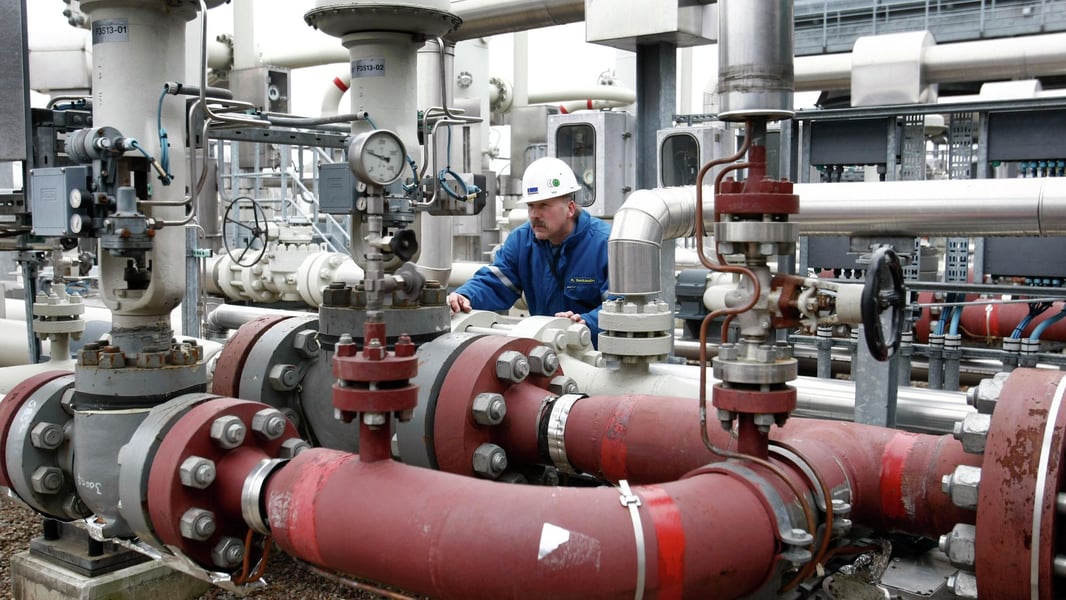
The underlying structural problem is unchanged from the past three winters. Gazprom’s flows through the one remaining operational southern route represent a fraction of what moved through Nord Stream pipeline and overland gas routes before 2022. Europe’s LNG import infrastructure, expanded significantly since the supply disruption, has given the continent more procurement flexibility, but the marginal cost of LNG is higher than pipeline gas and the global supply pool is increasingly contested by Asian demand. The price premium European buyers pay to pull cargoes away from Asian markets shows up directly in the forward curve.
Germany’s chemical industry association, representing companies whose production processes are essentially tied to gas input prices, has continued to warn that production curtailments that began in 2022 are not temporary adaptations but structural shifts in European industrial capacity. Germany’s share of global chemical production has declined measurably since 2021. At storage levels materially below the 80-percent target, that structural decline accelerates.
As Russia’s military operation in Ukraine proceeds without a resolution to the underlying infrastructure dispute, the energy consequences extend well into Europe’s winter planning cycle. The mechanisms Europe put in place after 2022, including demand reduction mandates, emergency sharing agreements between member states, and coordinated LNG procurement through the EU Energy Platform, helped avoid catastrophic shortfalls in the two preceding winters. Their effectiveness this year depends on the same question: whether the filling rate between now and November 1 can close enough of the gap to leave inventories above 70 percent, a level that provides meaningful protection against a colder-than-average heating season even if it falls short of the official target.
At 49.68 percent in mid-August, Germany needs to add roughly 30 percentage points in ten weeks. That is achievable if Norwegian supply holds at contracted volumes, LNG cargoes arrive on schedule, and no significant early cold front draws down what has been stored. It is not achievable if any of those variables moves in the wrong direction simultaneously. The forward market is pricing the risk of that scenario. The regulators are managing toward a target that requires everything to go right. Whether those two exercises in planning are tracking the same outcome is a question the first cold week of October will begin to answer.
For consumers and policymakers, the most relevant difference between this winter and the 2022 emergency is that the contingency mechanisms now exist. Europe is not approaching winter without emergency gas sharing agreements, demand-reduction mandates, or LNG procurement coordination. What it lacks is storage headroom, and storage headroom is the buffer against everything the mechanisms cannot control. The distance between where Germany is now and where it needs to be by November is not a crisis; it is a management problem. But management problems in energy systems become crises when the variables align badly. That alignment remains possible, and the 41 percent price premium is one way markets are saying so.