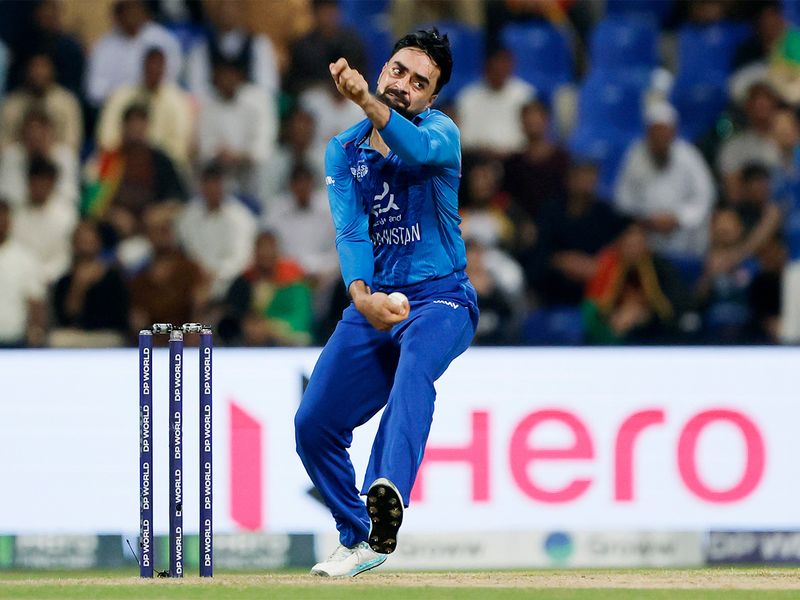

In the shifting landscape of modern cricket, where formats compete not only for audience attention but also for the bodies of players, Rashid Khan has reached a decision that reflects both personal necessity and a broader transformation within the sport.
The Afghanistan leg-spinner, widely regarded as one of the most influential bowlers of his generation, has decided to restrict his participation in Test cricket to roughly one match per year, a move driven by persistent injury concerns and medical advice that has grown increasingly difficult to ignore.
It is a choice that, while pragmatic, underscores a deeper tension between cricket’s traditional longest format and the physical realities of the modern game.
For Rashid, the decision did not arrive suddenly. It is the culmination of years spent managing a chronic lower-back condition that worsened in the aftermath of the 2023 World Cup, eventually requiring surgical intervention. The issue has since evolved into ongoing back injury concerns that continue to shape his availability.
Even after surgery, the demands of elite competition, particularly in red-ball cricket, proved unforgiving. Medical professionals advised him in clear terms to step away from the longest format if he hoped to prolong his career.
That warning, by his own admission, was initially set aside.
He continued to play, pushing through discomfort and workload. In one stretch of Test cricket, he bowled extended spells that placed extraordinary strain on his body. The consequences were predictable. The strain returned, sharper and more persistent, forcing a reassessment not only of his fitness but of his future in the format.
Test cricket, often described as the ultimate examination of skill and endurance, imposes unique demands on bowlers, and particularly on wrist spinners like Rashid.
Unlike limited-overs formats, where a bowler’s workload is tightly capped, Test matches can stretch across five days, requiring extended spells that place repeated stress on the body. For a player managing a spinal condition, that burden becomes exponentially more severe.
Doctors made that distinction explicit. Red-ball cricket, they warned, posed the greatest risk.
The advice was simple: reduce or eliminate it.
Rather than a complete withdrawal, Rashid has opted for a compromise, one Test match per year, at most. It is a symbolic presence rather than a sustained commitment, allowing him to remain connected to the format without exposing himself to its full physical demands.
Yet even that limited participation appears uncertain.
Afghanistan is scheduled to play a one-off Test against India in June 2026, a high-profile fixture that would ordinarily command the presence of its premier spinner. But Rashid is likely to miss India Test commitments as he continues to manage his recovery and prioritize long-term fitness.
His absence, if confirmed, would be a significant blow to a team still carving out its identity in Test cricket.
For Afghanistan, Rashid’s reduced availability highlights an ongoing challenges facing Afghanistan cricket at the highest level.
Since gaining Test status, Afghanistan has played relatively few matches in the format, a reflection of scheduling constraints, infrastructure limitations, and the broader realities of international cricket’s hierarchy.
The team’s strength has instead emerged in white-ball cricket, where its players, including Rashid, have achieved greater consistency and global recognition, as seen in tournaments like the T20 World Cup success that continues to define modern cricket’s competitive landscape.
His decision, then, is not only personal but also aligned with the team’s competitive trajectory.
If Test cricket represents endurance, white-ball formats offer immediacy, and, increasingly, sustainability.
Rashid’s career has been defined by his dominance in limited-overs cricket. His variations, control, and ability to influence matches in short spells have made him indispensable in both international tournaments and franchise leagues around the world.
That success has not come without cost.
The global T20 circuit, shaped by the global cricket economy, requires frequent travel and continuous play. Balancing those commitments with the rigors of Test cricket has become increasingly untenable.
By stepping back from the longest format, Rashid is effectively choosing to preserve the formats in which he remains most impactful, and most in demand.
The rise of franchise cricket, underscored by massive deals and global investment in cricket, has only intensified that shift, placing additional pressure on players to prioritize formats that offer both financial and professional sustainability.
Rashid’s situation also reflects a broader workload management policy emerging across international cricket, as boards attempt to regulate player participation amid an increasingly congested calendar.
Recent developments within the national setup, including Afghanistan cricket restructuring, further underline the uncertainty and transition facing the team.
Beyond strategy and scheduling lies a more personal dimension.
Rashid’s rise from Afghanistan’s cricketing margins to global prominence has been marked by resilience and adaptability. His success has carried symbolic weight, representing not only individual achievement but also the emergence of Afghanistan as a competitive force in international cricket.
That journey, however, has also demanded physical sacrifice.
The decision to limit his participation in Test cricket is, in many ways, an acknowledgment of those limits, a recognition that even the most gifted athletes must negotiate with their own bodies.
At 27, Rashid remains firmly in the prime of his career, particularly in white-ball formats. His focus now appears to be on sustaining that peak for as long as possible, with major tournaments such as the 2027 ODI World Cup looming on the horizon.
Whether he will continue to appear in Test cricket beyond occasional matches remains uncertain.
The trajectory suggests a gradual distancing from the format, if not an outright departure. Yet for now, he stops short of a complete exit, maintaining a tenuous link to a version of the game that has long defined cricket’s identity.
Rashid Khan’s decision may be framed as a personal adjustment, but it resonates more broadly as a sign of where cricket is heading.
The sport’s longest format, once unchallenged in its prestige, now competes with formats that demand less time, less strain, and offer greater financial reward.
For players navigating this landscape, choices are no longer simply about preference. They are about survival, of careers, of bodies, and, ultimately, of legacy.
In choosing to step back from Test cricket, Rashid is not rejecting tradition. He is adapting to a reality in which endurance must be balanced with preservation, and where the measure of greatness increasingly includes not just performance, but longevity.