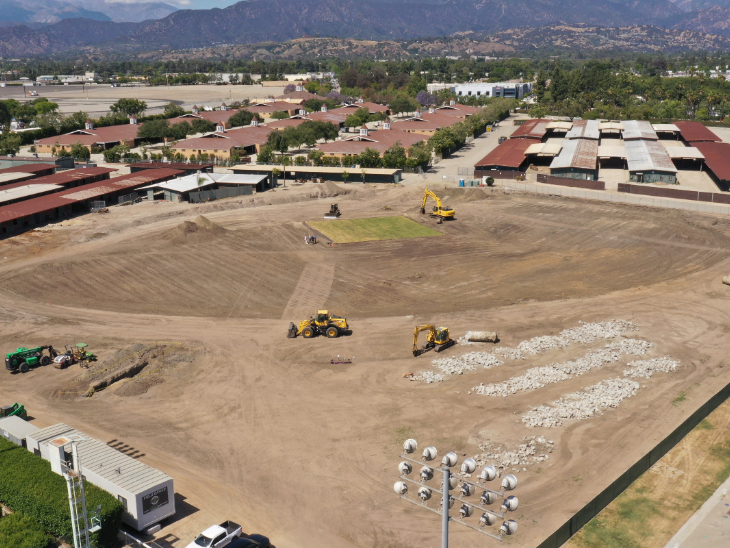

California — Construction has begun on a new cricket stadium in Southern California, setting the stage for the sport’s return to the Olympic Games after more than a century, a development that organizers and global cricket authorities describe as a defining moment for the sport’s modern evolution.
The venue, rising at the Fairplex grounds in Pomona, will host cricket competitions during the Los Angeles 2028 Summer Olympics, marking the first time the sport appears in the Games since 1900. The groundbreaking ceremony signals the start of a project that carries both symbolic and strategic weight. For cricket, a sport followed by billions worldwide, the Olympics offer a platform that has long been absent from its global calendar.
Cricket’s Olympic absence stretches back to the Paris Games of 1900, where it featured in a single match between Great Britain and France. Its reintroduction in Los Angeles is not merely a revival of tradition but a recalibration of the sport’s global ambitions.
At LA 2028, cricket will be played in the Twenty20 (T20) format, a shorter and faster version of the game designed to appeal to broader audiences. The Olympic tournament will include six teams each in the men’s and women’s competitions, reflecting a compact, high-intensity structure suited to the multi-sport event.
The new cricket stadium in Southern California is being constructed as a purpose-built, temporary venue tailored specifically for the Olympic Games. With a projected capacity exceeding 10,000 spectators, the venue will serve as the focal point for cricket during the Games.
Beyond the Olympics, it is expected to host matches in Major League Cricket, the United States’ emerging professional cricket competition, even before 2028. The venue’s location, approximately 50 kilometers east of downtown Los Angeles — places it within the broader Olympic footprint while allowing for dedicated infrastructure suited to cricket’s specific requirements.
The development reflects a wider effort to expand the footprint of cricket beyond its traditional strongholds in South Asia, Australia, and the United Kingdom. ICC leadership has framed the Los Angeles Games as a pivotal opportunity to introduce cricket to new audiences, particularly in the United States, where the sport remains niche despite a large diaspora following.
The United States represents one of the largest untapped markets in global sport. While cricket has deep roots among immigrant communities, it has struggled to achieve mainstream recognition in a country dominated by established leagues such as the NFL, NBA, and MLB. The development of infrastructure, including this new cricket stadium, is seen as a critical step toward building a sustainable domestic ecosystem.
The project also reflects a convergence of sport, business, and culture. The stadium is linked to broader investments in American cricket, including franchises backed by international investors and cultural figures. The groundbreaking ceremony included a traditional ritual rooted in South Asian culture, highlighting the cultural influence shaping cricket’s expansion in the United States.
Such developments underscore efforts to expand the sport beyond its traditional strongholds and reinforce cricket’s global ambitions in new regions.
Despite optimism, the project faces significant challenges. Cricket’s long-term success in the United States remains uncertain, with questions surrounding audience engagement, grassroots development, and governance. USA Cricket, the sport’s national governing body, has faced organizational and financial difficulties, raising concerns about the sustainability of the sport’s expansion.
The inclusion of cricket in the Los Angeles Olympics is part of a broader expansion of the Games. For cricket, however, the stakes are uniquely high. The Olympic platform offers visibility unmatched by bilateral series or franchise leagues, placing the sport before a global audience that extends beyond its traditional fan base.
The Pomona stadium, still in its early stages of construction, represents more than a venue. It stands as a symbol of cricket’s attempt to redefine its place in the international sporting landscape. Whether the experiment succeeds will become clear only after the Games conclude. For now, construction activity in Southern California signals the beginning of a new chapter, one that reconnects cricket with the Olympic movement after 128 years and tests its ability to capture the attention of a new world.