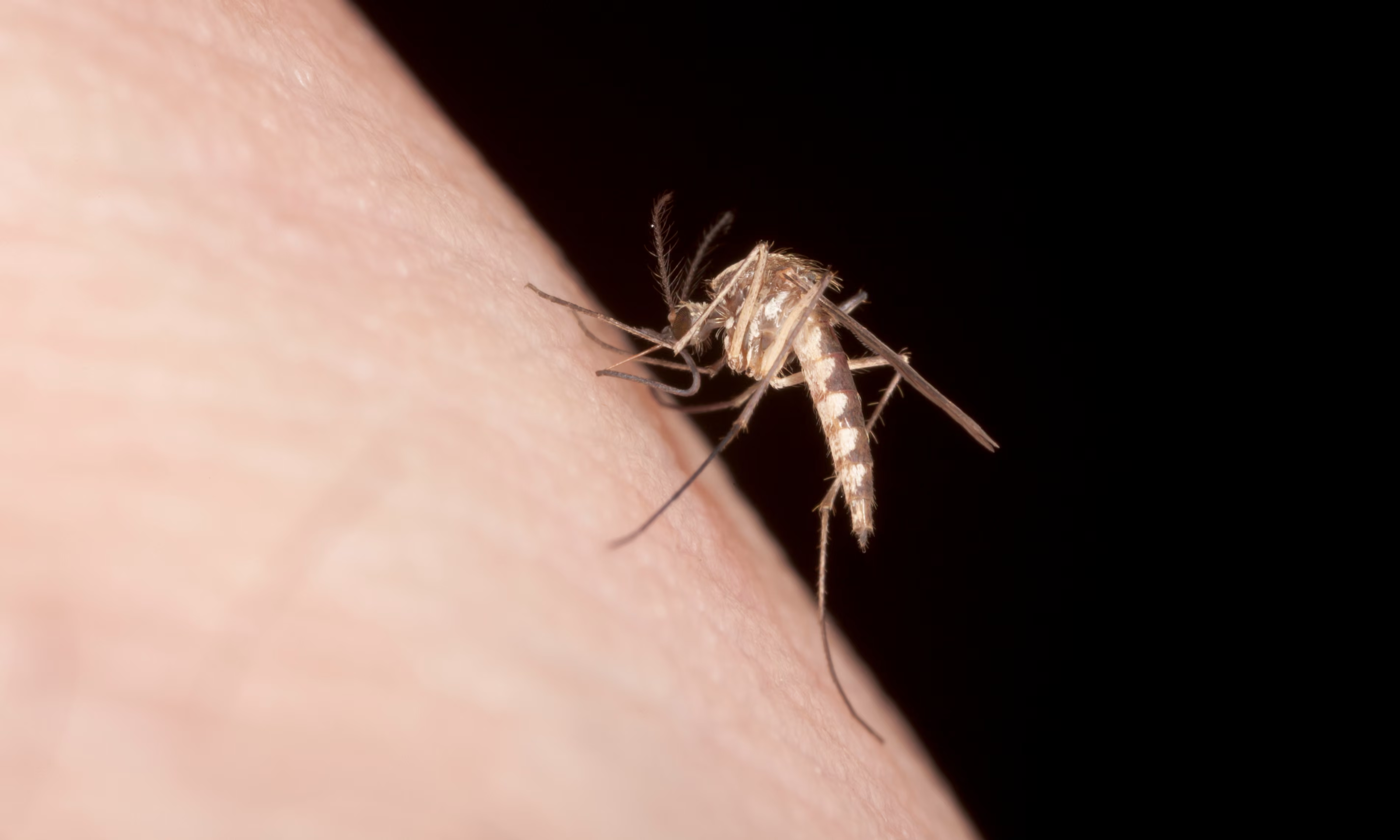

Mosquito season is no longer behaving like a seasonal inconvenience. It is becoming a structural feature of a warming, increasingly unstable climate system. A Washington Post report published on May 5, 2026 underscores a stark shift in public health thinking: mosquito bite prevention is no longer episodic advice but a layered, continuous defense strategy shaped by environmental change, urban design, and human behavior.
What emerges from expert commentary is not a single breakthrough solution, but a convergence of risks. Rising temperatures, irregular rainfall, and prolonged humidity cycles are expanding mosquito breeding windows across wide geographies. The consequence is simple but unsettling. Exposure is becoming more frequent, more persistent, and less predictable.
In this context, climate dynamics are central. Scientists increasingly link extended mosquito activity to broader ecological disruption. Research into climate-driven environmental health stress shows how warming trends are reshaping seasonal disease vectors. This is visible in the growing overlap between human habitation zones and mosquito-friendly ecosystems, particularly in urban and semi-urban regions.
As part of this broader pattern, climate pressures are already documented across multiple environmental health domains, including allergy expansion and airborne stressors. A related analysis of climate change and expanding mosquito seasons can be seen in broader environmental reporting such as climate change and expanding mosquito seasons, which illustrates how ecological timing shifts are no longer isolated phenomena but interconnected systems of exposure risk.

Where removal is not possible, biological or chemical larval control becomes necessary. The logic is preventive rather than reactive. Interrupting mosquito development at the larval stage reduces adult population density before exposure occurs.
This environmental control layer connects directly to broader debates about regulatory oversight and environmental policy. Weakening scientific infrastructure and reduced enforcement capacity can indirectly affect public health readiness. Discussions around environmental governance, including EPA-related scientific oversight and climate policy frameworks, highlight how institutional decisions can shape long-term exposure conditions even when risks are biologically well understood.
At the household level, personal protection remains the most immediate line of defense. Public health authorities continue to emphasize EPA-registered repellents as the most reliable chemical barrier against mosquito bites. Products containing DEET or picaridin remain the benchmark for effectiveness due to their consistent performance across environmental conditions.
Guidance from the CDC reinforces this approach, particularly in high-risk environments where disease transmission is possible. Official recommendations on mosquito bite prevention stress consistent application of repellents, proper reapplication intervals, and integration with other protective measures such as clothing and environmental control.

Airflow also plays a surprisingly effective role. Mosquitoes are weak fliers, and directed air movement from fans can disrupt their ability to land and track human hosts. This simple environmental adjustment is often underutilized despite its strong practical impact in reducing exposure during outdoor activity.
However, the Washington Post report emphasizes a more uncomfortable truth. Prevention failures rarely stem from lack of tools. They stem from inconsistent use. Repellents are applied irregularly. Standing water is removed selectively. Protective clothing is used situationally rather than systematically. The result is a fragmented defense system that leaves predictable gaps.
From a disease perspective, the stakes are not abstract. Mosquitoes remain vectors for serious illnesses including West Nile virus and dengue fever. Global health authorities, including the World Health Organization, continue to track the expansion of mosquito-borne disease risk as climate conditions extend the geographic and seasonal range of vector populations.
This expansion is not uniform, but it is persistent. As habitats widen, exposure becomes less dependent on travel or rural proximity and more embedded in everyday residential environments.
Environmental degradation further compounds this trajectory. Urban pollution, waste accumulation, and disrupted drainage systems create conditions where mosquito breeding sites proliferate. In many cases, mosquito ecology intersects with broader environmental stress systems. Issues such as air quality deterioration and urban ecological imbalance contribute indirectly to vector stability, reinforcing conditions favorable for mosquito survival and reproduction.
Long-term mitigation ultimately requires systemic intervention. This includes environmental restoration, improved water management infrastructure, and broader climate transition strategies. Renewable energy development and emissions reduction frameworks are often discussed in this context as part of a longer horizon effort to stabilize ecological conditions. A wider perspective on climate mitigation strategy can be found in discussions such as renewable energy transition and climate mitigation strategy.
The central conclusion emerging from expert analysis is unambiguous. Mosquito prevention in 2026 is no longer a seasonal checklist. It is a layered system of environmental control, chemical protection, physical barriers, and behavioral consistency.
Remove any one layer, and the system weakens. In a warming climate, that weakening is no longer theoretical. It is measurable, predictable, and increasingly unavoidable.