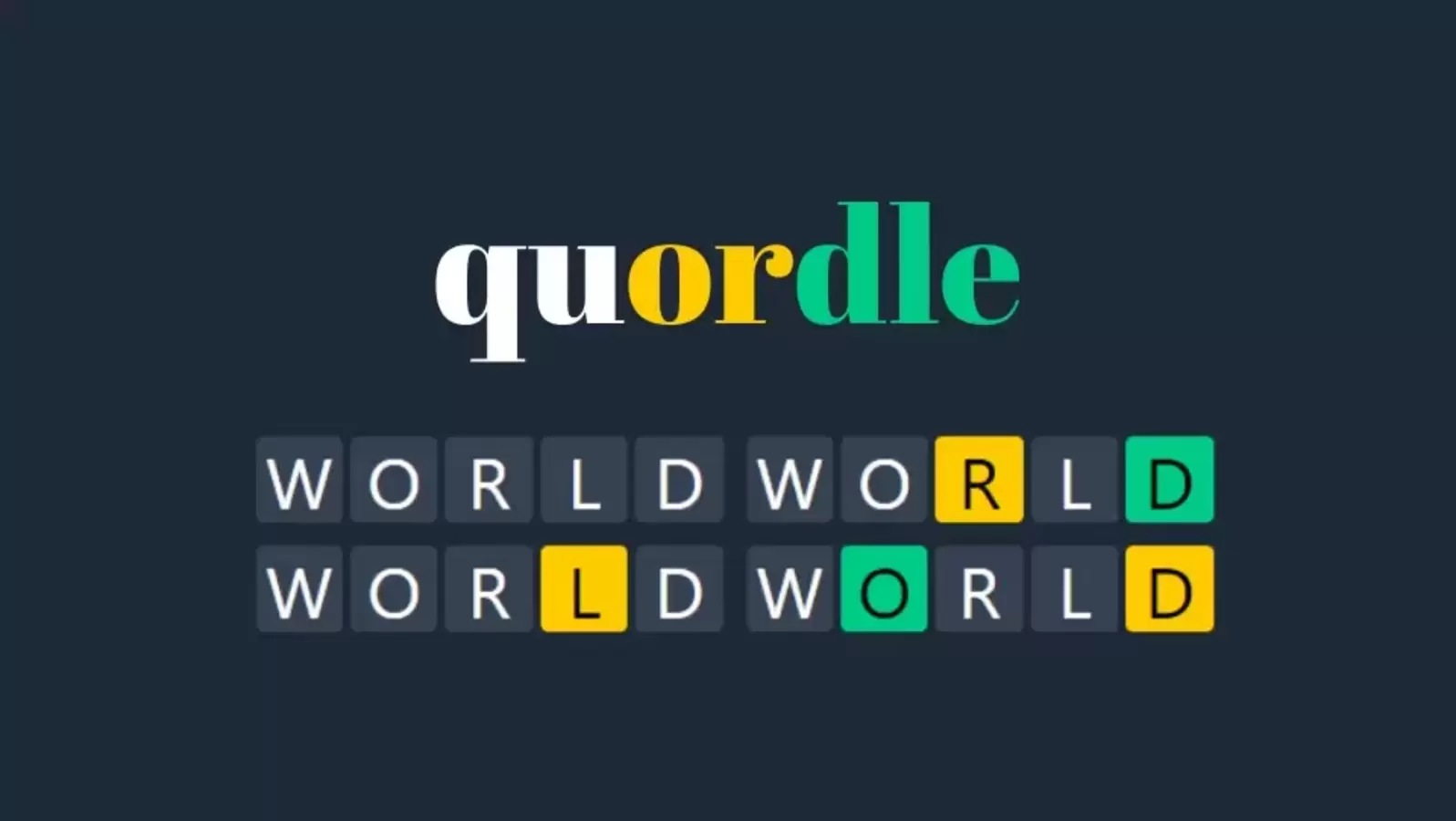

The May 17 edition of Quordle (#1574) continues the game’s steady evolution into a daily linguistic stress test that blends pattern recognition with vocabulary recall. As documented in ongoing coverage of Quordle gameplay trends, the puzzle has increasingly leaned toward emotionally charged and structurally deceptive word sets, a pattern also observed in recent daily breakdowns across the series such as Quordle May 16, 2026.
Today’s puzzle reinforces that trajectory. Instead of obscure lexical extremes, it relies on familiar words arranged in psychologically loaded categories. The verified solutions for Quordle Game #1574 are:
WHINE, TENET, KNAVE, GREED
Quordle May 17, 2026 — Full Answer Set
- WHINE
- TENET
- KNAVE
- GREED
The structure of today’s solution set reflects a deliberate thematic convergence around human behavior, belief systems, and moral deviation.
Word-by-Word Breakdown and Analysis
WHINE
WHINE operates as an emotionally expressive verb tied to complaint and dissatisfaction. Its simplicity masks positional ambiguity in letter placement, a recurring challenge in Quordle grids that reward early consonant diversification.
TENET
TENET is a palindrome and a philosophical term denoting a core principle or belief. Its mirrored structure introduces solving instability, particularly in elimination-based strategies. Similar structural complexity has been documented in broader word game analysis frameworks referenced in Quordle gameplay documentation.
KNAVE
KNAVE introduces archaic lexical weight and a disruptive consonant cluster (“KN”) that frequently misleads solvers. It represents a classic trap pattern in word puzzle design, where silent letters distort early inference.
GREED
GREED closes the set with moral abstraction and a doubled vowel structure that complicates positional certainty. It aligns with emotionally loaded vocabulary patterns seen in prior puzzles.
Difficulty Assessment
Today’s Quordle ranks as medium-to-high difficulty, driven less by obscure vocabulary and more by structural interference patterns:
- Palindrome constraint in TENET
- Silent consonant disruption in KNAVE
- Repeated vowel ambiguity in GREED
- Emotional vocabulary clustering across WHINE and GREED
Strategic Takeaways
Solving efficiency today depended on early diversification of consonant testing and avoidance of premature semantic clustering. Overreliance on emotional vocabulary assumptions led many solvers into early grid stagnation.
This aligns with observed solving behavior in prior puzzles such as Quordle May 14, 2026, where vowel dispersion similarly influenced difficulty curves.
Final Assessment
Quordle #1574 demonstrates a refined design philosophy: accessibility in vocabulary, complexity in structure. Rather than obscure terminology, it relies on cognitive misdirection through familiar words arranged in structurally disruptive patterns.
For players maintaining streaks, success today depended on systematic elimination rather than intuition-driven guessing. The puzzle rewards disciplined analytical play over lexical familiarity.
Context in Recent Quordle Trends
Previous puzzles such as Quordle May 13, 2026, Quordle May 11, 2026, and Quordle May 10, 2026 collectively indicate a sustained emphasis on structural traps over lexical obscurity.