
Spotify’s controversial disco-ball app icon may have lasted only days, but the backlash surrounding the redesign has exposed a much bigger problem for tech companies: users now treat app branding as part of their personal digital identity.
The streaming giant introduced the glitter-heavy redesign as part of its 20th anniversary celebrations and the launch of “Your Party of the Year(s),” a nostalgia-driven feature designed to revisit users’ earliest Spotify listening habits. The campaign was meant to feel playful, retro, and celebratory. Instead, it rapidly became one of the most mocked branding decisions of the year.
Within hours of the redesign appearing on iPhones, social media platforms filled with criticism. Users described the icon as “cheap,” “confusing,” “AI-generated,” and visually exhausting. Others said the sparkly green sphere resembled a corrupted app icon or an app update stuck mid-installation.
Spotify quickly moved into damage-control mode. The company publicly confirmed the redesign was temporary and promised the original logo would return within days.
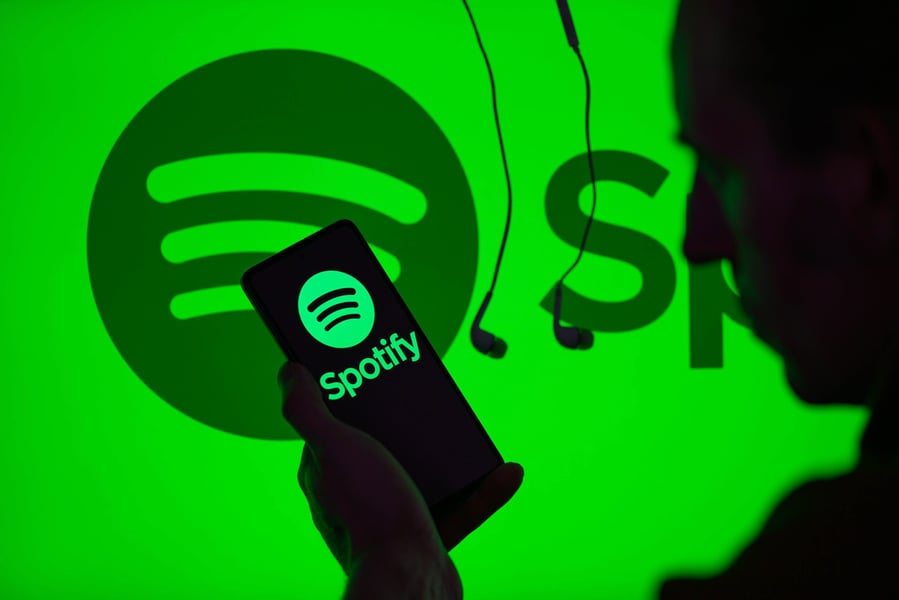
The speed of the reaction surprised many branding analysts because the redesign itself was relatively minor. Spotify did not change its core logo structure, typography, or signature soundwave symbol. Instead, it wrapped the familiar icon in a shimmering disco-ball aesthetic inspired by early-2000s skeuomorphic design.
But that proved to be exactly the problem.
For years, major tech companies have conditioned users to expect flat, minimalist, highly recognizable icons optimized for instant visual recognition. Spotify’s redesign disrupted that visual familiarity. According to Creative Bloq, the icon prioritized “sparkle over scalability,” causing the details to blur together once reduced to mobile app size.
The criticism became especially intense among iPhone users, many of whom said the glossy highlights made the logo resemble Apple’s update-progress overlay. Several Reddit users claimed they repeatedly mistook the icon for an unfinished app update sitting on their home screen.
Ironically, the backlash may have accomplished exactly what Spotify wanted.
The company’s anniversary campaign was competing for attention in an increasingly crowded streaming market dominated by algorithmic recommendations, TikTok-driven music discovery, and endless app notifications. By changing one of the world’s most recognizable app icons, Spotify instantly forced millions of users to notice something new.
Business Insider argued the controversy itself became the marketing strategy. Millions of users who otherwise might have ignored Spotify’s anniversary campaign suddenly searched for explanations, discussed the redesign online, and opened the app to investigate the changes.
Fast Company similarly reported that Spotify never intended the disco-ball icon to become permanent. According to the publication, the redesign was always designed as a temporary promotional experiment tied directly to the company’s 20th anniversary celebrations.
The temporary redesign also reignited a wider debate within the design industry about whether minimalism is starting to lose its grip on tech branding.
Over the last decade, major technology companies aggressively simplified their visual identities. Flat icons, geometric logos, muted gradients, and clean interfaces became dominant across mobile ecosystems. Spotify’s glitter-heavy redesign suddenly looked like a throwback to the glossy visual culture of the late 2000s.
Creative Bloq even coined the term “discomorphism” to describe Spotify’s visual experiment, blending disco aesthetics with old-school skeuomorphic design trends.
Some designers actually defended the logo for that reason.
A segment of users praised the redesign for feeling weird, loud, and visually imperfect at a time when most tech branding feels overly polished and algorithmically optimized. Several Reddit users argued the disco-ball icon felt more human and emotionally expressive than the sterile flat-design systems dominating modern apps.
Still, the overwhelming online sentiment remained negative.
The controversy highlights how emotionally attached users have become to tiny interface details that once seemed insignificant. App icons are no longer just shortcuts. For many people, they are embedded into daily routines, muscle memory, and even personal aesthetics.
That emotional attachment explains why even temporary visual changes can trigger reactions that seem wildly disproportionate to the actual redesign itself.
Spotify’s logo drama now joins a long list of controversial tech rebrands that generated massive online outrage, including redesigns from Instagram, Airbnb, Uber, and Google. Similar debates around modern tech branding and interface familiarity have increasingly become common across major platforms.
The backlash also mirrors criticism aimed at other streaming app redesign decisions affecting the broader listening experience, including YouTube Music’s recent interface overhaul discussed here.
Spotify’s expanding ecosystem has also remained in focus recently following new AI integrations and platform partnerships covered in this report.
Meanwhile, broader conversations around simplified interface design and visual familiarity have extended beyond music apps into wearable technology ecosystems as well, particularly with Apple’s latest redesign direction explored here.
The situation also reflects how rapidly changing user behavior and platform experimentation can trigger emotional responses online, similar to reactions surrounding Instagram’s newest disappearing-content features detailed here.
Yet unlike many permanent rebrands, Spotify’s disco-ball experiment was never meant to last.
And perhaps that was the smartest part of the strategy.
The company dominated online conversation for days, generated headlines across design and technology publications, and turned a temporary icon swap into a viral cultural debate. Whether users loved it or hated it, they talked about Spotify again.
In an attention economy, that may have been the real objective all along.