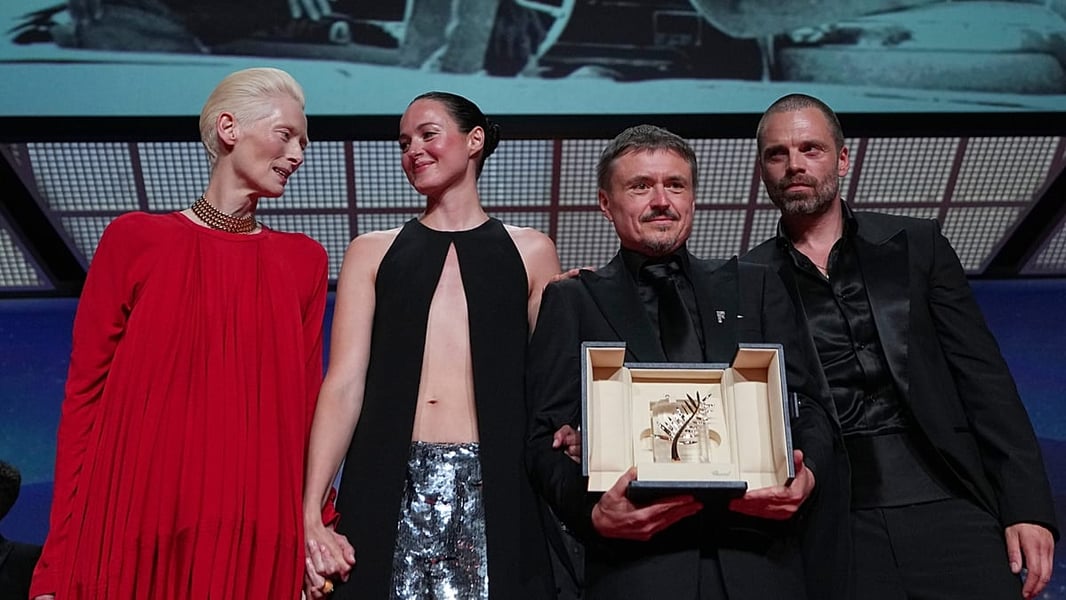

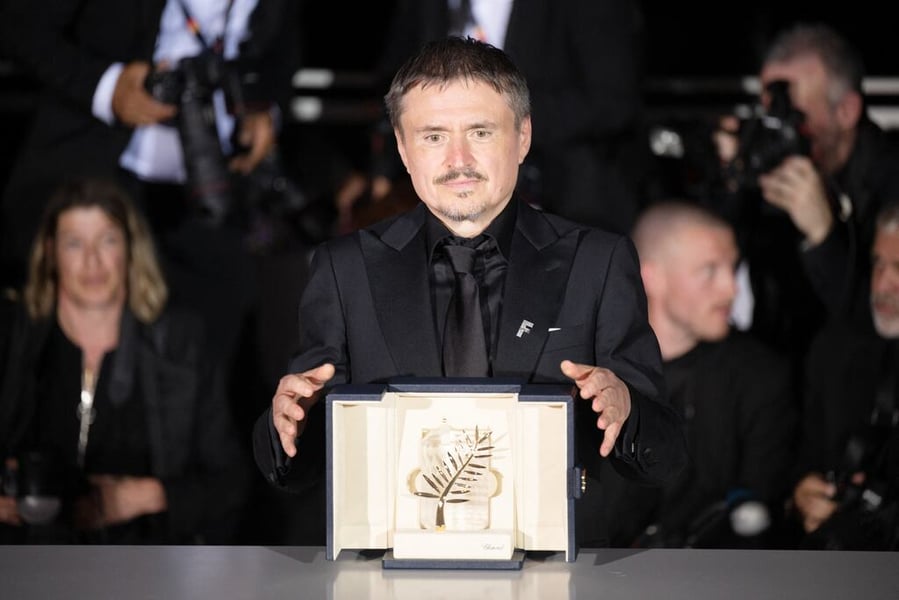
CANNES, France – Romanian director Cristian Mungiu won the Palme d’Or at the 79th Cannes Film Festival on Saturday night for Fjord, a tense family drama starring Sebastian Stan and Renate Reinsve, becoming only the eleventh filmmaker in the festival’s history to claim its top prize twice.
Mungiu, who first won the Palme in 2007 for 4 Months, 3 Weeks and 2 Days, accepted the award alongside his lead actors after a jury led by South Korean filmmaker Park Chan-wook handed Fjord the night’s most coveted honor. The film follows a Romanian evangelical family who relocate to a small Norwegian town on the edge of a fjord, only to collide with neighbors and child welfare authorities whose worldview proves irreconcilable with their own.
“The state of the world is not the best, I’m not very proud with what we’re leaving to our kids,” Mungiu told the audience inside the Grand Theatre Lumiere. “The change must start with us. Today the society is split. This film is a pledge against fundamentalism. We need to apply lovely words like tolerance more often.”
Park, presenting the award after two weeks of deliberation, said the jury had been moved by the way Fjord addressed difficult questions about cultural difference and parental authority without offering easy answers. The film was the most decorated of the festival, also collecting the FIPRESCI prize, the Prize of the Ecumenical Jury and the Prix François Chalais.
Fjord’s win was a particular triumph for its American distributor, NEON, which now holds North American rights to the Palme d’Or winner for the seventh consecutive year, a run that began with Bong Joon-ho’s Parasite in 2019. No studio has previously matched that streak. The independent label will release the film theatrically in the United States this fall.
Stan, the Romanian-American actor best known for his decade as the Winter Soldier in the Marvel Cinematic Universe and his Oscar-nominated turn in 2024’s The Apprentice, drew some of the night’s warmest applause as he joined Mungiu on stage. Reinsve, the Norwegian star who broke through in 2021 with The Worst Person in the World, told reporters earlier in the festival that the shoot had pushed her to confront her own assumptions about motherhood and faith.
The Grand Prix, the festival’s second-highest honor, went to Russian director Andrey Zvyagintsev for Minotaur, his first film since 2017’s Loveless. Zvyagintsev used his acceptance speech to address Russian President Vladimir Putin directly, calling on him to stop “the carnage,” in remarks that drew sustained applause inside the Palais des Festivals.
Best Director was shared between Pawel Pawlikowski for Fatherland and the Spanish duo Javier Calvo and Javier Ambrossi, known collectively as Los Javis, for The Black Ball. Pawlikowski, who previously won the same prize in 2018 for Cold War, is now one of the most decorated directors of his generation on the Croisette.
In a festival marked by ties, the acting prizes were split. Virginie Efira and Tao Okamoto shared Best Actress for Ryusuke Hamaguchi’s All of a Sudden, in which the two performers spend much of the film acting in each other’s native languages. Emmanuel Macchia and Valentin Campagne took Best Actor for their roles as soldiers who fall in love during the First World War in Lukas Dhont’s Coward.
The screenplay prize went to French filmmaker Emmanuel Marre for A Man of His Time, a portrait of his great-grandfather’s opportunism during the Vichy regime. The Camera d’Or for best first feature was awarded to Rwandan director Marie Clémentine Dusabejambo for Ben’Imana, a story of reconciliation in post-genocide Rwanda. The short film Palme d’Or went to Federico Luis for For The Opponents.
Two honorary Palmes d’Or were also presented this year. The first went to New Zealand filmmaker Peter Jackson, recognized for his work on The Lord of the Rings trilogy and his contributions to global cinema. The second was awarded to American actress and singer Barbra Streisand, who was unable to attend in person due to a knee injury and appeared by video message from Los Angeles. French actor Isabelle Huppert accepted the prize on her behalf.
Saturday’s ceremony closed a festival that had been dominated by debates over war on screen, with prize-winning films set in Norway, Russia, Spain, Belgium and Vichy France. Critics in Cannes had pointed to the depth of the competition lineup, which also included acclaimed entries from Valeska Grisebach, Léa Mysius and Boots Riley. Several titles, including James Gray’s Paper Tiger and Valeska Grisebach’s The Dreamed Adventure, left the festival without the Palme despite generating considerable buzz, a reminder of how unpredictable the race can be.
For Romanian cinema, Mungiu’s second Palme cements a remarkable run that began two decades ago. He joins a club of double winners that includes Francis Ford Coppola, Emir Kusturica, the Dardenne brothers, Michael Haneke, Ken Loach, Bille August, Shohei Imamura, Alf Sjoberg and most recently Ruben Ostlund and Bong Joon-ho. The result also revives questions about how the awards landscape may reshape the road to the 2027 Academy Awards, where NEON has frequently positioned its Cannes winners as serious Oscar contenders.
According to early reporting from the Croisette, Fjord is expected to open in select American theaters in November, with a wider release tied to the start of awards season. Mungiu has said he plans to return to Romania for a short rest before beginning post-festival press, having spent the past two years shooting in some of the most remote villages of western Norway. His previous Cannes-recognized features, including Beyond the Hills and Graduation, have all received American releases, but Fjord is widely seen as the most commercial work of his career, anchored by Stan’s growing Hollywood profile and Reinsve’s expanding international reputation.
The festival reported strong attendance and rising international press accreditations, suggesting that two decades after Mungiu first walked away with the Palme, the appetite for serious, character-driven world cinema remains intact. As Park closed the ceremony, he thanked the jury for their patience and praised what he described as a slate of films defined by “the diversity of voices and the courage of their makers,” a sentiment Mungiu echoed in his final remarks before leaving the stage with the Palme in hand.