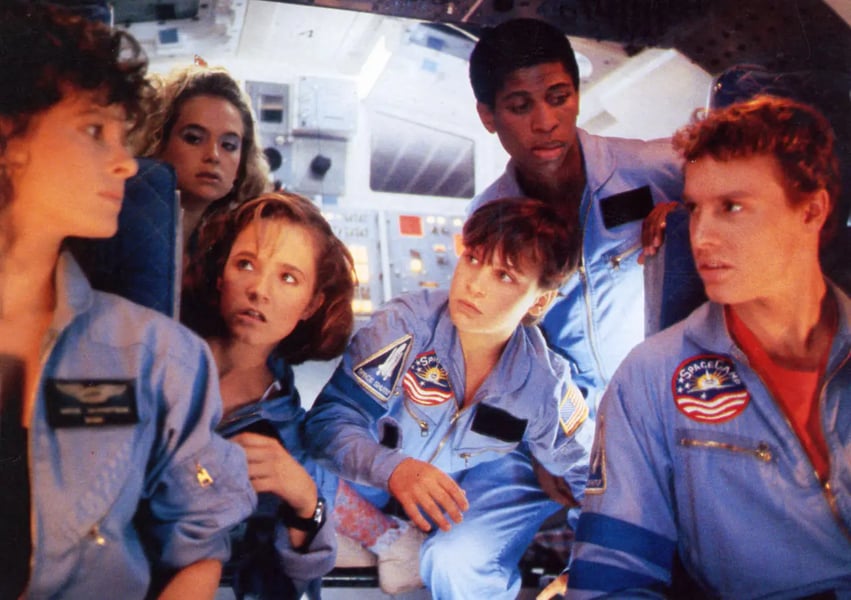

Forty years ago this June, a family adventure film opened in American theaters and vanished almost immediately, swallowed by grief, bad timing, and the still-raw wound of a national tragedy. The film was SpaceCamp, a buoyant 20th Century Fox production about a ragtag group of teenagers accidentally launched into orbit aboard a NASA space shuttle. It had a John Williams score, a cast of the era’s brightest young stars, and the full blessing of the American space agency. It had, in theory, everything it needed to be the summer movie of 1986.
What it did not have was luck.
On January 28, 1986, five months before the film’s scheduled release, the Space Shuttle Challenger broke apart 73 seconds after liftoff from Kennedy Space Center. Seven astronauts died. Among them was Christa McAuliffe, a New Hampshire schoolteacher who had been selected as the first civilian to travel to space, a detail that had made the launch uniquely visible inside classrooms across the country. Millions of children watched it happen live on television. The nation entered a period of mourning that had no clean end date, and the idea of a cheerful theatrical entertainment built around a near-identical premise suddenly seemed, to put it gently, untenable.
The filmmakers, for their part, made a decision that history has judged harshly. Rather than shelving the picture, they chose to proceed. The release was pushed back to June 6, 1986, the same date that the Rogers Commission, the presidential panel investigating the accident, delivered its final report to the Reagan administration. SpaceCamp opened, as one contemporary critic observed, into a country still processing its grief, not hunting for catharsis at a multiplex showing shuttle launches gone wrong. It earned under $10 million domestically against an estimated budget of up to $25 million, and the reviews were, with a few exceptions, unkind.
That might have been the end of it. Most films that stumble so badly at release simply disappear. But SpaceCamp survived, routed onto cable television and VHS tapes, where it found the audience that theaters had denied it: children of the late 1980s and early 1990s who had no memory of Challenger’s plume of smoke against a January sky and received the film purely as what it had always wanted to be. An adventure. A dream.
Forty years on, the film rewards the kind of reassessment it has rarely received.
The plot is engineered with the confident illogic of 1980s adventure cinema. Max, the boy played by Phoenix, befriends a camp robot named Jinx, voiced by Frank Welker. Jinx, taking the boy’s wish to go to space as a literal directive, manipulates the shuttle’s systems during a routine engine test and causes an accidental launch. The five young campers and their instructor suddenly find themselves in orbit, without adequate oxygen, without training sufficient for the crisis, and without a plan for how to get home. Mission Control, led by Tom Skerritt, scrambles to save them. The children scramble to save themselves.
What the film does well, and what has been consistently underappreciated, is its earnestness about the appeal of space. The movie does not mock its protagonists’ love for NASA. It treats the stars as a genuine destination, exploration as a legitimate human calling, and scientific knowledge as something worth having. In an era when Hollywood frequently made cynicism the default register of its entertainment, SpaceCamp held the opposite view, and it holds it with disarming sincerity.
The Challenger shadow changed the meaning of that sincerity without erasing it. Watching the film now, the optimism feels fragile in ways the filmmakers could not have intended, but which resonate all the more for being unearned and unguarded. The faith in the shuttle program, the easy confidence in NASA’s machines and systems, the breezy assumption that adventure awaits anyone who points themselves upward: these sentiments had barely survived the winter of 1986, and the movie carries them into summer like a flag that does not yet know what has happened to the country that flies it.
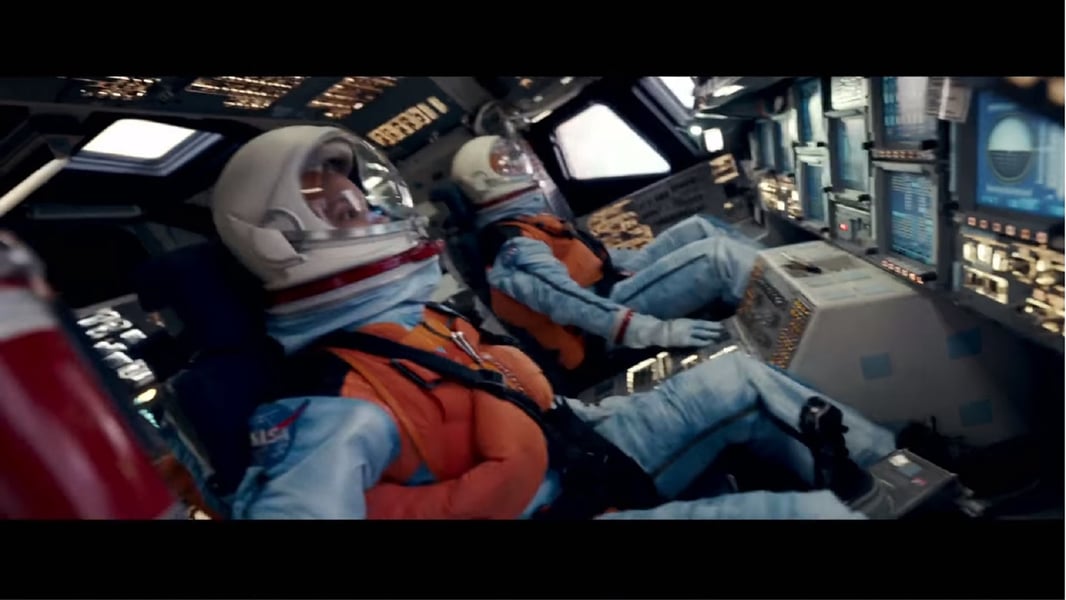
There is an additional layer of tragic irony that has calcified over the decades. At the film’s climax, Lea Thompson’s character must hold the shuttle at a precise angle to survive reentry into the atmosphere, a technical sequence staged as the movie’s emotional peak. The particular danger she faces, a shuttle breaking apart on reentry due to thermal stress, was, of course, the precise mechanism of the Columbia disaster in February 2003, when the shuttle disintegrated over Texas and Louisiana sixteen minutes before its scheduled landing, killing all seven crew members aboard. The film’s most triumphant scene has become, through no fault of its creators, a ghost of a tragedy that had not yet happened when the cameras rolled.
The question of what SpaceCamp actually is, as a film rather than a cultural artifact, remains genuinely interesting at 40. It is not a particularly well-made movie. The visual effects betray their era in ways that some 1986 films do not. The robot Jinx belongs to a tradition of screen companions who provoke more irritation than affection in modern audiences. The character development operates on the economy of the type rather than the intricacy of the individual. A long third act tests patience that the film’s earlier energy earns incompletely.
And yet there is something in the picture that holds. Phoenix, even at 12, is entirely present in a way that some child actors are not. Thompson brings a seriousness to her role that the material does not always demand but that it repays. The John Williams score, criticized on release as bombastic, functions now as exactly what it was designed to be: a declaration that the story matters, that these children in this shuttle deserve the full weight of cinematic attention.
The Disney streaming service has a remake in development, written by Saturday Night Live veterans Mikey Day and Streeter Seidell. Hollywood’s current appetite for remaking properties from its recent past is relentless, and SpaceCamp fits the profile of the attempt: recognizable enough to carry a brand, obscure enough to carry no real expectations. Whether that project will honor the original’s specific kind of hopefulness, or simply strip-mine the premise for content, remains to be seen.
What the original had, and what any remake will struggle to replicate, is the specific quality of American confidence about space in the years before January 28, 1986. The film is a document of a moment when NASA was an institution of uncomplicated national pride, when the shuttle program was a routine miracle rather than a tragic proof of institutional failure, and when the idea of putting teenagers in space could be framed as an adventure rather than a catastrophe.
Forty years on, that confidence looks like innocence. And there is something in the film that earns, if not forgiveness for its terrible timing, then at least a kind of retrospective tenderness, for the moment it captured, and for the country it believed itself to be speaking to.