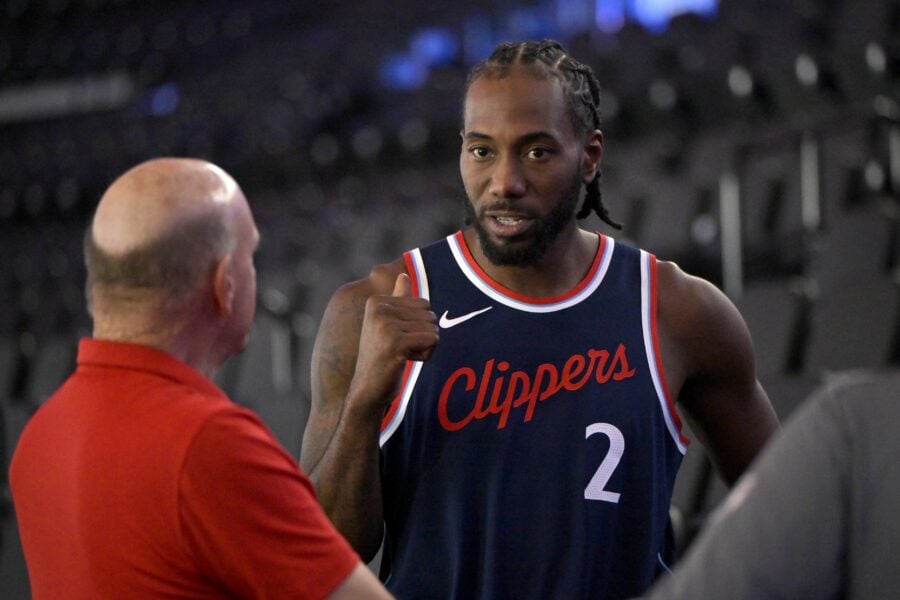

LOS ANGELES — Nine months into what was supposed to be an independent inquiry, the NBA’s investigation into whether the Los Angeles Clippers secretly funneled money to Kawhi Leonard through a failing green-banking startup has finally reached the man at the center of it all. Leonard and his uncle, Dennis Robertson, who also serves as his business adviser, have been interviewed by investigators from Wachtell, Lipton, Rosen & Katz, the New York-based law firm the league retained last September, according to a report by Baxter Holmes of ESPN.
The interviews confirm that the legal team working the case has now spoken with the principal figures on both sides of the alleged arrangement — and that the probe, for all the months it has consumed, still hasn’t produced a public conclusion.
Commissioner Adam Silver addressed the investigation during his press conference in San Antonio on Wednesday, hours before Game 1 of the NBA Finals. He offered no timeline but made the closest thing to an end-of-process statement he has given since the probe began. The investigation, Silver said, is “far along.” He told reporters the outside firm understood that “you could keep going on and on” but that the league was “close to the point” where it needed finality — both for the Clippers and for the other 29 franchises operating under the same salary-cap rules the case calls into question.
“The investigation is being conducted by a law firm independent of the NBA,” Silver said. “My instruction to them is we can’t be investigating forever and at some point we have to wrap it up, but at the same time, I think the most important thing is we get it right.”
The allegations at the core of the case were first reported by journalist Pablo Torre, whose podcast series, as ESPN reported, alleged that Clippers owner Steve Ballmer invested $50 million in Aspiration — a self-described environmentally focused banking company — as a vehicle to route additional compensation to Leonard, effectively circumventing the league’s salary cap. Ballmer, the Clippers organization, and Leonard’s camp have all publicly denied the allegations. A representative for Leonard denied them again to Holmes following the ESPN report.

What the investigation has so far revealed is a picture of a franchise caught between two uncomfortable realities. Investigators have interviewed Ballmer, Clippers executives, Robertson and now Leonard himself. Former Aspiration employees have also been interviewed, according to previous reporting by Torre — though five of those ex-employees told Torre they were not asked about Ballmer, whose investment is central to the theory of circumvention. Clippers executives, Holmes reported, have privately expressed frustration with “trying to prove innocence for a violation that they say they didn’t commit.”
The fate of Aspiration itself may have sharpened the urgency around wrapping up the inquiry. On Monday — two days before Silver’s press conference — Aspiration co-founder Joe Sandberg was sentenced to 14 years in federal prison after being convicted of defrauding investors. The collapse and criminal prosecution of the company that sits at the center of the NBA’s cap-circumvention theory makes any remaining claim that the arrangement was an arm’s-length commercial deal harder to sustain in public, whatever the legal conclusion turns out to be.
The case originated from Torre’s investigative podcast, which in May won the 2026 Pulitzer Prize for Audio Reporting. The series released its 11th installment on Friday. That body of reporting has created a public record the NBA cannot easily outrun regardless of how Wachtell, Lipton ultimately frames its findings.
Silver has said consistently that his disciplinary powers in such a matter are “very broad” — capable of reaching owners, teams, and players alike — but has declined to discuss potential penalties before the investigation concludes. On Wednesday, he said his role was to “follow the facts” rather than act on perception or external pressure. The league’s structure gives him discretion that is, in practice, nearly unreviewable: the final report from the outside firm goes to Silver, and Silver alone determines what discipline, if any, follows from its findings.
“What essentially happens here is that the factual report, together with findings, will be made by this independent firm,” Silver said. “That’s presented to me. It’s then, ultimately, my role to determine what the appropriate discipline, if any, should be meted out based on their findings.”
The investigation has shadowed Leonard’s final year under contract with Los Angeles — he played just 23 games this past season before a knee procedure ended his year in January. He is entering free agency this summer with his future in Los Angeles unresolved both athletically and legally. Whether the league’s findings arrive before, during or after free agency negotiations begin will shape what leverage, if any, either side holds. That the NBA cannot yet say which of those windows will apply is, at this point, the most revealing thing Silver has said.
The Clippers, for their part, have maintained throughout that the franchise’s relationship with Leonard has always operated within league rules. Whether Wachtell, Lipton agrees — and what Silver does with that answer — remains the question the NBA cannot yet answer.