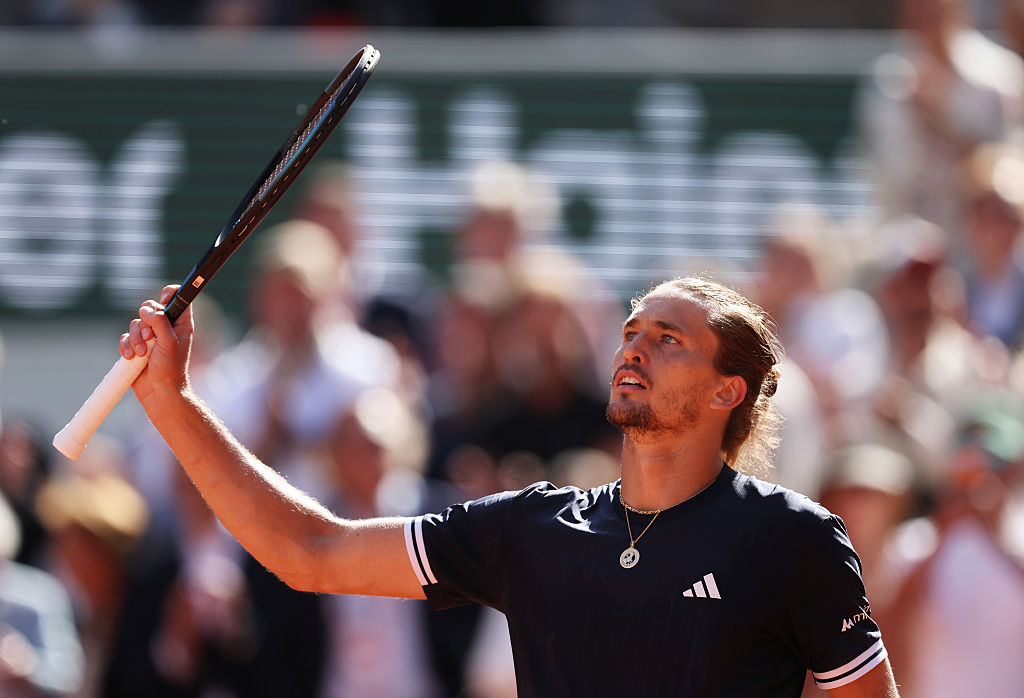

PARIS – The question has followed Alexander Zverev across four different Grand Slam finals and several years of suffocating expectation. On Sunday at Court Philippe-Chatrier, he will finally have his answer.
Zverev will face Flavio Cobolli in the Roland Garros men’s final, a match that pits the sport’s most decorated near-miss finisher against a 24-year-old Italian who was losing to a 186th-ranked qualifier in Melbourne just five months ago. Neither man has won a Grand Slam title. One of them will on Sunday. The question of which one carries considerably more weight for the German.
Three times Zverev has arrived at this stage. Three times he has left without the trophy. The 2020 US Open slipped away over five sets to Dominic Thiem. The 2025 Australian Open went the same way. And then there was Roland Garros 2024, the cruelest of the lot – Zverev led Carlos Alcaraz by two sets to one on this very court before the Spaniard dismantled him in the final two sets, turning what appeared to be a coronation into something considerably more painful. What Zverev does with the memory of that afternoon will go some distance toward determining Sunday’s outcome.
“The only thing I can control is that I play good tennis,” Zverev said after defeating Jakub Mensik in Friday’s semifinal, a four-set match that the Czech 26th seed made competitive deep into the third set before the German’s weight of shot eventually settled the matter. Pressed on the pressure of standing at this threshold again, Zverev would not go further than the clinical. “I will try to show my level. I will try to do the right things. That’s the only thing that matters to me.”
That tight-lipped professionalism conceals how much this final costs him emotionally. Zverev has spent the better part of a decade as the answer to a question no player wants to be: the best man never to have won a major. The company is distinguished but not desirable. At 29, with Sinner sidelined and Alcaraz absent through injury, the draw in Paris represented his clearest path since that painful 2024 afternoon. He has dropped just two sets in six matches. His serve has been accurate. His backhand, which can be both a weapon and an alibi depending on the match state, has held.
What Zverev does not yet know is how Cobolli will approach him with fresh legs. The Italian advanced to Sunday’s final after his semifinal opponent, compatriot Matteo Arnaldi, withdrew with a viral illness roughly an hour before their scheduled match – ending what would have been the first all-Italian men’s major semifinal. For Cobolli, the walkover meant an unexpected four days without a competitive match heading into the final. Whether that additional rest sharpens him or costs him the rhythm he had built through five demanding matches here is one of the genuine unknowns Sunday afternoon will settle.
“When he came to me almost one hour ago, I almost cried,” Cobolli said of the moment Arnaldi informed him of the withdrawal. “It’s something that you don’t expect at all. I was ready to play this match. When he came, I was completely sad for him. But at the same time, of course I’m really happy with the result.”
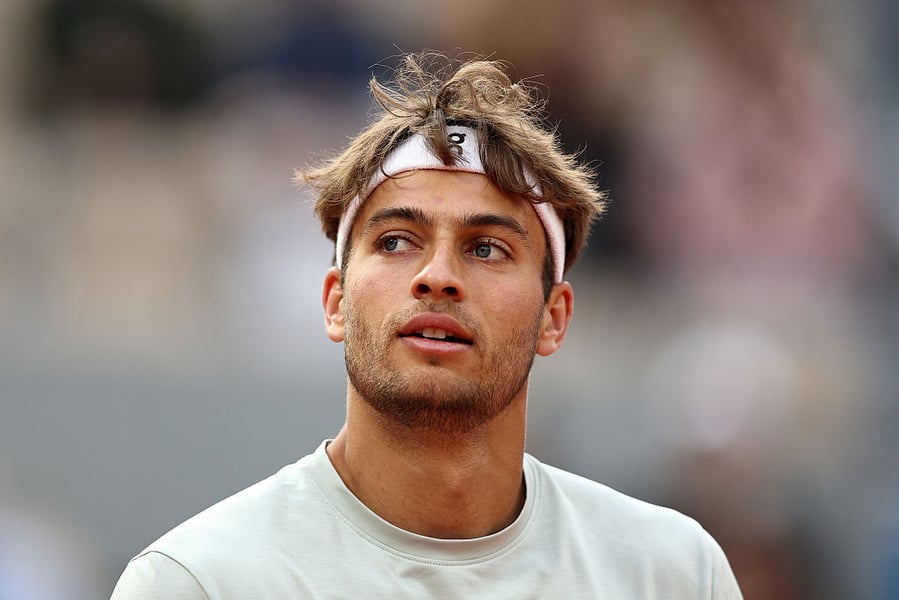
Cobolli’s path to a first major final reads less like a career arc and more like a season-long argument against narrative gravity. He opened 2026 with a first-round exit at the Australian Open to Arthur Fery, ranked 186th in the world. He then won the title in Acapulco, reached the final in Munich, and arrived at Roland Garros seeded 10th with the clay-court form of someone who had quietly become one of the more dangerous players on the surface. He beat fourth seed Felix Auger-Aliassime in four sets in the quarterfinals and, earlier in the week, knocked out Learner Tien. The Berrettini retirement in the quarterfinals meant Italian tennis was left to process two competing storylines simultaneously – one ending, one beginning.
The Zverev-Cobolli head-to-head stands at 3-1 in the German’s favor, but one of those meetings this clay season produced the most relevant data point. In Munich’s semifinals, Cobolli defeated Zverev 6-3, 6-3 – a scoreline that spoke to how comprehensively the Italian can disrupt the German when his footwork is right and his groundstrokes are finding their angles early in rallies. Zverev answered with a 6-1, 6-4 victory in Madrid twelve days later, the kind of clinical margin that suggested he had solved the problem. A Grand Slam final, with its different surface conditions and different psychological weight, is neither Munich nor Madrid.
The tactical calculation is straightforward in theory and demanding in practice. Cobolli needs to attack Zverev’s second serve, take the ball early, and force the German into net positions he does not prefer. Zverev’s heavy backhand can be neutralized when an opponent refuses him the time and depth to set up. The Italian has the footspeed and the topspin off the forehand to execute this plan. Whether he can sustain it for the duration of a best-of-five final, with the crowd and the moment bearing down, is what the match will test.
For Zverev, the incentive structure is clear. He knows this court. He knows what it felt like to win the first two sets in 2024 and then watch the trophy disappear. He also knows what it felt like to leave Roland Garros in 2022 on a stretcher, his ankle badly rolled during a semifinal against Rafael Nadal that ended his season. The rehabilitation, the comeback, the three subsequent years of sustained excellence without the title – Sunday offers him the chance to write a different final chapter on the same ground.
A win would also make Zverev the first player from Germany to hold a Grand Slam title since Michael Stich won Wimbledon in 1991. The weight of that particular absence has not escaped German tennis, nor has it escaped Zverev, who has worn it publicly throughout his career. He has declined, mostly successfully, to let it become a wound. But it has not stopped being a fact.
Cobolli is coached by his father Stefano, himself a former ATP professional, which gives this run an intimacy that has registered throughout the fortnight. The image of father and son embracing courtside when the Top 10 ranking was confirmed – Cobolli said their usual routine was a big hug when he reached a new career high, and they did the same – has become one of the tournament’s recurring images. Should that hug come on Sunday afternoon, it will mean something considerably larger: Cobolli would become just the second Italian man in the Open Era to win the French Open, after Adriano Panatta in 1976.
The absence of Sinner, Alcaraz, and Djokovic from the latter stages of the draw has invited the familiar qualification that this is an open final, a final without giants, a final that will produce a champion but perhaps not a defining one. That framing misreads what is at stake. The semifinals established that this tournament has been shaped by genuine quality, not merely by default. Zverev’s path required navigating a draw that still contained significant opposition. Cobolli’s victories over Auger-Aliassime and Tien were not accidents.
The ranking consequences are also meaningful. A Cobolli title would take him to world No. 5, a ranking that would represent the steepest single-tournament climb of his career. He is already guaranteed to enter the Top 10 on Monday regardless of Sunday’s result. A Zverev title would further consolidate his position at No. 3, narrowing the gap to Carlos Alcaraz at No. 2 to 2,605 points. Neither man is playing for rankings on Sunday. But the mathematics of where each would stand afterward adds texture to stakes that need no embellishment.
What this final cannot offer is certainty. Zverev has been here before and failed. Whether that history makes him harder to beat – conditioned, experienced, clear-eyed about what the moment demands – or whether it carries its own particular burden into the third and fourth sets is the question no preview can answer. Cobolli has not been here before. That, too, cuts in two directions.
Sunday’s match is scheduled for no earlier than 3 p.m. CEST on Court Philippe-Chatrier.