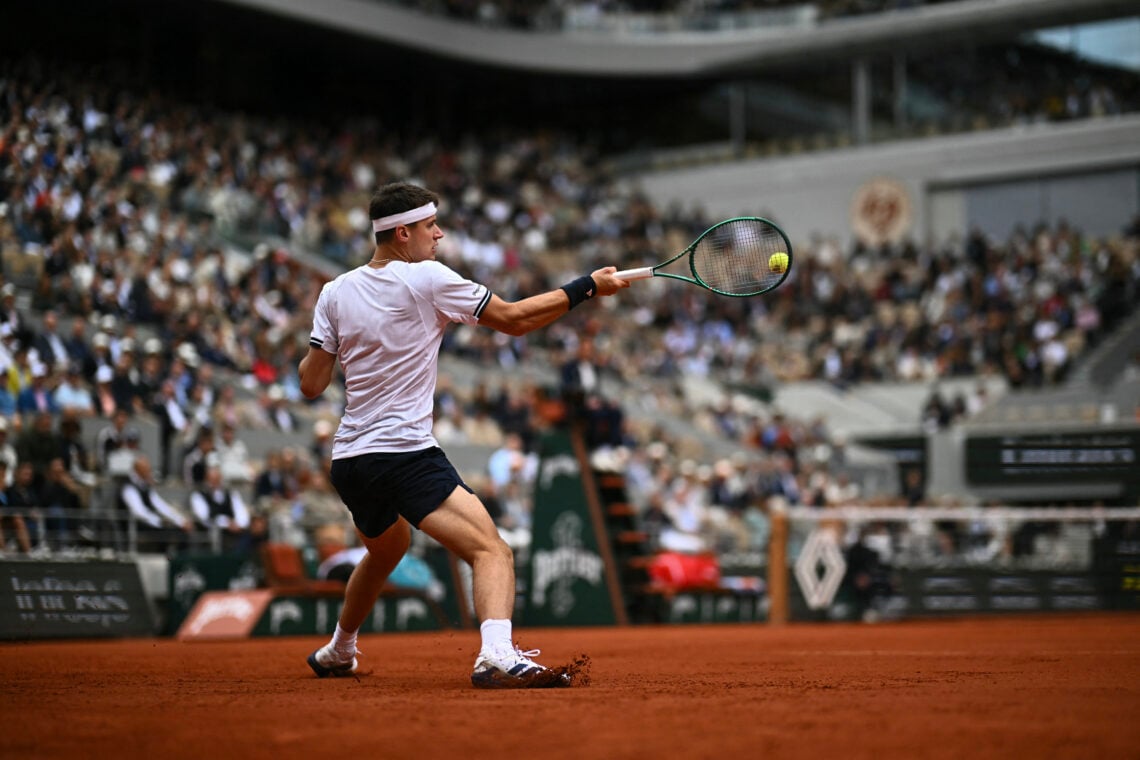

PARIS — The neck went stiff in the fourth set. At 2-3 down, already carrying the weight of 20 sets played over a fortnight, Jakub Mensik felt something tighten in his left side that reduced his range of motion on certain shots. He did not ask for a trainer. He did not break his service game, and he did not let Alexander Zverev sense it. He lost anyway, 7-5, 6-2, 3-6, 6-3, and walked off Court Philippe-Chatrier as the best loser Roland Garros has produced this decade.
That is not the same as being a loser. The distinction matters for what comes next.
The 20-year-old Czech had never been past the fourth round at a major before this fortnight. He had reached the second round in Paris in prior visits. On Friday he became the youngest Czech man in history to reach the semifinal of a Grand Slam, and he did it fighting through a neck problem, a stamina deficit that accumulated across five-set wins against Mariano Navone and Andrey Rublev, and a fourth-round four-set dismissal of Alex de Minaur before he blitzed Joao Fonseca in the quarters. He played 20 sets to reach Alexander Zverev. Zverev had played 16.
“There were a lot of tough moments that it was basically already done for me,” Mensik said at his post-match press conference. “But I stood up and I kept fighting, and I found a way how to win.”
He said it without self-pity, which is perhaps the most revealing thing about him. The sentence was past tense — a description of what the tournament had already been before the Zverev match ended it. He was not asking for credit. He was noting the record.
Tim Henman, watching courtside for TNT Sports, was not prepared to let the defeat be the last word. The British former player and broadcaster has seen enough of these tournaments to know the difference between a player who reaches a major semifinal on a favorable draw and one who earns it the hard way. Mensik earned it. “He is 20 years of age, he has won a Masters 1000,” Henman said immediately after the result. “This is his first Grand Slam semi-final; he is going to take enormous confidence away from this. He is going to be in many more semi-finals. I definitely think he will be in Grand Slam finals and I would not be surprised if he wins them. There is so much upside from the last couple of weeks for Mensik.”
That kind of prediction from Henman, who does not dispense them often, says something about what the past two weeks have revealed. Mensik is not being discussed as a promising young player any longer. He is being discussed as an inevitable one.
The neck issue complicates the narrative slightly without changing it. Mensik confirmed it had been stiffening during the match but was at pains to distinguish discomfort from incapacity. “I wouldn’t say it’s an injury or something that will get me out for a long time,” he told reporters. “It was just at that moment that I felt a stiff neck, which didn’t allow me to do some movements. So I would say of course it’s a little discomfort during the match. But it’s nothing serious.” That said, he acknowledged the physical toll of 20 sets. “Physically I would say it is a long tournament. I recovered well those two days, but still, during the match, I felt like my left neck was getting a little bit stiffer.”
The question of whether a fully rested Mensik would have found a way past Zverev is unanswerable and probably beside the point. The second seed was formidable. He served well, stayed deep on return, and denied Mensik the angles he had exploited against everyone else. “Sascha is a very tough guy on the court,” Mensik said of Zverev. “He’s not giving you any free points. It’s very tough to find the rhythm, especially when he’s staying so much back and you feel like you’re hitting the wall.” Those were not the words of someone making excuses. They were a technical assessment of a player who has now beaten him twice in three matches, including a prior meeting at the Madrid Open.
Zverev, for his part, advances to the final on Sunday against Flavio Cobolli, the 10th seed who received a walkover after compatriot Matteo Arnaldi withdrew with a viral illness. It will be Zverev’s fourth major final — and his second at Roland Garros — and the first time since the 2024 Australian Open that a first-time Grand Slam champion will be crowned. The German is 29 years old. He has been called the best player never to win a Slam for long enough that the phrase has begun to feel unkind.
Mensik will leave Paris ranked 16th in the world according to the PIF ATP Live Rankings, up 11 spots, with a 23-10 record on the year. He is the reigning Miami Open champion. He is 20 years old. When Henman listed the young generation banging on the door of the sport’s elite, Mensik was the one he singled out first.
The comparisons to his generational peers have begun to feel strained. Joao Fonseca — whom Mensik beat in the quarterfinals — Rafael Jodar and Learner Tien are all talented. None of them has reached a major semifinal. None has a Masters 1000 title. Mensik has both, at 20. The phrasing “promising young player” no longer applies. The question now is not whether he will win a Grand Slam but when, and on which surface, and against whom.
He has not said. Neither has the ranking, which is still rising. Roland Garros asked him a question he had never been asked before — could he win 20 sets in two weeks at a major — and he nearly answered yes. The stiff neck in the fourth set is the only thing that keeps the answer from being cleaner than it already was. That is worth remembering. So is the fact that he has not yet won a Slam, and the gap between “inevitable” and “actual” in tennis history is littered with players who never quite closed it.
Mensik showed enough in Paris to make the ceiling look very high. Whether he reaches it is a story the next several years will tell. According to the ATP Tour’s official match record, he is now 23-10 this season — and that number would have been higher still had Carlos Alcaraz not withdrawn before the tournament began, opening a draw that rewarded every player willing to fight for it. Mensik fought. It was not enough, and it was more than enough, simultaneously. That is the particular condition of a 20-year-old who just played his first Grand Slam semifinal, lost to the second seed in four sets on a stiff neck, and left Paris ranked 16th in the world.
Tim Henman, at least, does not think the wait for that first Slam title will be long. The question is whether he is right, or whether the weight of expectation will become its own obstacle. Jannik Sinner, the tournament’s biggest casualty, could tell him something about that.
Related Posts