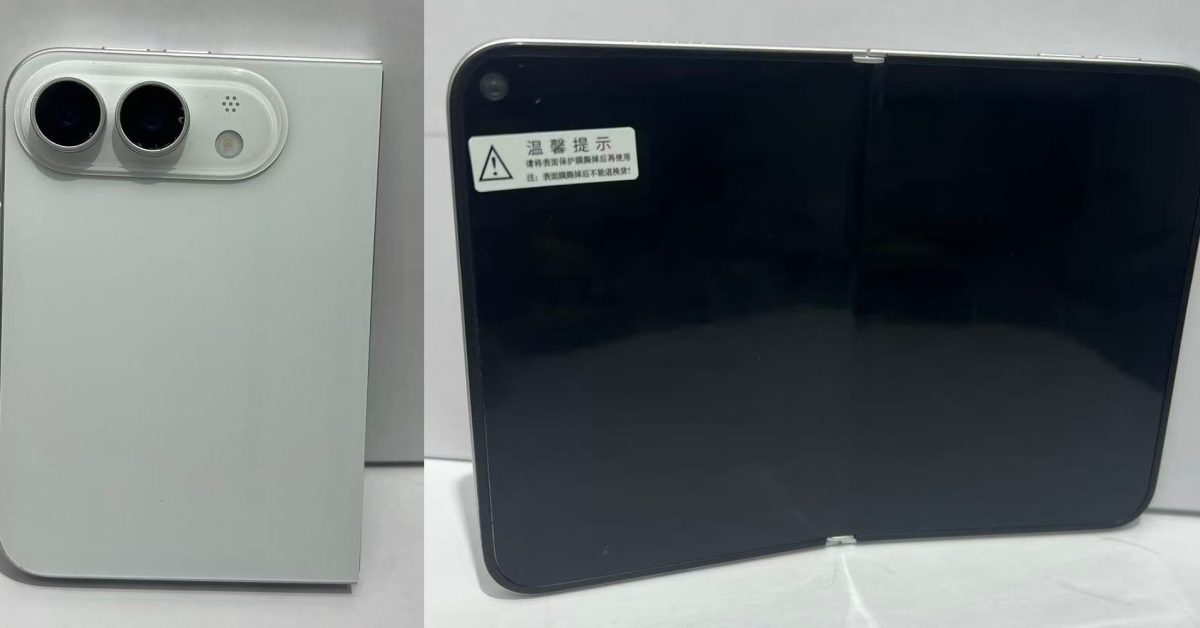

CUPERTINO — The photos, shared by leaker Sonny Dickson on Saturday, did not look like a mystery. The device sitting in the frame was white, compact when folded into something close to a passport’s proportions, and equipped with two rear cameras. What made them significant was not what they showed, but what they confirmed was missing.
No Face ID module. No color variants. Just a single, white aluminum-and-glass slab that, according to Dickson, may be the only version of Apple’s first foldable iPhone that consumers will be able to buy when the device ships later this year.
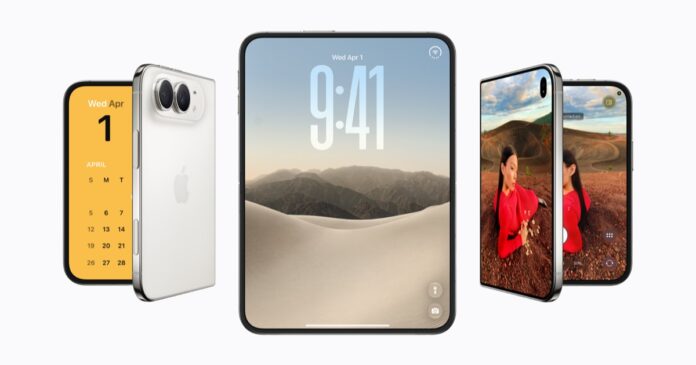
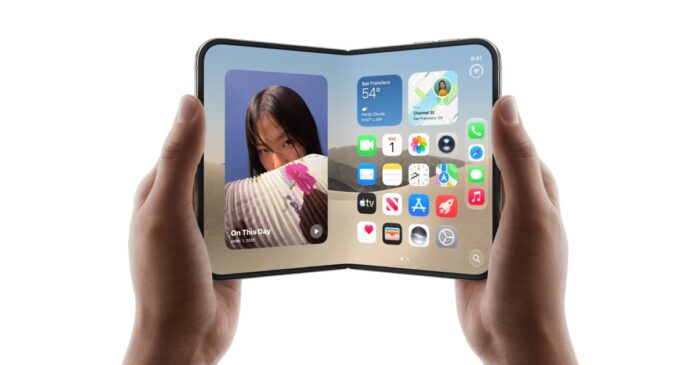
The dummy units, physical stand-ins used by case manufacturers and carriers to plan accessories ahead of a launch, offer the clearest look yet at what Apple is preparing. The inner display measures approximately 7.8 inches when unfolded — an area comparable to an iPad mini — while the outer cover screen sits at roughly 5.5 inches. The front-facing camera is positioned in the top-left corner of the inner panel, paired with a hole-punch cutout rather than a Dynamic Island. When closed, the proportions are shorter and wider than a standard iPhone, giving the device what several observers have described as a passport form factor.
The single color that appears on these units matters more than it might seem. Bloomberg’s Mark Gurman had previously indicated that the foldable would come in black and white. Dickson now suggests white may be the only option — a possibility that, if accurate, would make Apple’s most expensive iPhone in years also its most constrained at launch.
Apple has launched color-limited products before. The original iPhone came in one finish. The iPhone X arrived in only silver and space gray. That history is real. But those were simpler chassis to prototype and coat, and none of them required the company to validate a color finish across a hinge mechanism strong enough to survive tens of thousands of open-and-close cycles. What Apple has not yet publicly addressed — and what the dummy units do nothing to resolve — is whether the white limitation is a deliberate product decision or an engineering constraint the company has not yet solved.
Meanwhile, independent leaker Ice Universe shared a photo of the foldable in a white and silver finish via Weibo in early June, corroborating the general palette. Apple’s foldable is expected to measure 120.6mm tall and 167.6mm wide when unfolded, folding to 9.23mm thick at the hinge — or 13mm when accounting for the camera island. The two sources — one from a hardware supply chain leaker, one from a Weibo tipster with a strong track record on Apple hardware — landing on the same color is not a coincidence that analysts are dismissing lightly.
The authentication question is equally consequential. Apple’s foldable will ship with Touch ID integrated into the power button — not Face ID, the biometric system the company has deployed on every flagship iPhone since 2017. The decision was not made by choice, according to analyst Ming-Chi Kuo, who noted that Apple was effectively forced to use Touch ID due to space and thickness constraints. The iPhone Ultra, as the device is expected to be called, will measure only 4.5 to 4.8 millimeters thick when unfolded — thinner than the already-slim iPhone Air, which itself measures 5.6 millimeters. Face ID requires a hardware sensor cluster. Accommodating two such clusters — one for each display — was evidently not feasible within that frame.
The practical consequence is straightforward: Face ID, the feature that once defined the premium iPhone experience, will not be present on the most premium iPhone Apple has ever made. Whether consumers who pay what is expected to be a price above $2,000 for the device will tolerate that trade-off is the question Apple’s product team has presumably asked itself at length and answered in the affirmative. Touch ID via the power button works. It is fast, reliable, and mature. But it is not the experience that eleven years of iPhone marketing has positioned as the apex of Apple authentication.
The battery picture is marginally more reassuring. The device is rumored to carry between 5,400 and 5,800 milliamp-hours of capacity — the largest ever shipped in an iPhone by a significant margin, exceeding the iPhone 17 Pro Max. That reserve is presumably necessary given that powering two displays at once is a materially different energy proposition than running a single screen. Whether the thermal management — the device is also expected to feature a vapor chamber within its hinge structure — will keep performance consistent across sustained use is not something dummy units can demonstrate.
Apple is expected to announce the foldable iPhone at its usual September event, alongside the iPhone 18 series. The initial production run is estimated at approximately 11 million units, a figure that Wccftech noted represents a deliberately cautious allocation given the complexity and cost of the components involved. Samsung Display is widely reported to be supplying the foldable panels. The hinge, incorporating liquid metal elements said to be stronger than titanium, is Apple’s own engineering contribution to a product category that its rivals have struggled to make either profitable or durable at scale.
What the dummy units cannot answer — and what no leak has fully addressed — is how the device will behave after the first year of daily use. The crease question in particular remains open. Apple’s suppliers have told analysts the inner display will have a nearly invisible fold line. That claim has not been tested in mass production. The difference between “nearly invisible” in a controlled engineering environment and “acceptable to a paying consumer” is precisely the margin where foldable phones from other manufacturers have encountered their most persistent commercial problems.
The iPhone Fold — or iPhone Ultra, if that name holds — is arriving on Apple’s timeline, in Apple’s one color, with Apple’s own authentication system standing in for the one it could not fit. That may be enough. It may also be, as Apple has demonstrated before with both the original iPhone and the Vision Pro, a first-generation statement of intent that only becomes fully realized one or two hardware cycles later.