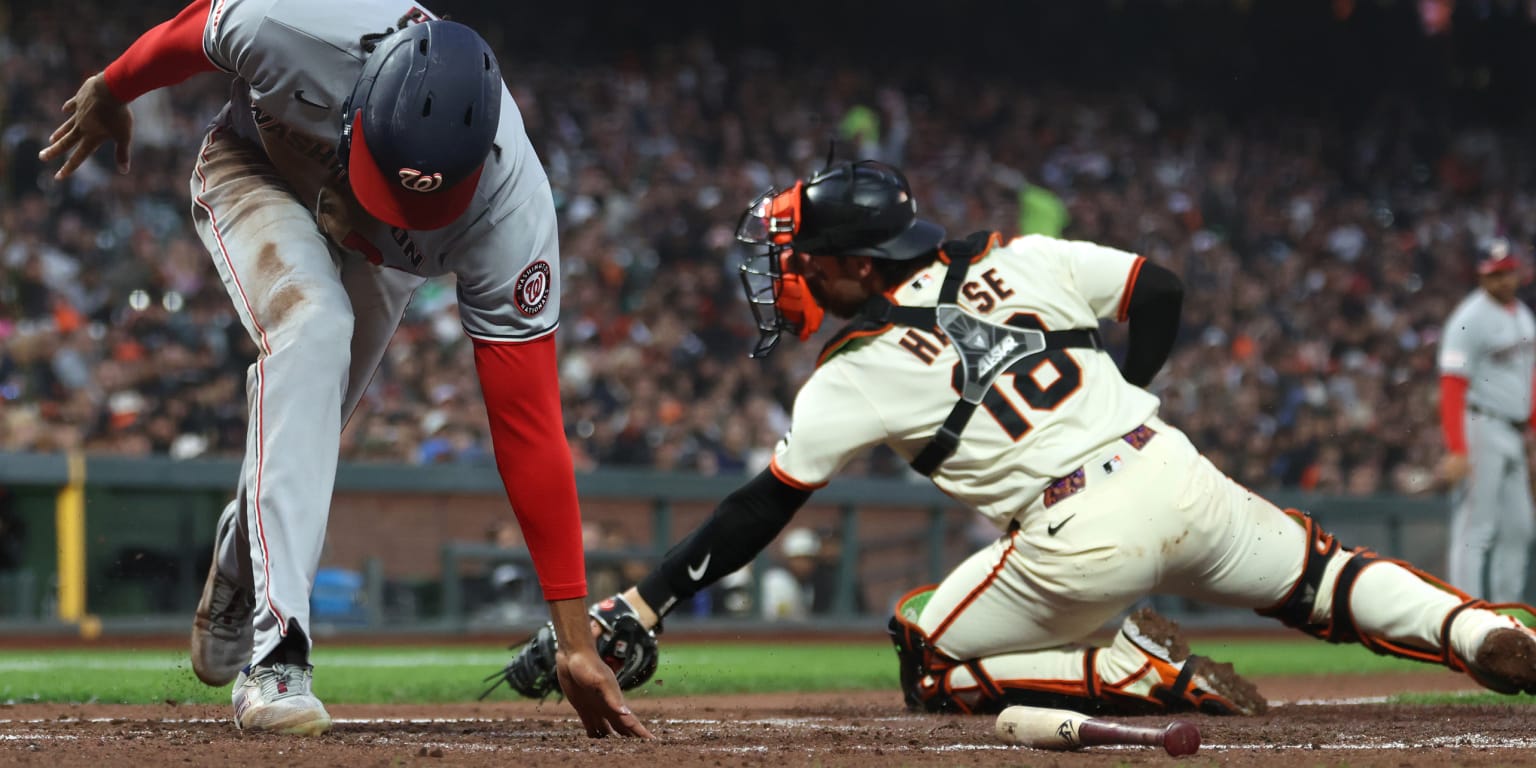

SAN FRANCISCO — The catcher was already moving up the baseline. The throw from right field was on its way. James Wood, charging home from second base on a Luis García Jr. single, had perhaps one second to process all of it.
He did not slide.
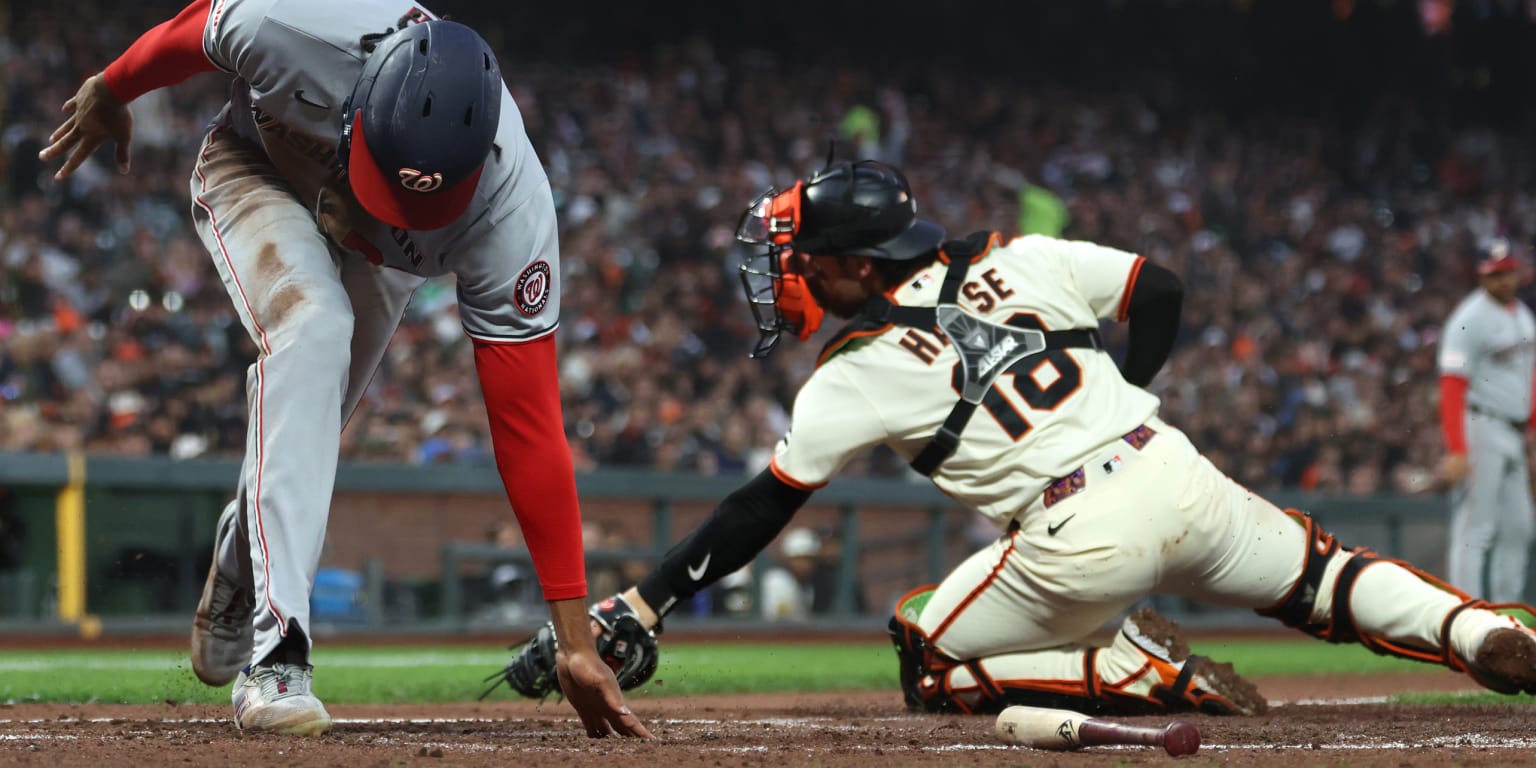
Instead, the 6-foot-6 Washington Nationals outfielder simply bent at the waist and reached down with his left hand, touching home plate while Eric Haase’s tag swept through empty air above him. It counted as a run. It wound up being one of the three the Nationals scored in the final four innings of a 4-3 come-from-behind win over the San Francisco Giants on Monday night at Oracle Park — a victory that moved Washington to an even .500 at 34-33 on the season.
“I was going in for the slide and then I saw Haase kind of run up the line,” Wood said afterward. “I guess that was my attempt to try and slide and still touch the base.”
What it looked like, from the stands and from the Nationals’ dugout, was something else entirely: a 23-year-old athlete using a wingspan that has no business being on a baseball diamond to solve a problem that would have stopped most players cold. Nationals manager Blake Butera watched the sequence unfold from the dugout steps and arrived at the same conclusion everyone else did.
“The ability for him to get on there and steal second at his size, and score from second there,” Butera said. “I think he was in between sliding and standing up, so he didn’t mean to reach down to touch home and then slide after he got to home. But hey, that’s one way to do it, and it counted as a run.”
The run — the Nationals’ first of the game — came in the sixth inning of what had been a locked scoreless contest between Washington starter Miles Mikolas and Giants ace Logan Webb. Wood had cracked it open himself four batters earlier, ripping a 114.3 mph single up the middle against Webb that was the hardest-hit ball of the game by either side. He stole second base on the very next pitch, a headfirst slide that left a scrape on his lower lip when his helmet bounced off the turf and back into his face.
“Yeah, I got smoked,” Wood said, grinning, while teammate CJ Abrams dissolved into laughter a few lockers over.
García’s single into right field then sent Wood barreling around third. Jung Hoo Lee’s throw came in from the corner. Haase positioned himself to block the plate. What happened next was not a conventional baseball play — it was a reminder that Wood’s physical dimensions, which present real challenges on the back end of his swing, have begun to present other teams with problems that no coaching staff has yet figured out how to solve.
There are only so many ways to prepare a defense for a man who can reach home plate without leaving his feet.
Wood said the thought crystallized in the dugout immediately after he scored. “I was thinking that when I got in the dugout,” he said. “I was like, ‘That was an interesting trip.'” Abrams and the rest of the bench had plenty to say about it. “I caught a lot of flak, yeah.”
The Nationals had entered the night as a team still sorting out its identity. Washington’s front office has staked the franchise’s near-term ceiling on a handful of young cornerstones, Wood foremost among them. He arrived in 2025 with enormous expectations and delivered a first half that justified every word of them — 24 home runs, a .915 OPS — before a second half derailed by a spiking strikeout rate and nagging knee and quad injuries reminded everyone how young he still is. This season, the work has been quieter and more considered. Monday night at Oracle Park offered a different kind of evidence: that Wood at full acceleration, in a close game, against one of the better pitchers in the National League, is already something most defenses cannot contain.
Webb had permitted almost nothing all night. His sinker sat at 94 mph and produced the kind of weak contact that has defined his career in San Francisco, and the Giants — who entered the series at 27-39 — needed every out he could give them. The Nationals were held scoreless through five. Then Wood singled at 114 mph, stole second, and scored without sliding. CJ Abrams and Daylen Lile then combined to plate two more runs in the ninth inning, completing a comeback that left the Giants’ bullpen — and presumably Haase, who is still explaining what he tagged — with an uncomfortable flight to wherever they go next.
Haase had been one of the Giants’ offensive bright spots in recent weeks, and he will be difficult to fault for what happened at the plate in the sixth. The geometry simply did not work in his favor. What Wood did — reach down across his own body while in motion, find a five-inch rubber slab at knee height, and avoid the tag — is not something a catcher can train a read for. It requires a very specific combination of length, body control, and split-second recognition that belongs almost exclusively to a player built the way Wood is built.
It is worth remembering, too, that three weeks before Monday night Wood hit an inside-the-park grand slam against the Mets at Nationals Park — only the second in franchise history in the modern era, and one that required him to run the bases at full speed while 90 feet of warning track chaos sorted itself out around him. That was not an accident of circumstance, either. It was Wood again leveraging a physical package that does not come with instructions.
The Nationals still have a lot to prove. Roster construction across the NL remains unsettled heading into the second third of the season, and Washington’s pitching — Mikolas went five innings and left with a 1-0 lead before the bullpen took over — remains the most credible question mark between this team and October. What is no longer a question is what Wood does to a baseball game simply by being on the field. Monday, he scored a run that required him to reach six inches closer to the earth than almost any other player in the sport could have managed. The run counted. The game was won. And Haase is still, presumably, trying to figure out where the tag was supposed to go.