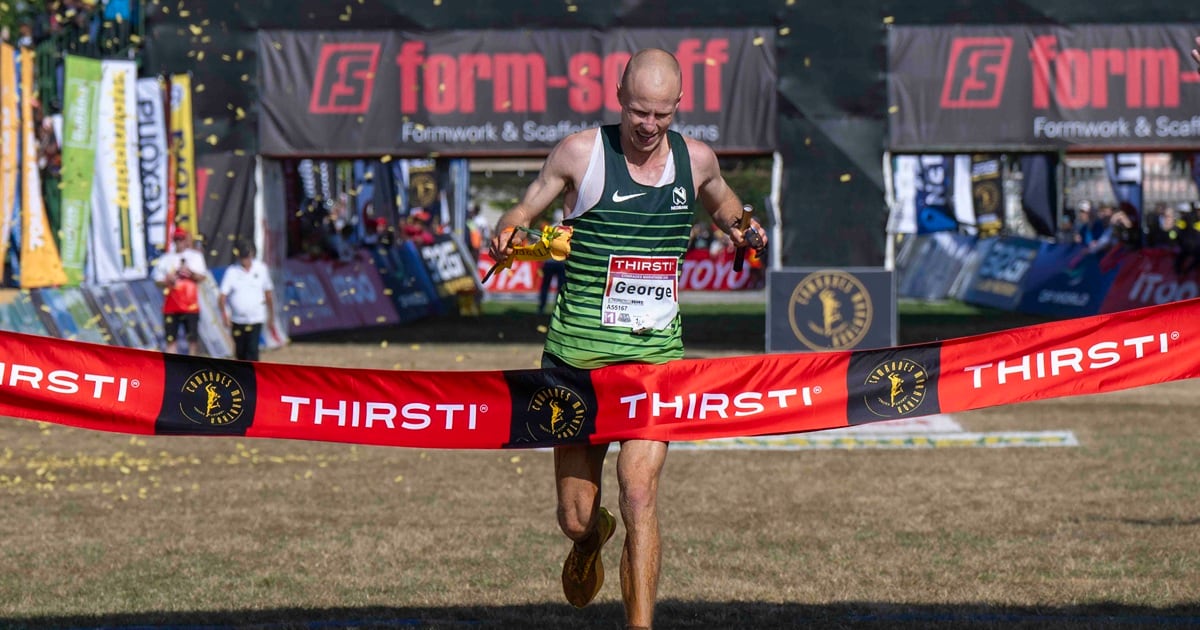

PIETERMARITZBURG – With about 10 kilometres left in the 99th Comrades Marathon, George Kusche was in trouble. His stomach had turned on him – not for the first time in an ultramarathon, not even for the first time in this race – and the question was no longer whether he could run fast. The question was whether he could keep moving at all.
He kept moving. He won.
Kusche, a 27-year-old Pretoria-based data scientist running only his second Comrades, crossed the finish line at Hollywoodbets Scottsville Racecourse on Sunday morning in 5 hours, 15 minutes and 56 seconds – obliterating the men’s Up Run record of 5:24:49 that Russian Leonid Shvetsov had held since 2008. In the women’s race, Gerda Steyn did what she has done every year since 2022: she won, finishing in 5:44:53 to break her own women’s Up Run record and claim her fifth Comrades title in what has become less a competition and more a coronation.
Together, the two South Africans rewrote the record books on the 85.77-kilometre route from Durban to Pietermaritzburg and earned more than R2 million each in prize money for doing so. But the manner of their victories could not have been more different – and that contrast is where Sunday’s race found its drama.
Kusche’s win was not supposed to happen this way. The early pace was set by Mashau Rasogo, who bolted to the front before cramping and dropping out barely an hour in. Jobo Khatoane of Lesotho and Samuel Moloi of Phantane traded the lead before Mbuti Mollo of Maxed Elite usurped them both, holding position deep into the race until his legs gave out and left him walking with 10 kilometres remaining. That was the moment Kusche passed him. That was the moment the race was won.
Defending Up Run champion Piet Wiersma of the Netherlands finished second in 5:19:45, and Mollo – having somehow recovered enough to keep running – held on for third in 5:21:40. Both men finished inside the old record time, which says something about the standard of Sunday’s race and perhaps something about Kusche’s pace, which dragged the entire field faster than it had ever been dragged before.
“That was the hardest thing I’ve ever done,” Kusche told reporters after crossing the line, his voice carrying the particular flatness of a man who had recently been through something he was still processing. “I knew I was taking a gamble.”
The gamble was in the pacing. Kusche, according to TimesLive, took the lead only with 10 kilometres remaining – an eternity in ultramarathon terms, a blink in terms of the damage already accumulated. He is self-coached, which in a race this old and this storied is its own kind of statement. He studied actuarial science at university in the United States, came to ultra-distance running from a track background, and ran the 2025 Comrades as a 12th-place debutant while battling vomiting at the halfway mark. Sunday was his second attempt. He won the race. He broke the record. He did it through a stomach upset and a 10-kilometre gamble and a refusal to let either one of those things be decisive.
His prize money reflected the magnitude of what he had done: R925,000 for the win, R242,000 for being the first South African to finish, R605,000 for breaking the course record, and an additional R550,000 for the fastest average pace per kilometre. The total exceeded R2 million.

The women’s race offered a different kind of suspense – not the question of who would win, but the question of how far Steyn would push the record. She is, at this point, in a category of her own. Her competitors said so themselves in the days before the race; eNCA reported their assessment as one of collective resignation. She has won the Two Oceans Marathon seven consecutive times. She has now won Comrades five times. Like Nelly Korda’s recent run of major titles in women’s golf, the question has shifted from whether Steyn will win to whether any rival can identify a weakness to exploit. She runs the Up Run from Durban to Pietermaritzburg with a smile that her rivals describe as the most disconcerting thing about her – a physiological quirk that turns out to be a tactical weapon, because it makes it impossible to tell how much she is suffering.
On Sunday she broke her own Up Run record of 5:49:46 set in 2024, finishing more than four minutes faster. The prize money structure mirrored Kusche’s: R925,000 for the win, R605,000 for the course record, and R550,000 for breaking her own fastest average pace record of 4:04.28 minutes per kilometre set in 2024. Her total payout was R2.08 million.
The race was also the 50th Up Run – the Comrades alternates direction each year – and the occasion added a layer of significance to performances that would have been historic in any context. Kusche’s men’s record broke a mark that had stood for 18 years across different editions and different course configurations. What makes the comparison meaningful is that Shvetsov’s 2008 record was set on a course approximately 800 metres longer than Sunday’s route; Kusche, even accounting for that difference, ran faster by a margin that makes the comparison academic. He was simply quicker.
For South African athletics, Sunday’s results carry a particular weight. The country has produced distance running champions for decades, but the combination of Steyn’s sustained dominance – now entering its fourth consecutive year at Comrades – and Kusche’s emergence as a potential generational talent in his own right suggests something is happening in the country’s ultra-distance ecosystem. What that something is, precisely, remains unclear. Kusche is self-coached. Steyn runs for Hollywood, Kusche for Nedbank. There is no single programme or system to point to. There is, for now, just the results. As distance runners know, the road eventually reveals everything.
The 99th Comrades drew 515 police officers from all nine South African provinces to the route, alongside the roughly 22,000 entrants who started the race each year. KwaZulu-Natal Police Commissioner Nhlanhla Mkhwanazi, welcoming officers ahead of the race, told Eyewitness News that they were not running for themselves but for the badge of the South African Police Service – a comment that revealed something about the race’s place in South African public life, where an ultramarathon doubles as a vehicle for institutional credibility and community trust.
The 100th edition of the Comrades – a centenary race of considerable symbolic weight – is scheduled for next year. Steyn has made no public statement about whether she intends to run it. The question of who, if anyone, can stop her is one her competitors have already been asked and cannot answer. The question of whether Kusche can repeat Sunday’s performance on the Down Run – the reverse route from Pietermaritzburg to Durban – is one nobody yet knows how to evaluate. What is known is that both of them, on a winter morning on the roads between KwaZulu-Natal’s two largest cities, ran faster than anyone ever had. The 99th Comrades may be remembered as the race where records fell. It may also be remembered as the race where the 100th began to take shape.