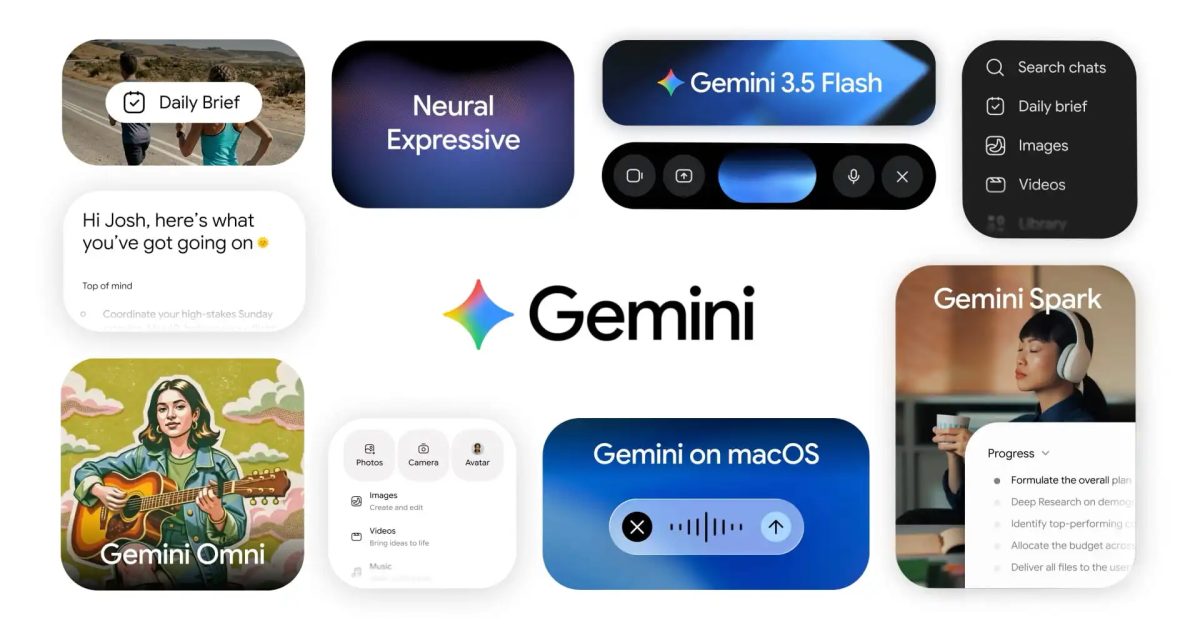

SAN FRANCISCO – There is a moment, early in most people’s experience with Google’s new Gemini Daily Brief, when the feature does something that feels slightly uncanny. It surfaces a scheduling conflict you hadn’t consciously noticed, or flags an email you’d buried under three days of inbox drift, or suggests that the project you’ve been quietly stalling on might be worth attention today. It is helpful in the way that only something with access to your entire professional life can be helpful.
That is exactly the point. It is also exactly what makes it worth examining with more care than the feature’s warm early reviews have managed.
Daily Brief, which Google unveiled at Google I/O 2026 in May, is the company’s attempt to turn Gemini from a reactive chatbot into something that functions more like a personal chief of staff. Each morning, the feature synthesizes a user’s Gmail, Google Calendar, and Google Tasks into a structured digest, organized by urgency, with suggested next steps attached to the most pressing items. The company says it does not merely summarize – it prioritizes, and it recommends. It launched for Google AI Plus, Pro, and Ultra subscribers in the United States, with the lowest entry point sitting at $4.99 a month. The data trade-off that makes it function has no published price at all.
Writers at Android Police and MakeUseOf who have lived with the feature for several weeks described an experience that is, by and large, genuinely useful. The briefs arrive organized by importance, not chronologically. They pull from Google Drive services that were not explicitly advertised as data sources – Docs, Sheets – surfacing context a calendar entry alone would miss. Users can tap individual brief items to inspect which service contributed each piece of information, and they can toggle access per app in Gemini’s Connected Apps settings. The errors that appear tend to be superficial: a misattributed venue, a company name swapped for a partner organization. Annoying, not dangerous, precisely because the reader already knows the underlying facts the AI is trying to assemble.
That last detail matters more than it sounds. Daily Brief works best when you already know your own schedule well enough to catch its mistakes. It is, in other words, a productivity tool optimized for people who are already organized – and a data-collection surface that functions continuously even on days when the digest is not particularly illuminating.
Google has 900 million monthly active Gemini users, the company confirmed at I/O 2026, roughly doubling its figure from the previous year. Not all of those users will activate Daily Brief – the feature requires a paid subscription, and it requires enabling Personal Intelligence, Workspace connections, and Gemini Memory in settings, a chain of opt-ins specific enough that many casual users will never complete it. But for those who do, the scope of what Gemini reads is substantial. Gmail alone contains, for the average professional, the entire correspondence history of a working life.
The privacy questions surrounding Daily Brief are not hypothetical. Google’s standard data handling policies apply to information processed through Gemini, but the company has not specifically disclosed how long the synthesized summaries the feature generates are retained, whether the patterns it learns about a user’s priorities feed into broader model training, or how enterprise data handled in personal Gmail accounts interacts with the Workspace compliance framework. Those are not gotcha questions; they are the basic hygiene disclosures that the AI industry has been avoiding since generative features first began reading private inboxes. Google declined to address them specifically when contacted, pointing instead to its general Gemini privacy documentation.
The feature’s defenders – and there are genuine ones, not merely Google’s marketing apparatus – argue that this concern applies to virtually every productivity tool a modern professional uses. Calendar apps have always read your schedule. Email clients have always indexed your inbox. The difference with Daily Brief is the synthesis layer: an AI model that does not just store your data but actively reasons about it, every morning, and makes judgments about what matters to you today. Whether that represents a qualitative shift in the data relationship or merely a more visible version of what has always been happening is, genuinely, an open question.
What is less open is the feature’s competitive logic. Google’s real competition here is not ChatGPT’s conversational interface or Perplexity’s search layer. It is the habit of starting the morning by opening five different apps, and the specific anxiety that comes with knowing you have probably missed something important. Daily Brief does not claim to solve everything. It claims to solve that. For users whose work lives are built entirely inside Google Workspace – and that is a very large number of people – the argument is difficult to dismiss.
It is also worth noting what Daily Brief is not. It cannot take actions on your behalf; that capability belongs to Gemini Spark, the more ambitious 24/7 background agent Google also announced at I/O 2026 and placed behind the higher Google AI Ultra subscription. Daily Brief tells you what to do. Spark, in theory, does it. The distinction matters because it shapes the privacy exposure: Daily Brief reads your data and presents it back to you; Spark reads your data and acts on it, autonomously, while you sleep. The two features share architecture but occupy very different positions on the spectrum of AI autonomy – and the industry’s track record on communicating that distinction to users is not encouraging.
The Daily Brief feature itself was, notably, not a new idea at Google. The company had attempted a version of it previously under the name Daily Hub, introduced on the Pixel 10 series, and quietly removed it after users found it more disorienting than useful. The I/O 2026 version appears to have addressed the core complaints – better organization, clearer sourcing, more actionable suggestions – but the resurrection of a feature Google once abandoned because users rejected it is itself an editorial data point. The company believes it has solved the interface problem. The underlying data problem was never the interface.
Early users who have written about their experience tend to describe something close to a negotiated peace with that reality. The trade-off is legible, the controls are accessible, and the feature earns its keep on most mornings. One user noted that the errors in their brief were easy to catch precisely because they were already familiar with the underlying facts – which is a polite way of saying that Daily Brief functions as a second opinion on a day you already mostly understand, not as an authoritative oracle of what your day will require. That framing is, perhaps, the most honest account of what useful AI productivity tooling currently looks like: not a replacement for human attention, but a somewhat error-prone assistant that handles the tedious work of sorting so that attention can go somewhere more valuable.
Google has not said when Daily Brief will expand beyond the United States, or when it will reach users on the free tier. What the company has made clear is that the feature requires Gemini Memory to be enabled – a setting that, once active, allows the AI to accumulate a running model of your preferences and priorities over time. The brief gets better as that model deepens. Google’s broader Gemini Spark ambitions rest on the same foundation. The data relationship is not a one-time consent event; it is a continuous negotiation that becomes harder to exit the longer the model learns.
Whether that is a fair trade depends on a question Google has not fully answered: what, precisely, it does with everything Daily Brief learns about you, and how long it keeps what it knows. Most mornings, the digest will be useful enough that the question will not feel urgent. That is, historically, how these trade-offs tend to get made.