
MONTERREY – Mattias Svanberg had been on the pitch for thirteen seconds when he scored. That part of the story was easy. The hard part — the part that will follow this tournament for years — is what made his goal legal.
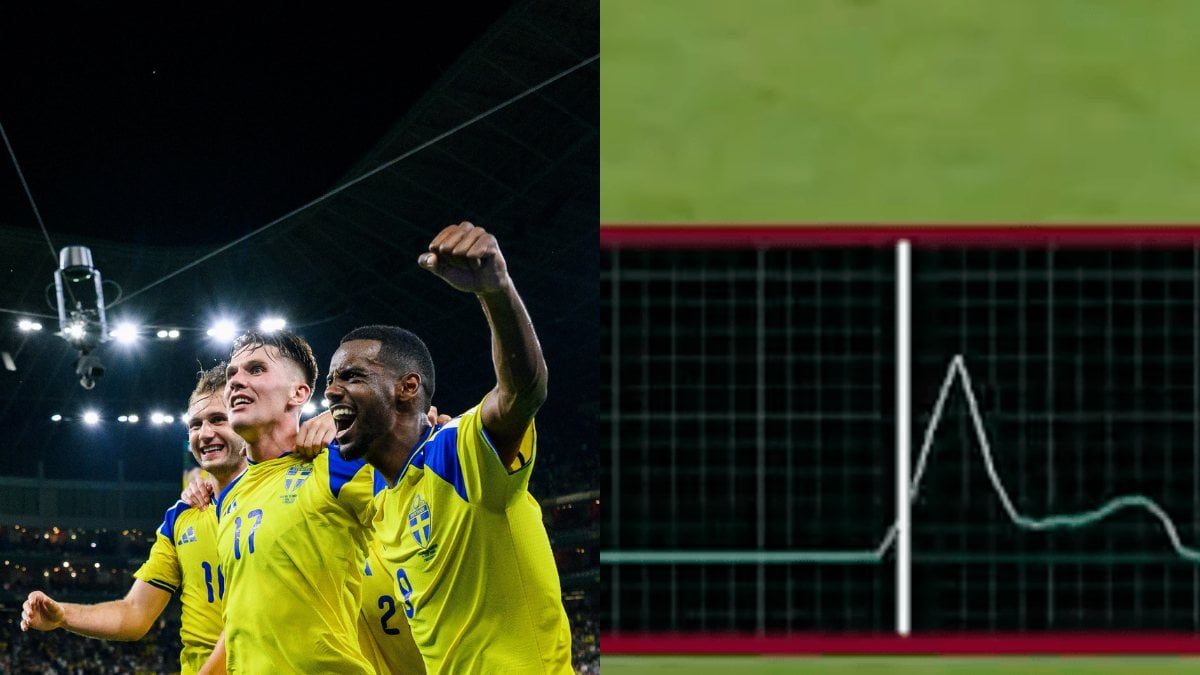
A sensor buried inside the Adidas Trionda match ball detected a contact between the ball and Alexander Isak’s right boot at the precise moment the free kick passed him. The sensor samples movement 500 times per second. The contact it recorded lasted, by broadcast estimates, less than a single frame of broadcast video. No assistant referee saw it. No fan in Estadio BBVA in Monterrey saw it. The Video Assistant Referee team did not see it in the footage. What they saw was a spike on a waveform graphic — a visual readout generated by the ball’s inertial measurement unit — and that spike, rendered in the form cricket has used for decades to catch edges off the bat, is what turned an offside call into a World Cup goal.
Sweden had been cruising toward a comfortable 3-1 victory over Tunisia when the moment arrived. Yasin Ayari’s free kick in the 84th minute found Svanberg arriving at the near post, and the midfielder converted with what appeared to be his first touch of the game. The assistant’s flag went up immediately. Svanberg was in an offside position when the ball was played — that much was not in dispute. What was disputed was whether anyone else had touched it between Ayari’s boot and Svanberg’s.
Graham Potter’s coaching staff argued from the touchline that Isak, cutting across the delivery path, had deflected the ball. If Isak touched it last, Svanberg’s position at the moment of the free kick was irrelevant; the offside clock would reset. VAR checked, and saw what the eye could not. The waveform showed a spike as the ball passed Isak. Sweden’s fourth goal stood.
By the time Ayari added his fifth in stoppage time — another long-range strike, emphatic enough to require no technological interpretation — the Svanberg moment had already spread. Broadcasters showed the waveform graphic on loop. Commentators invoked cricket’s Snickometer, the audio-amplification tool that detects bat-on-ball contact through vibration spikes. The comparison was immediate and accurate.
What neither the broadcast nor the post-match discussion properly addressed was the deeper problem it introduced.
In cricket, the Snickometer exists to resolve one question: did the ball touch the bat? The answer is binary and confined. The consequence — one fielder’s catch, one bowler’s wicket — is local. In football, the same logic now operates under entirely different stakes. A deflection detected by a microchip at 500Hz does not just settle an offside dispute. It redefines what a “touch” is. If a contact too faint for any human sense organ to register constitutes a touch in law, then the game has outsourced the definition of a basic fact to instrumentation that operates beyond the range of human perception. That is a structural change, not a refinement.
FIFA has deployed connected ball technology since Qatar 2022. The principle has been well-publicized: the Trionda ball’s IMU sensor, co-developed with Adidas and Lenovo — named FIFA’s official technology partner for the 2026 tournament — transmits positional and contact data to VAR in real time. The system previously identified a micro-touch by Cristiano Ronaldo on a free kick in Qatar that was initially credited to Bruno Fernandes, and detected a handball in the build-up to a Romelu Lukaku goal at Euro 2024. Each of those instances involved detectable contacts — touches that, with sufficiently slow-motion replay, might at least have been visually confirmed. The Svanberg incident may represent something qualitatively different: a contact whose existence is asserted entirely by the instrument, with no secondary verification possible.
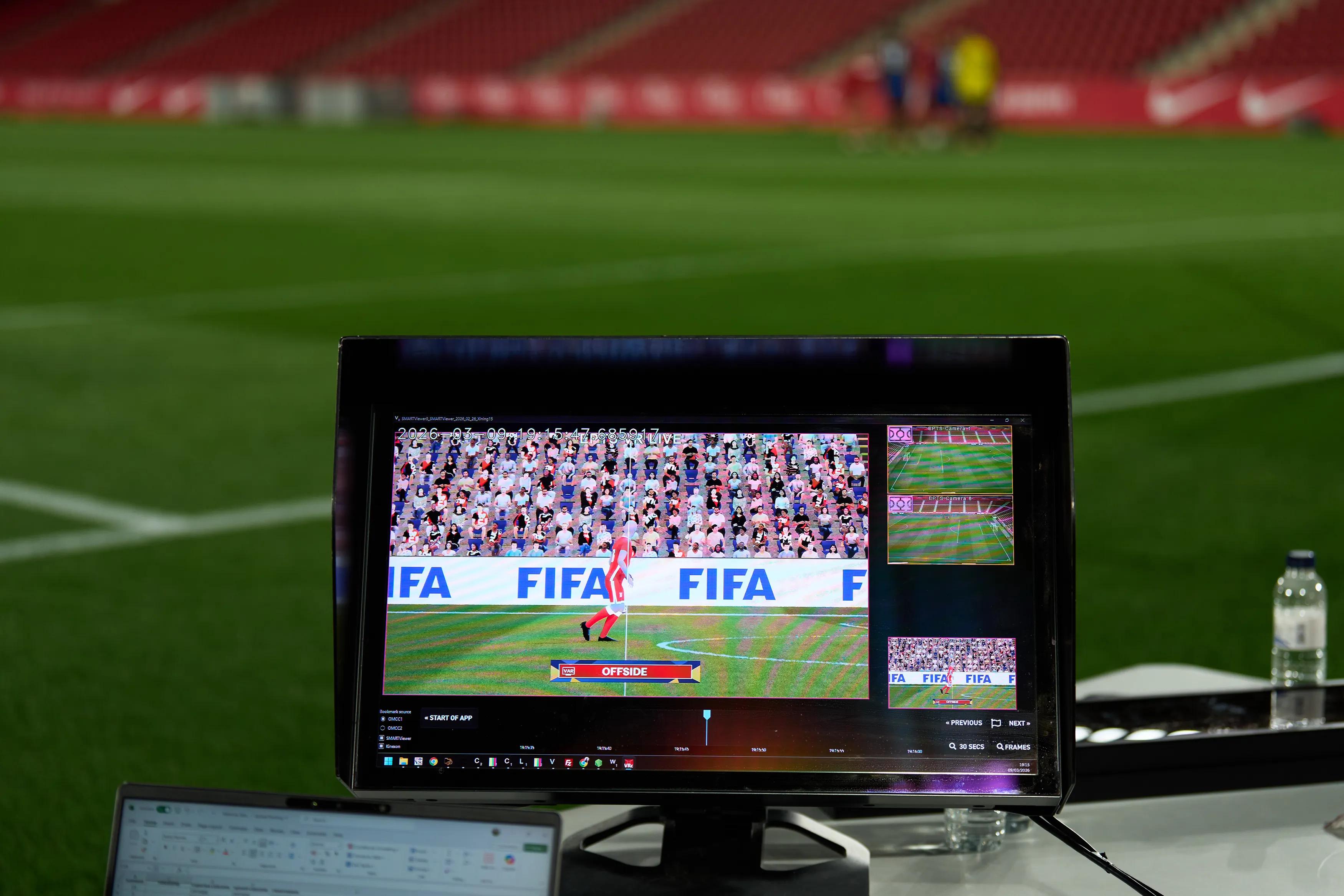
FIFA’s Director of Innovation Johannes Holzmüller, speaking ahead of the tournament, confirmed that the 2026 system has been further refined and now works in concert with Advanced Semi-Automated Offside Technology. Every player in the field has been 3D-scanned, with digital avatars fed into the offside system for precision body-part tracking. What Holzmüller did not say — and what Monterrey now forces the question — is what threshold of physical contact qualifies as a touch under the laws of the game, and who sets it.
There is a legitimate counterargument. Officiating has always been constrained by the limits of human perception, and technology has consistently narrowed those limits in beneficial ways. Goal-line technology ended decades of controversy over whether balls had crossed the line. Semi-automated offside ended the minutes-long freeze where players could not celebrate while a line was drawn on a screen. The case for the microchip is that it does not change football’s rules; it simply executes them more precisely. If Isak touched the ball, he touched it. The sensor detected the touch. The goal was correct.
What that argument cannot quite account for is the difference between precision and resolution. A human referee calling a foul is exercising judgment within the range of what humans can perceive, agree on, and dispute. A sensor calling a touch at a resolution where human perception cannot follow has stepped outside that range entirely. The game’s authority over its own facts has shifted — subtly, officially, and with very little public debate.
Sweden ended the night top of Group F with a result as emphatic as their performance. Isak and Viktor Gyökeres combined with the fluid interplay that made them one of the tournament’s most anticipated attacking partnerships, and Ayari’s long-range double was the kind of display that earns players transfer column inches before a group stage has concluded. As Japan and the Netherlands drew 2-2 in the same group earlier in the day, Sweden’s goal difference could matter significantly before the group is resolved.
Tunisia left Monterrey with a fair set of grievances and a goal deficit that does not reflect how competitive this match was through its first half-hour. The question they cannot resolve — whether Svanberg’s goal should have stood — may not be answerable by anyone except the machine that ruled on it. FIFA’s authority over the laws of the game has never been more complete, or more difficult to interrogate.
That is the part of Monday night worth sitting with. Not whether the technology worked. It almost certainly did. But whether the game has thought carefully enough about where its own facts end and its instruments’ facts begin.