
SEOUL – Three months ago, SK Hynix was quietly discussing a potential U.S. listing at around $14 billion. When the company confirmed its plans this week, the target had grown to $29.65 billion. The gap between those two figures is a precise measure of how dramatically AI infrastructure ambitions have inflated since March, and of how completely SK Hynix has positioned itself at the center of every major AI investment made anywhere on the planet.
The South Korean memory maker said Wednesday it plans to sell American depositary receipts on the Nasdaq Global Select Market, with trading expected to begin July 10, subject to regulatory approval. At the top of its range, the offering would surpass both Saudi Aramco’s $25.6 billion IPO in 2019 and Alibaba Group’s $21.8 billion New York debut in 2014, making it the largest ADR transaction in history, CNBC reported. Bookbuilding is ongoing and final pricing has not been set; the $29.65 billion figure represents a ceiling, not a confirmed outcome.
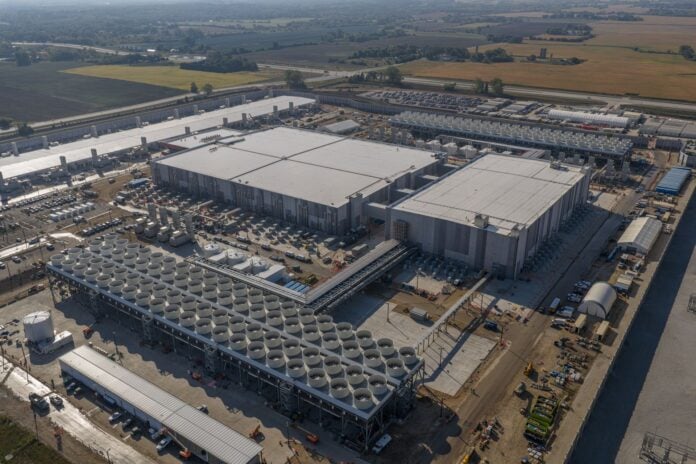
What is not in dispute is what the money is for. Every dollar of proceeds will go toward physical manufacturing capacity: building out the first phase of the Yongin semiconductor cluster on the Korean peninsula, constructing the Cheongju P&T7 advanced-packaging facility dedicated to high-bandwidth memory, and ordering extreme ultraviolet lithography scanners from ASML, the Dutch equipment maker whose machines define the frontier of advanced chip production. A single EUV tool costs approximately $380 million. SK Hynix intends to acquire a fleet of them.
The urgency behind that capital plan runs directly through Nvidia. SK Hynix supplies the HBM3E stacks that sit directly atop the chips inside Nvidia’s H200 and B200 AI accelerators, the processors powering the data centers behind Google Gemini, ChatGPT, and every comparable AI system at scale. The company controls roughly 60 percent of the global high-bandwidth memory market and its entire HBM supply through 2026 is fully contracted. There is no spare inventory at any price a buyer might offer. Nvidia needs more of these chips than currently exist, and SK Hynix has to build the fabs that will produce them.
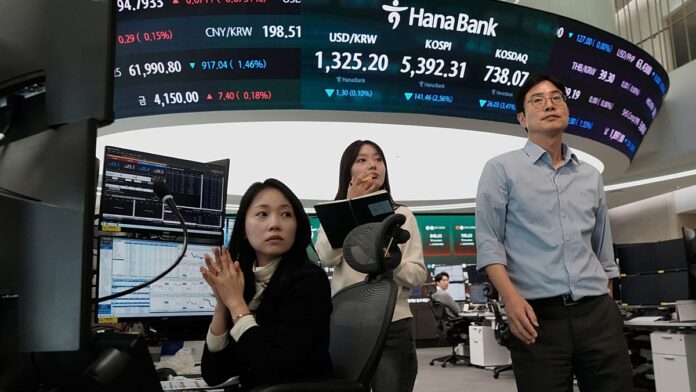
That constraint produced a 12 percent surge in SK Hynix shares on the Seoul exchange when the listing plans were disclosed. A market read not of current quarterly performance but of what it means to control the most critical component in the world’s fastest-growing hardware category. The AI memory supercycle, which TrendForce projects will sustain HBM price premiums through at least 2027, has made SK Hynix’s position worth considerably more than its pre-AI valuation reflected.
The offering structure converts each common Korean share into 10 ADRs, giving U.S. institutional and retail investors direct dollar-denominated exposure without navigating the Korea Stock Exchange. The company said it expects the Nasdaq listing to expand its investor base and allow its true corporate value to be properly evaluated. A pointed remark, given that SK Hynix has historically traded at a discount to Micron Technology on a price-to-earnings basis despite holding a larger share of the AI memory market. Closing that valuation gap is part of what the listing is designed to accomplish.
The competitive picture at the top of the HBM market sharpens the case. Samsung Electronics, which holds the second-largest position in high-bandwidth memory, has struggled to certify its HBM3E chips to Nvidia’s specifications and has ceded market share as a result. SK Hynix has been converting that gap into structural advantage over the past year. Micron Technology holds the remaining slice, reporting last week that its HBM production is also fully sold out through 2026 and projecting quarterly revenue of $50 billion. The memory market is a three-party oligopoly in which all three suppliers are running at capacity, none can fulfill incremental demand, and the largest of them is now seeking $30 billion in capital to build more.
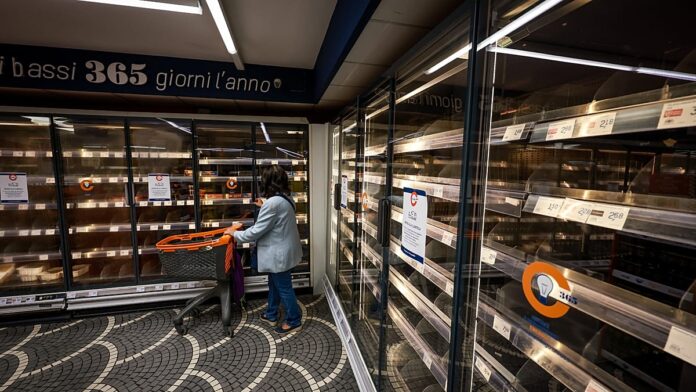
That dynamic has already cascaded beyond the data center. As Apple and Microsoft demonstrated last week when they raised prices on Mac computers, iPads, and Xbox consoles, AI infrastructure demand has crowded out the standard DRAM supply that consumer electronics companies depend on. SK Hynix building new fabs would in theory relieve some of that pressure, but the Yongin cluster is designed to produce more HBM for AI customers, not more DRAM for laptop makers. The consumer electronics industry’s memory problem does not resolve until AI demand growth slows or Samsung closes its HBM qualification gap and frees up mainstream DRAM production.
South Korea’s government has made the semiconductor sector the center of its industrial policy, offering tax incentives and infrastructure support for the Yongin cluster that SK Hynix’s listing proceeds will partially fund. The listing is, in that sense, more than a capital raise. It is a statement about where the company and its government believe the next decade of semiconductor manufacturing leadership will be decided: in the AI memory stack, at the frontier of EUV lithography, at a price that only a listing of this scale can support.
What remains unresolved is the most important variable in the investment case: whether the HBM supercycle sustains. Memory chip markets carry cyclical histories that dwarf almost every other category in semiconductors. DRAM and NAND have moved through boom-bust cycles measured in years, and HBM has so far avoided those dynamics only because supply has been genuinely insufficient against exploding AI demand. That calculus could shift if hyperscaler capital budgets contract, if Nvidia’s next-generation chips prove more memory-efficient than H200, or if Samsung closes the certification gap faster than the market currently assumes. At those inflection points, the economics underpinning a $29.65 billion raise would look considerably different, and the answer to whether SK Hynix has locked in its lead or borrowed against its peak would become considerably more urgent.
The market will begin pricing that question on July 10, when SK Hynix ADRs open on Nasdaq and the world’s leading HBM supplier becomes available to every investor with a U.S. brokerage account. The number that will matter most that morning is not $29.65 billion. It is where the ADRs actually trade.