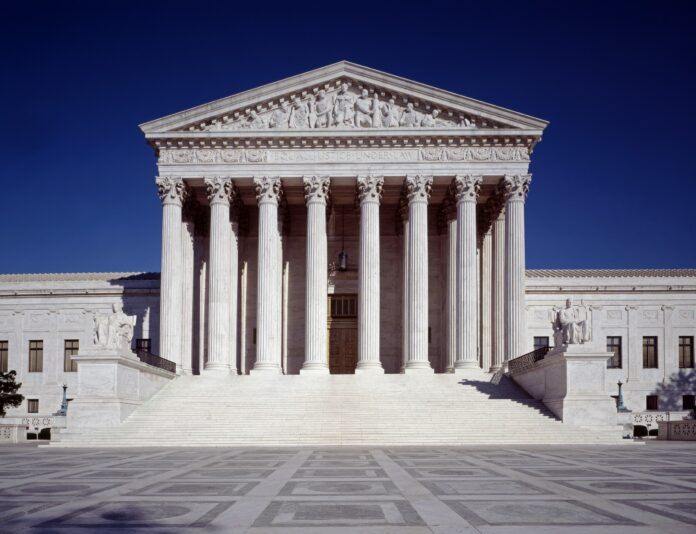
WASHINGTON – She walked for eleven days through southern Mexico to reach the Tijuana port of entry. Border agents met her on the bridge, turned her back, told her to wait in Mexico until there was processing capacity. When the Supreme Court issued its ruling Thursday morning, she was still waiting. She no longer has the right to wait.
In a 6-3 decision in Mullin v. Al Otro Lado (No. 25-5), the Supreme Court held that a person who seeks to enter the United States from Mexico does not “arrive in the United States” while standing on Mexican soil, even if the only reason they have not stepped across is that a U.S. border agent has blocked their path. The ruling allows the federal government to turn back anyone physically stopped at the border before completing entry, without triggering the asylum review process that Congress established in 1980.
The decision, the third immigration ruling the Court handed down Thursday alongside companion cases that stripped TPS protections from 350,000 Haitian and Syrian immigrants, extends the most aggressive expansion of presidential border authority in the Trump era. The White House called the ruling “another tremendous win for border security.”
The case arose from a practice known as metering. Since late 2016, Customs and Border Protection agents physically stationed at ports of entry along the U.S.-Mexico border limited the number of asylum seekers allowed to step across and be processed on any given day. People whose names were placed on waiting lists often remained in Mexican border cities for weeks or months. Al Otro Lado, a Tijuana-based immigration advocacy organization, sued arguing this violated the 1980 Refugee Act, which requires immigration officers to inspect and process anyone who “arrives in” the United States and expresses a fear of persecution. The Ninth Circuit agreed. The Supreme Court reversed.
Justice Samuel Alito, writing for the six-justice majority, framed the question as one of plain English. No one would say a person “arrives in” Chicago while still at the airport, waiting to clear customs. The inspection requirement in the Refugee Act is triggered only once a person physically enters U.S. territory, not while being held at the threshold. The metering policy, Alito wrote, simply “places a limit on the number of noncitizens who may enter on a given day,” a logistical decision within the executive’s statutory authority.
Critics of the ruling called that reading a legal fiction. The metering policy was not a waiting room; it was a physical bar. CBP agents stood on U.S. soil, on the bridge, and told families to turn around. Under Alito’s framework, an agent who tells a family to wait in Nogales indefinitely commits no violation of the asylum statute, no matter how dangerous conditions in the Mexican border city become. The ruling removes the one mechanism asylum seekers had to compel an interaction with U.S. officials: physically crossing.
In dissent, Justice Sonia Sotomayor, joined by Justices Elena Kagan and Ketanji Brown Jackson, called the ruling a dismantling of a protection Congress built deliberately. “The majority reads the statute as if Congress intended for the executive to have complete discretion over who may even attempt to apply,” Sotomayor wrote. “It did not.” She cited House and Senate legislative records from 1980, when lawmakers passed the Refugee Act explicitly in response to U.S. refusals to admit Vietnamese refugees who had reached American shores without documentation, and voiced explicit concern about agents turning people away at the threshold.
The practical scale of the ruling is difficult to overstate. The Trump administration revived and expanded the metering framework through a new CBP One app system, managing border crossing volumes by controlling how many people may present themselves daily. Advocacy groups have estimated that tens of thousands of people are currently waiting in Mexican border cities under these arrangements. Thursday’s ruling means those arrangements now carry explicit Supreme Court endorsement and face no statutory floor.
The American Civil Liberties Union, which filed an amicus brief supporting Al Otro Lado, said the Court had “erased fifty years of asylum law with a grammar lesson.” The ACLU said it was reviewing whether Fifth Amendment due process challenges remain available to people turned away at the border, though Alito’s majority opinion offers limited purchase for that argument: a person who has not legally arrived, under the Court’s reading, has not engaged the constitutional protections that apply on U.S. soil.
Thursday’s ruling joined the TPS decisions and the same-day Wolford v. Lopez gun ruling to form the most consequential single sitting of the Supreme Court since the Dobbs abortion decision in 2022. In the space of a morning, the six-member conservative majority simultaneously reshaped immigration protections for people already living in the country, the rights of asylum seekers not yet inside it, and the scope of concealed-carry law for the forty-five states where carry permits are issued. CNN reported that the Court has additional decisions expected Monday, with birthright citizenship still pending.
For the Trump administration, the asylum ruling validates a legal strategy built across two terms: not to ask Congress to rewrite immigration law but to persuade courts that existing law contains less protection than it appeared to. The 1952 Immigration and Nationality Act and the 1980 Refugee Act were the twin pillars of modern U.S. asylum procedure. Thursday’s ruling removed the pillar that said anyone who reaches the threshold must be permitted to ask.
How Mexico will manage the expected increase in people remaining on its side of the border is a question the ruling does not address. The Mexican government had not commented as of Thursday afternoon. The people waiting in Tijuana, Nogales, and Ciudad Juarez have no appeal in U.S. courts. They are, by the Supreme Court’s definition, not yet here.