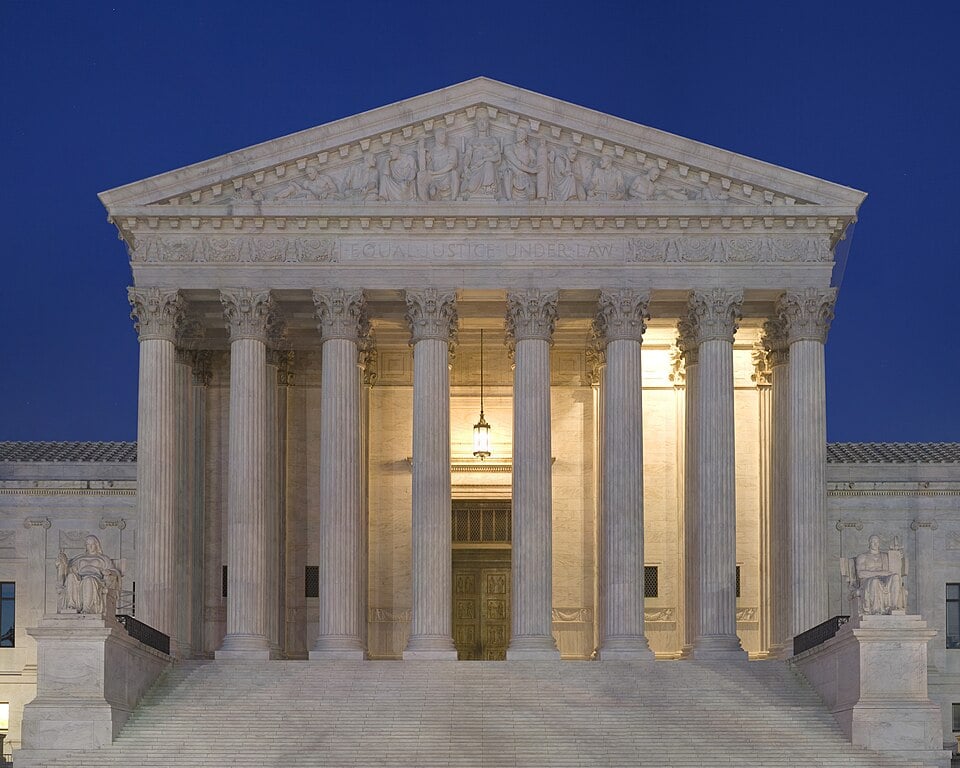

WASHINGTON – In Hawaii, silence used to mean no. A restaurant or gas station that never posted a policy, never told customers where it stood on guns, could count on the state’s rule: firearms were not welcome unless the owner had explicitly said otherwise. The Supreme Court ruled Thursday that arrangement violates the Constitution.
The 6-3 decision in Wolford v. Lopez (No. 24-1046) strikes down Hawaii’s “default-off” firearms law, which required concealed-carry permit holders to obtain the express and affirmative consent of property owners before bringing guns into any private business open to the public. Justice Samuel Alito, writing for the court’s conservative supermajority, found that the requirement “hobbles what the Second Amendment protects: the right of Americans to carry arms for self-defense as they go about their daily lives.”
The same six justices (Roberts, Thomas, Alito, Gorsuch, Kavanaugh, and Barrett) handed down the ruling in the same session that produced two other 6-3 decisions stripping deportation shields from 350,000 Haitian and Syrian immigrants. The court’s final weeks of the term have become a rolling expansion of executive and individual conservative priorities, with gun rights and presidential immigration power advancing on the same morning, by the same votes.
The practical reach of Thursday’s ruling extends well beyond Hawaii. California, New Jersey, Maryland, Illinois, Delaware, Massachusetts, Rhode Island, and Colorado all have laws with similar or identical “default-off” architecture, requiring affirmative opt-in from property owners before gun owners may carry. Everytown for Gun Safety, which tracks Second Amendment litigation nationally, said the ruling “puts at risk similar default-no laws in states across the country” and predicted immediate legal challenges to each of them.
The plaintiffs in the case were Maui residents who held state-issued concealed-carry permits. Under Hawaii law, those permits granted the legal right to carry, but required, at every business and public space, that the holder seek the owner’s affirmative blessing before entering armed. They argued the requirement was so burdensome it effectively nullified the right the permit was supposed to confer. Alito agreed.
The opinion extended the reasoning from New York State Rifle & Pistol Association v. Bruen (2022), the landmark ruling that required all gun regulations to be consistent with the nation’s historical tradition of firearm regulation, a test demanding specific historical analogues, not merely an argument that a law serves public safety. Hawaii had pointed to colonial and early American statutes restricting gun-carrying in certain contexts, and argued that its island geography and history justified stricter baseline rules. Alito rejected both. The colonial laws cited were narrower than Hawaii’s sweeping default prohibition, he found, and no state may invoke “unique” local conditions to evade constitutional requirements that apply nationally.
Property owners were not left without recourse. The ruling does not grant gun owners an affirmative right to enter any business armed. What it converts is the default: where before a business’s silence meant guns were prohibited, it now means they are permitted. Businesses that want to ban firearms retain full constitutional authority to do so; they must post a sign, or otherwise communicate the policy, rather than relying on the state to do it for them.
The three liberal justices dissented along two distinct lines. Justice Elena Kagan wrote alone that the historical record disproved the majority’s core claim. She cited colonial and founding-era laws requiring affirmative consent from property owners before anyone could enter armed, arguing Hawaii’s rule was “a modern-day analogue” of those traditions, precisely the kind of precedent the court’s own Bruen test was meant to validate, not override.
Justice Ketanji Brown Jackson, joined by Justice Sonia Sotomayor, went further, rejecting the framing entirely. “There is no constitutional right to enter private property without the owner’s permission, let alone with a firearm,” Jackson wrote. Her dissent recast the case as a property-rights dispute that the majority had forced into a Second Amendment mold. Hawaii’s law, she argued, “fairly applies a first principle of property law, the right to exclude, and does no harm to the Second Amendment.” Under this reading, a ruling against Hawaii was not a ruling for gun owners; it was a ruling against property owners who now shoulder a burden the state used to carry for them.
The majority’s answer to Jackson’s argument was embedded in the outcome: gun owners’ right to carry through the public sphere is weighty enough to convert that burden to the other side.
Thursday’s decision was the fourth major Second Amendment ruling handed down by the court’s conservative bloc since Bruen established the historical-tradition test four years ago. The prior decisions addressed New York’s may-issue permitting regime, bump stocks, and ghost-gun kits. Each has expanded the constitutional floor below which state legislatures cannot regulate, and narrowed the legal ground on which they can act. CBS News reported that additional Second Amendment cases remain pending before the court, which has not yet announced a final recess date for the current term.
What the ruling does not answer is how ordinary commercial life adjusts. A diner in Honolulu that never considered its gun policy now faces a decision the state used to make on its behalf. Whether most Hawaii businesses choose to post prohibition signs, and whether the same calculus repeats across California, New Jersey, and Maryland once legal challenges arrive, is an empirical question Thursday’s ruling created but left entirely open.