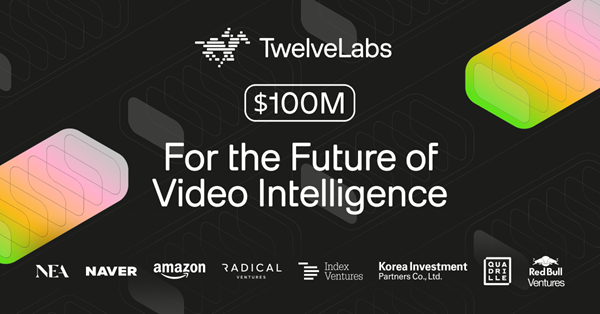

SAN FRANCISCO – The most important unsolved problem in enterprise AI is not generating images or writing code. It is making video searchable the way Google made text searchable in 1998. A five-year-old startup spent its entire existence working on that problem, and on Tuesday it secured $100 million and a hardware commitment from one of the world’s three largest cloud providers.
TwelveLabs, which builds software that allows machines to understand what is happening in video content, announced on July 1 that it closed a $100 million Series B co-led by NEA and NAVER Ventures, with Amazon participating directly as an investor alongside Radical Ventures, Korea Investment Partners, Index Ventures, Quadrille Capital, and Red Bull Ventures. The round brings the company’s total known funding to approximately $150 million. No valuation was disclosed.
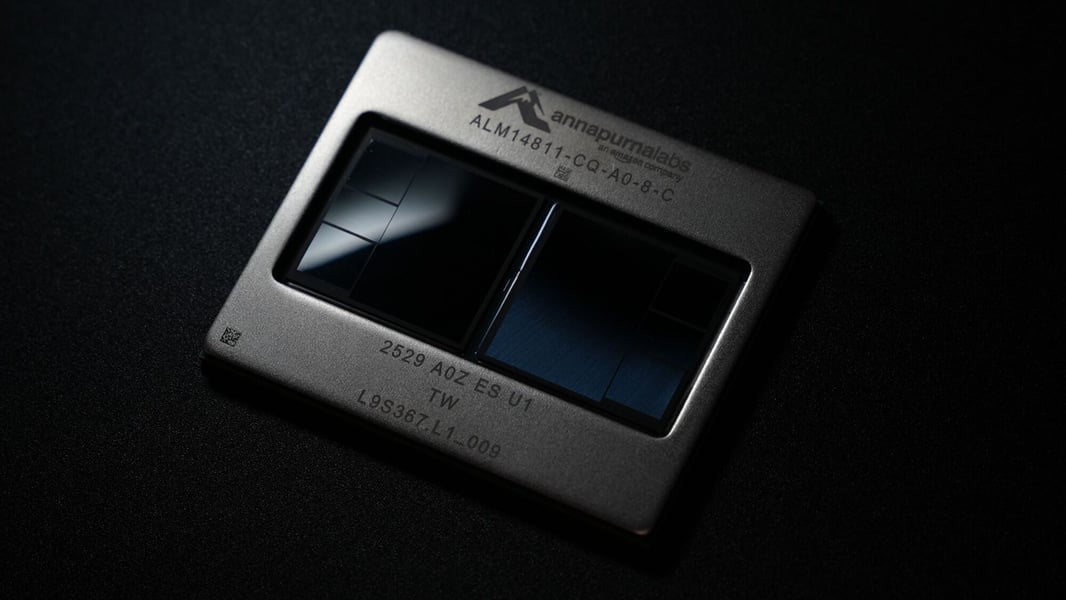
The more revealing part of the announcement was not the fundraise. Amazon Web Services has signed a multiyear commitment to serve as TwelveLabs’ preferred cloud provider, with the company’s video inference workloads to be optimized specifically for AWS Trainium chips, Amazon’s in-house AI accelerator built to reduce reliance on Nvidia for inference tasks. New TwelveLabs models will launch first on AWS before becoming available elsewhere. That arrangement, combined with Amazon’s direct equity stake in the round, gives the infrastructure partnership a financial incentive that straightforward cloud contracts do not carry.
To understand why that deal carries weight, it helps to understand what TwelveLabs actually builds. The company’s core platform sits at the intersection of video and multimodal AI, allowing organizations to run semantic search, automated scene analysis, and entity extraction across raw video content without manual tagging. Its Marengo 3.0 model handles video embedding, processing audio, on-screen text, and motion together rather than as separate streams. Pegasus 1.5 converts those signals into structured data: scene boundaries, named entities, temporal segments. Together, they allow a broadcaster to search 20 years of unlabeled game footage for a specific play, or let a security operator query a surveillance archive by describing what they are looking for in plain language.
That framing places TwelveLabs in direct competition with Google’s video understanding capabilities, specifically its Vertex AI Video Intelligence API and the AI-powered search features built into YouTube. Google has been working on this problem for years and owns the largest labeled video dataset on earth. TwelveLabs CEO Jae Lee, who co-founded the company in 2021, argues that Google’s approach carries a structural ceiling: its video models were built on top of language models adapted to process frames, inheriting the limitations of systems not designed for video natively. Lee describes TwelveLabs’ architecture as “genuine multimodality,” meaning models built from the ground up to treat video as a first-class data type rather than a sequence of still images with audio attached. Whether that architectural choice translates into meaningfully better enterprise results is the claim the $100 million is meant to prove.
AWS Trainium is central to the performance argument. Amazon has invested heavily in Trainium as an alternative to Nvidia’s GPU-dominated AI inference market, and TwelveLabs’ commitment to optimize its workloads specifically for Trainium chips is useful proof for Amazon that its custom silicon can attract serious AI companies. As Eastern Herald reported last week, Nvidia itself has begun offering revenue-sharing financing arrangements to cloud operators partly because competition from AWS Trainium and Google’s TPUs is compressing its grip on AI inference infrastructure.
The fundraise also coincides with TwelveLabs moving beyond API infrastructure. The company announced Rodeo alongside its funding round, its first application-layer product, marking a strategic shift toward end-user software. That move mirrors a path several AI infrastructure companies have taken in recent years, with results that vary considerably depending on whether their enterprise sales capabilities match their engineering ones.
With the new capital, TwelveLabs plans to expand from its current bases in San Francisco, Seoul, and Los Angeles into New York and London, targeting media companies, government and defense agencies, automotive companies, and sports organizations, all of which hold large video archives that currently require human labor to organize and search. The company has made its models available on Amazon Bedrock for more than a year, giving AWS a concrete commercial interest in TwelveLabs’ continued model development that predates this announcement.
NAVER Ventures, which co-led the round alongside NEA, is the corporate venture arm of NAVER Corporation, South Korea’s largest internet company. The involvement reflects a wider pattern of Korean technology companies placing strategic bets on AI infrastructure plays, a trend that also includes Samsung in discussions with Anthropic on custom chip manufacturing. Anthropic is exploring a custom 2nm chip built with Samsung that would give it some independence from Nvidia’s supply chain. TwelveLabs is operating inside the same infrastructure consolidation dynamic, with Amazon’s hardware investment representing its version of a bet that custom silicon and preferred-provider arrangements will define where serious AI workloads run.
What TwelveLabs has not published is any figure that would allow an outside assessment of whether its traction justifies the round on its own merits: no revenue numbers, no customer counts, no utilization metrics for Marengo and Pegasus in production. The commercial case rests partly on CEO Lee’s articulation of the company’s thesis, drawn directly from the announcement: “Models commoditise. The intel layer that composes them does not.” That argument is made by every AI infrastructure company raising at scale in 2026. The specific test for TwelveLabs is whether its video-native architecture is genuinely harder to replicate than the competition believes, and whether Amazon’s multiyear cloud commitment will hold if its infrastructure competitors offer more favorable terms for the workloads it just promised to run on Trainium. The funding answers neither question.