BEIJING – Sixty-five years after two ideologically aligned states signed a pact that helped define the Cold War’s Asian architecture, China and North Korea marked the anniversary on Friday with an exchange of personal messages carrying a pointed contemporary signal: their alliance remains bound, above all, by shared opposition to American influence in the region.
Chinese President Xi Jinping and North Korean leader Kim Jong Un exchanged congratulatory letters to mark the 65th anniversary of the Treaty of Friendship, Cooperation and Mutual Assistance, sealed in Beijing on July 11, 1961, a document that obligated China to defend North Korea in the event of foreign attack. Xi used the occasion to pledge three unchanging commitments: to preserve the traditional friendship between the two nations, to continue supporting the direction Kim has set for the country, and to safeguard their mutual interests against outside pressure, according to Xinhua.
Kim responded by reaffirming the DPRK’s support for China’s position on Taiwan, aligning Pyongyang publicly with Beijing’s most sensitive territorial claim.
The exchange arrives as both countries navigate intensifying economic and strategic pressure from the United States and its allies. Xi urged the two sides to maintain what he called “strategic resolve” and “strategic confidence,” a pairing of terms that signals not passive endurance but coordinated defiance of Western-led structures.
The anniversary holds particular weight this year. Xi made a state visit to Pyongyang in June 2026, his first trip to North Korea in years, which produced a joint statement on security cooperation. Friday’s messages appeared to translate the spirit of that visit into something more durable: a reiteration, in writing, that neither side intends to be separated from the other by diplomatic pressure or economic inducement.
The 1961 treaty was a product of its era, conceived when the Korean War had ended less than a decade earlier and Mao Zedong and Kim Il Sung were building a relationship forged in shared sacrifice on the peninsula. Much has changed since then. China has become the world’s second-largest economy, with global trade relationships that create tensions with Pyongyang’s international isolation. North Korea has developed nuclear weapons that occasionally unsettle Beijing. And yet the treaty has never been formally revised or abrogated.
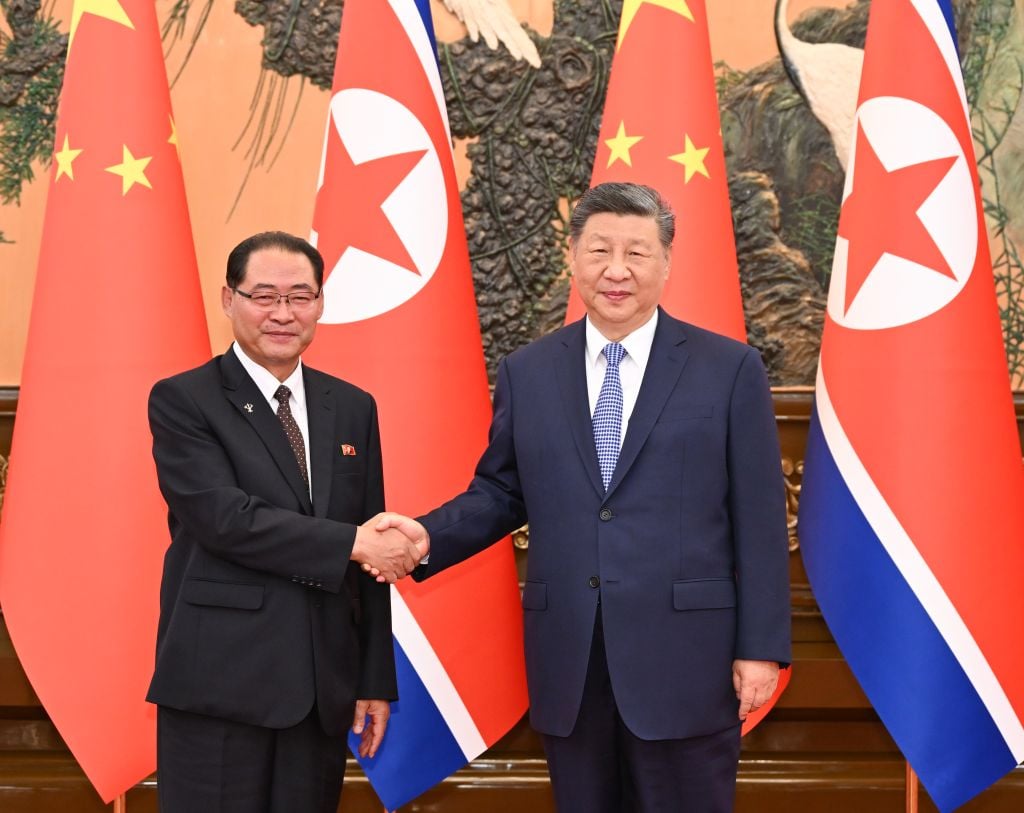
Analysts who study the relationship describe it as simultaneously strong and complicated. China remains North Korea’s economic lifeline, accounting for the overwhelming share of Pyongyang’s external trade, while also being the country most capable of moderating North Korea’s behavior, a role Beijing exercises with considerable discretion. What Xi chose to emphasize on Friday was the alliance’s permanence, not its tensions.
Kim’s statement on Taiwan was the detail that carried the most immediate significance. North Korea does not have diplomatic ties with Taipei and has consistently supported Beijing’s position that Taiwan is an inalienable part of China. The explicit reference in a bilateral anniversary message gives that formulation a sharper edge at a moment when Taiwan has emerged as the most contested geographic question in Asian security. For Washington, which maintains a policy of strategic ambiguity over its obligations to defend the island, North Korean solidarity with Beijing is a useful reminder of the bloc dynamics shaping the Pacific.
The exchange did not occur in isolation. North Korean Premier Pak Thae-song arrived in Beijing this week for a separate three-day visit aimed at deepening economic cooperation, a parallel track of engagement that reinforces the impression of an alliance operating on multiple registers simultaneously.
North Korea’s weapons development has advanced substantially since the 1961 treaty was written. Pyongyang now possesses intercontinental ballistic missiles capable of reaching the continental United States and has declared itself a nuclear power. The treaty’s mutual defense clause, once a meaningful form of Chinese security guarantee to an outgunned ally, now covers a state with significant deterrent capacity of its own. What Pyongyang still needs from Beijing is not a defense umbrella but economic oxygen, and what Beijing gains from Pyongyang is a heavily armed buffer state and a useful instrument for signaling to Washington.
Xi’s language on Friday, built around three “unchanging” commitments, was structured to convey permanence regardless of external pressure. The choice of that word has appeared in Chinese diplomatic messaging toward allies and partners before, functioning as a rhetorical countermeasure against the suggestion that sanctions or diplomatic isolation can erode the relationship.
Whether such language reflects a deep and tested commitment or a form of reassurance calibrated to this particular anniversary is a question that cannot be answered from the text of congratulatory messages alone. North Korea has, at various points, been a source of genuine discomfort for Beijing, conducting nuclear tests without warning China and engaging in diplomatic gambits with Washington that Beijing did not fully control. Xi’s June visit to Pyongyang sought to recalibrate the relationship and reassert Chinese centrality. Friday’s anniversary exchange sustained that message.
What the 65th anniversary cannot settle is whether the alliance will remain functional as North Korea’s nuclear status grows more established and its bargaining position becomes more complex. The 1961 treaty was written for a different North Korea. The state it now governs, nuclear-armed and isolated by sanctions, has both more leverage and more unpredictability than the framers of that document anticipated.
The congratulatory exchange was transmitted through official channels, consistent with prior practice, and contained no new operational commitments and no announcement of a summit. It was, by design, a statement of continuity, marking a milestone while projecting forward the bond that milestone represents.