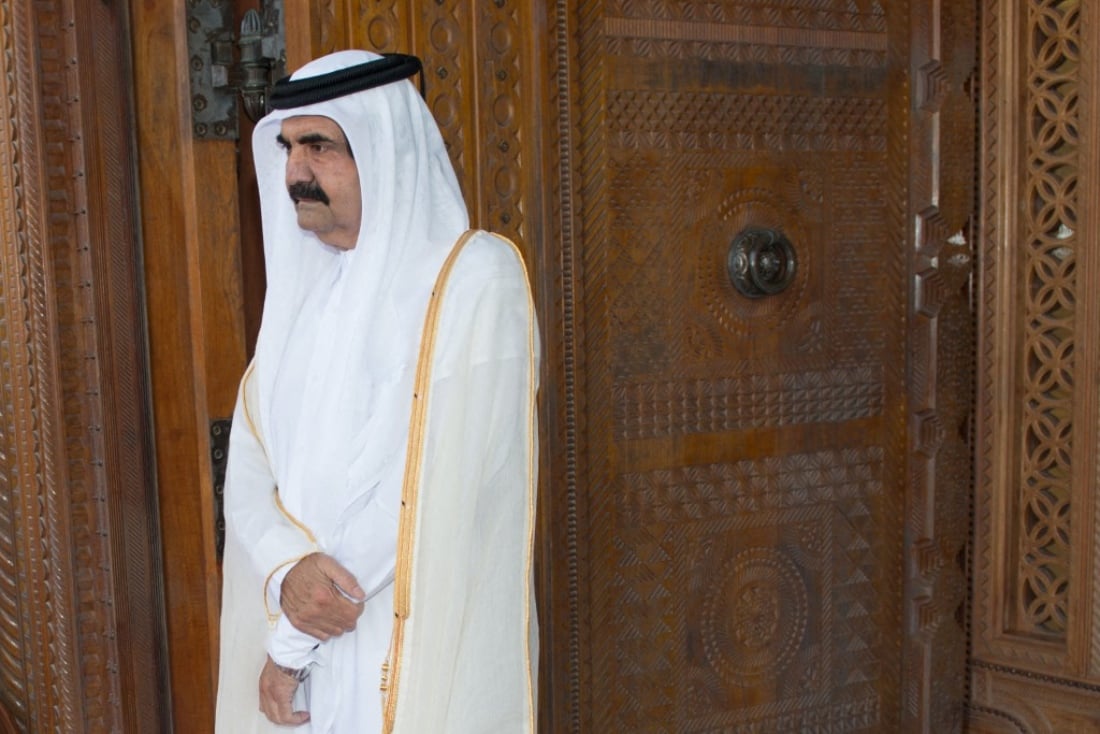

DOHA – He came to power by deposing his own father, then left by handing the throne to his son. Sheikh Hamad bin Khalifa Al Thani, the former Emir of Qatar who transformed a gas-rich Gulf sheikhdom into one of the most consequential small states in the world, died Sunday. He was 74.
Qatar’s Amiri Diwan, the nation’s top governing body, announced his death in a statement released Sunday morning. “The Amiri Diwan mourns the great loss to the nation of the late, may God have mercy on him, His Highness the Father Amir Sheikh Hamad bin Khalifa Al Thani, who passed away this morning,” the court said, in an announcement confirmed by Al Jazeera. No cause of death was announced.
He is survived by his son, Emir Sheikh Tamim bin Hamad Al Thani, who has led Qatar since 2013, and by his second wife Sheikha Mozah bint Nasser Al Missned, one of the Arab world’s most prominent advocates for education and humanitarian causes.
The man Qataris called the Father Amir held power for eighteen years that compressed a generation’s worth of transformation into a single reign. In June 1995, while his father, Emir Khalifa bin Hamad Al Thani, was abroad on vacation, Sheikh Hamad moved. The palace coup was bloodless. The old Emir did not return to Doha. Qatar had a new ruler.
Within a year, he licensed what would become Al Jazeera. Launched in 1996 with Qatari state funding, the 24-hour Arabic satellite news channel brought live war coverage and adversarial political debate into Arab living rooms at a scale state broadcasters had never permitted. Governments from Cairo to Riyadh condemned it. Millions of viewers made it essential. The network later launched English-language programming and reshaped how the Arab world consumed news.
Al Jazeera was only the most visible expression of a broader design. Qatar’s natural gas reserves, among the largest in the world, were monetized at scale. A sovereign wealth fund grew to hold stakes in global companies and prominent real estate. Hamad International Airport, museums, and universities appeared across Doha. The Qatar Investment Authority became one of the world’s most influential state funds.
He pursued a foreign policy that consistently unsettled his neighbors. Qatar under Sheikh Hamad maintained open lines with Iran, hosted the political bureau of Hamas, and later opened diplomatic channels with the Taliban at a time when Western governments were demanding isolation. Doha became the city where adversaries who refused to meet directly could nonetheless sit across a table. Qatar’s mediation between the United States and Iran would extend well beyond his reign.
In 2010, FIFA awarded Qatar the rights to host the 2022 World Cup, the first time the tournament would be held in the Arab world. The decision drew years of controversy, including allegations tied to the bidding process and sustained criticism over labor conditions that the Qatari government disputed. The tournament took place regardless, in a country that had barely registered on global maps when Sheikh Hamad first came to power.
The decision that set him apart from nearly every Arab leader of his generation was not the coup. It was what followed eighteen years later. In June 2013, Sheikh Hamad summoned members of the Al Thani family and announced he was stepping down, handing full authority to his then-33-year-old son Tamim. No health crisis had precipitated the move. No political pressure had made it necessary. He chose to go.
Voluntary abdications are without precedent in modern Arab monarchies. The transfer was smooth, public, and deliberate. India’s support for Qatar’s sovereignty and the continued role Doha has played as a diplomatic hub reflected an architecture that survived the transition because it had been built to survive it.
Since stepping down, Sheikh Hamad had remained a figure of symbolic weight, present at state occasions while leaving governance to his son. The mediation role Qatar has continued to play in Gaza negotiations and in the broader Iran file built directly on diplomatic foundations his reign established.
No cause of death has been announced. No official condolences from foreign governments had been formally published at the time of this report. Qatar has not released details of funeral arrangements.
What remains is the country he shaped: the news network, the stadiums, the sovereign fund, the foreign policy that refused alignment. None of that required his presence to continue. That, too, was part of what he built.