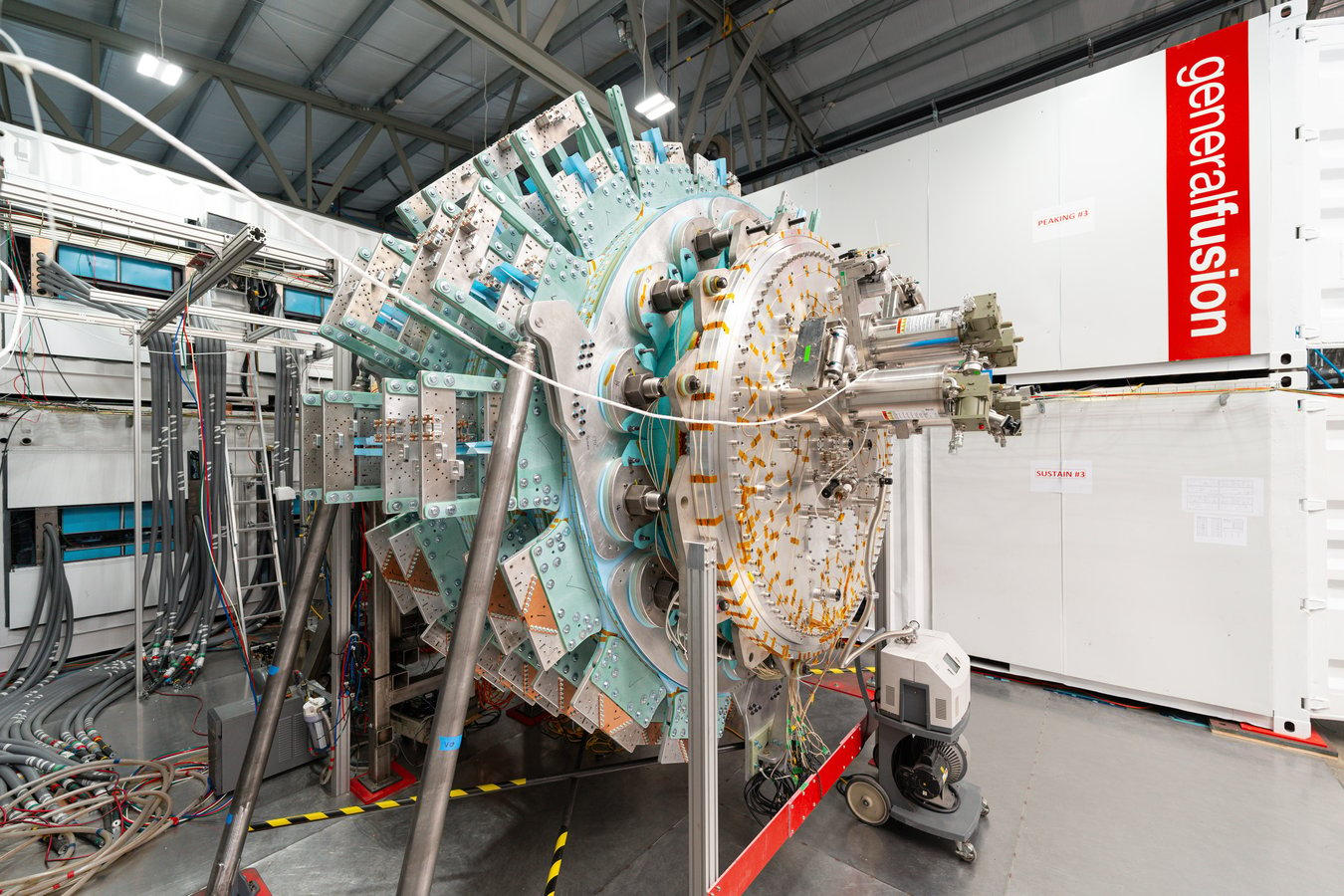

NEW YORK – General Fusion began trading on Nasdaq Monday under the ticker GFUZ, opening at $12.85 a share and climbing 40 percent by midday, marking the first time investors can buy equity in a nuclear fusion company on a public stock exchange.
The debut came through a reverse merger with Spring Valley Acquisition Corp. III, a blank-check acquisition vehicle. High redemption rates from the SPAC’s shareholders stripped away most of the expected proceeds. General Fusion entered trading with roughly $150 million in cash: less than $30 million from the SPAC itself, and an additional $108 million raised from private investors who committed capital to close the transaction. The original de-SPAC was projected to deliver more than $230 million.
The company has not disclosed how long that cash position is expected to last. The milestone it is racing toward – a demonstration of fusion energy breakeven, the point at which the reaction generates as much energy as it consumes – has already slipped once. General Fusion originally targeted 2026 for this result with its LM26 experimental device. That target has moved to 2028 or later, and the company’s first commercial power plant is not expected until around 2035.
General Fusion uses magnetized target fusion, a different approach from the tokamak designs that dominate publicly funded programs. The technology works by injecting plasma into a lithium-lined chamber, then compressing it with electromagnetic fields. The method requires less physical infrastructure than a conventional tokamak, and has attracted investment on the premise that it could produce a more manufacturable fusion reactor than the large government-funded programs are likely to deliver in this decade.
Founded in Burnaby, British Columbia in 2002, General Fusion has raised over $600 million from private investors over more than two decades, TechCrunch reported. The company’s investor base spans high-net-worth individuals, institutional funds, and government-backed capital from multiple countries. That funding sustained a research program across more than two decades without producing commercially meaningful energy output at any stage.
The period immediately before the IPO was not smooth. In May 2025, General Fusion cut 25 percent of its workforce, citing a shortage of operating capital – one of the steeper contractions any fusion startup has publicly disclosed. Three months later, the company closed a $22 million financing round with “pay to play” terms, a structure that penalizes non-participating investors and typically signals constrained options. The de-SPAC transaction, negotiated during this period, became the company’s exit from a private funding cycle it could no longer sustain.
A fusion energy company trading on a public exchange had long been treated as an eventual sector milestone, without certainty about which company would reach it or whether the market would be receptive. General Fusion’s first-day rally suggests investors are willing to treat fusion as an investable category even without a confirmed path to commercial power. The 40 percent gain is a vote of confidence for a company whose primary product remains experimental and whose breakeven date has already slipped. The listing comes six weeks after SpaceX went public at an $86 billion valuation, a period in which capital markets have shown sustained appetite for high-risk, long-timeline technology ventures.
The broader fusion energy sector has attracted significant private capital in recent years, with multiple companies each raising hundreds of millions of dollars from institutional and individual investors. None of those competitors have listed publicly. General Fusion’s Nasdaq debut gives the sector its first real-time price signal: investors can now express a view on fusion energy’s commercial viability through a liquid security, rather than in the opaque terms of a private funding round. The technology sector broadly has seen sustained revenue growth in 2026, driven by AI infrastructure demand, conditions that have historically encouraged capital to flow toward longer-duration technology bets.
The company’s $150 million cash position against a 2028 breakeven target and a 2035 commercial timeline suggests a follow-on capital raise will almost certainly be required. Whether that comes through secondary equity offerings, debt, or government grants will depend on how the stock performs once the first-day enthusiasm subsides. What the debut established is that a market for fusion energy equity now exists. Whether it can sustain a company through the decade of research still ahead is the open question that General Fusion has just taken public.