
CHICAGO — The company that built its American franchise on the promise of the affordable meal now finds itself unable to hold its own customers. McDonald’s named a new president for its United States operations Monday after second-quarter data showed domestic same-store sales rising by the smallest margin in a year, laying bare the precarious position of a brand caught between its working-class identity and the reality of an American consumer who has quietly begun counting what a meal is worth.
McDonald’s earned $2.36 billion in net income during the second quarter, or $3.32 per diluted share, up from $2.25 billion, or $3.14 per share, in the same period a year ago. Excluding one-time charges, adjusted earnings reached $3.38 per share, topping analyst estimates of $3.32. Revenue grew to $7.1 billion from $6.84 billion, falling just short of Wall Street’s $7.13 billion target. Associated Press reported that shares rose less than 2 percent in early trading.
The numbers that registered most sharply with investors were not in the profit column. United States same-store sales edged up just 0.8 percent, a sharp deceleration from the 2.5 percent growth the chain reported in the same quarter of 2025. Global same-store sales rose 1.3 percent. The divergence between international performance and domestic results pointed toward something specific about the American market, and the chain’s own leadership acknowledged it.
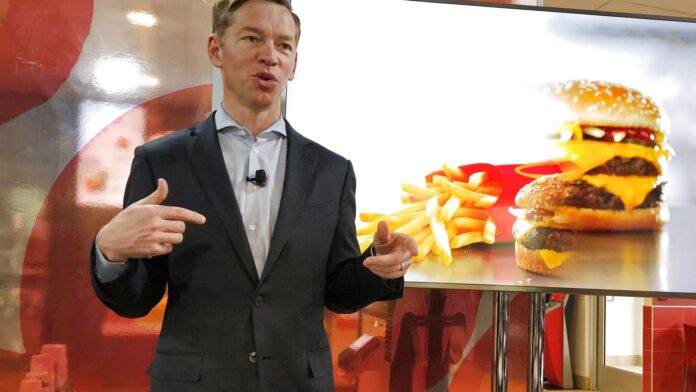
“We don’t have a strategy problem,” Chief Executive Chris Kempczinski said in a call with analysts. “We simply didn’t execute at the level we needed to in the second quarter.” The admission was notable for its precision: not a reckoning with the competitive landscape, not an indictment of the economic environment, but a concession about operational delivery at the chain’s roughly 13,500 domestic locations.
McDonald’s named Skye Anderson as president of McDonald’s USA, placing her at the head of the company’s largest market at a moment when execution is the stated priority. Anderson assumes a portfolio that accounts for a significant share of McDonald’s global revenue and one that has faced persistent questions about whether the chain’s value proposition still resonates with the American families it has historically served.
Chief Financial Officer Ian Borden identified a specific mechanism behind the customer shortfall: the chain pulled back on digital promotional offers during the quarter, and customers who had grown accustomed to those incentives visited less frequently. McDonald’s plans to relaunch expanded digital promotions nationally and roll out personalized offers to loyal customers through its app, a strategy aimed at rebuilding visit frequency without sacrificing per-transaction margins.
The consumer backdrop has not been forgiving. Gas prices averaged $4.56 per gallon nationally in May, compounding a prolonged period of household budget pressure that has reordered spending priorities for tens of millions of Americans. McDonald’s, which introduced its McValue menu with items priced at $3 or less, has tried to position itself as a refuge from that pressure. The quarter’s results suggest the pitch has required more active reinforcement than the chain initially anticipated.
The second-quarter season has produced a split picture of corporate America. While Caterpillar logged a record $20.5 billion revenue quarter driven by data center construction demand, a segment of the economy insulated from consumer volatility, the picture at ground level has looked more strained. For McDonald’s, which operates at a price point that should benefit when Americans seek value, the slippage in domestic sales carries more weight than a single quarter’s headline.
McDonald’s has long served as one of the more reliable consumer barometers available to analysts. The chain serves roughly 70 million customers daily across its global network, and its U.S. traffic trends have tracked household confidence with particular sensitivity. When consumers pull back at McDonald’s, it carries a different signal than a decline at higher-priced competitors. A deceleration this sharp, even against a backdrop where Wall Street reached record highs, suggests the gap between market performance and household budget reality may have grown wider through the first half of the year.
What McDonald’s has not yet shown is whether Anderson’s appointment will be accompanied by any substantive shift in how the company addresses the structural element of its challenge: the American consumer who has recalibrated what counts as an affordable meal. The McValue menu and the forthcoming digital promotions represent tactical adjustments. Whether they are enough to reverse the domestic sales trajectory, and whether that reversal requires changes beyond execution, is a question the chain has left open, at least for now.