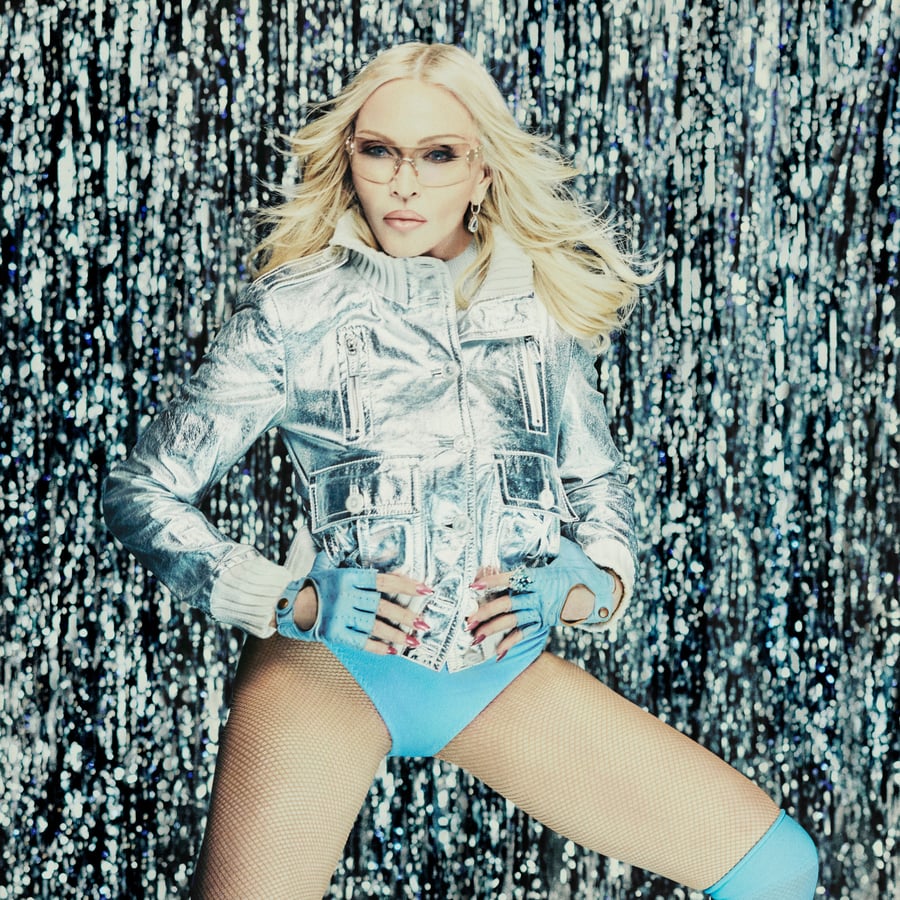

LOS ANGELES – The chart position arrived on Sunday, and the number itself told a story the music industry has not seen at this scale in decades. “Confessions II” opened at No. 1 on the Billboard 200, giving Madonna her 10th chart-topping album and confirming that the promotional architecture her team built over five months had worked precisely as intended.
The album’s first-week performance was built on 134,000 total album-equivalent units, including 114,000 in traditional sales and 20.1 million streams, according to Billboard’s official chart data. Those numbers placed “Confessions II” well ahead of the week’s No. 2 album, Olivia Rodrigo’s “You Seem Pretty Sad for a Girl So in Love,” which opened to 97,000 units. That Madonna cleared Rodrigo in opening week, at a moment when Rodrigo commands near-total control over the pop streaming landscape, is a commercial statement that extends beyond nostalgia.
The promotional machinery that produced the result was built on a single audacious move. In April, Madonna appeared unannounced during Sabrina Carpenter’s Coachella headlining set to debut lead single “Bring Your Love,” a calculated injection into the conversation about who controls the pop cultural center. The appearance hit every entertainment front page and refreshed her profile with an audience largely too young to have caught the original “Confessions.” The campaign extended through May with pop-up performances in West Hollywood and Times Square, and a short film screening at the Tribeca Film Festival in June closed the artistic credibility loop before the album dropped.
Critical reception for “Confessions II” has been unusually uniform. The album is widely being lauded as her best work since the 2005 original, the record that repositioned her from legacy act to contemporary force. That original “Confessions on a Dance Floor” was produced by Stuart Price, who has returned for the sequel, and the continuity of that collaboration appears to have produced the continuity of quality that critics are hearing. Her 2019 project “Madame X” debuted at No. 2 and carried real critical ambitions; that it did not reach the top felt, at the time, like evidence of a ceiling. The new album removes that ceiling and adds a number to a career tally that already had few peers.
The rest of the chart’s top five filled out with Ella Langley’s “Dandelion” at No. 3, Morgan Wallen’s “I’m the Problem” holding at No. 4, and Drake’s “Iceman” at No. 5. The breadth of genres in the top five, spanning dance-pop, country, and rap, reflected how fragmented the streaming landscape has become, and it made Madonna’s first-week lead that much more notable. “Confessions II” crossed genre lines in a way that most major releases no longer attempt.
The arc that runs from her June 2023 hospitalization, when a bacterial infection put her in intensive care and threatened to cancel what became the Celebration Tour, to the top of the Billboard 200 in July 2026 is not incidental to how the music industry is reading this chart position. Comebacks at this scale are rare enough that they reshape the language used to discuss them; what the album’s first-week figures suggest is not a comeback but something closer to a resumption. The 2005 “Confessions on a Dance Floor” run was never properly finished on her own terms; the tour was cut short, and the artistic follow-through took two decades. “Confessions II” reads commercially as a statement that the thread was never actually dropped.
Ten No. 1 albums carries specific weight in an industry that measures longevity through decades of format changes: vinyl to cassette to CD to streaming, radio gatekeeping that shifted completely, and the reordering of what counts as commercial success when Billboard’s methodology changed to album-equivalent units in 2016. Legacy artists generally struggled with the adjustment; the new formula rewarded streaming catalog depth over event purchasing, and event purchasing is what older fan bases do. Madonna’s first-week performance under that framework was not a legacy exception to the rule; it was 134,000 units of current-market competition. The methodology did not rescue the number; the number earned it.
The next test arrives sooner than a typical album cycle would suggest. Madonna is set to co-headline the inaugural FIFA World Cup Final Halftime Show alongside Justin Bieber, BTS, and Shakira, an event that will reach the largest live television audience any of them has faced in a single night. The show arrives while “Confessions II” is still in its initial chart run, and the alignment between commercial momentum and global broadcast exposure appears to be part of the strategy. Stadium-scale halftime performances that follow a major album debut can either cement a narrative or expose its limits; the 2005 “Confessions” cycle never had an equivalent accelerant.
What the opening-week data cannot answer is whether “Confessions II” sustains into its second and third chart positions, which typically reveal whether a debut was driven by fan pre-order behavior or by broader cultural uptake. Opening-week numbers for artists with deep, organized fan bases can be engineered by pre-release mechanics; the weeks that follow cannot. The critical consensus still forming around the album will also harden into something either lasting or revisionist as summer continues. As The Hollywood Reporter noted, the album is being widely lauded as her best since the 2005 original; what that means commercially by the end of the quarter is the question the chart has not yet answered.