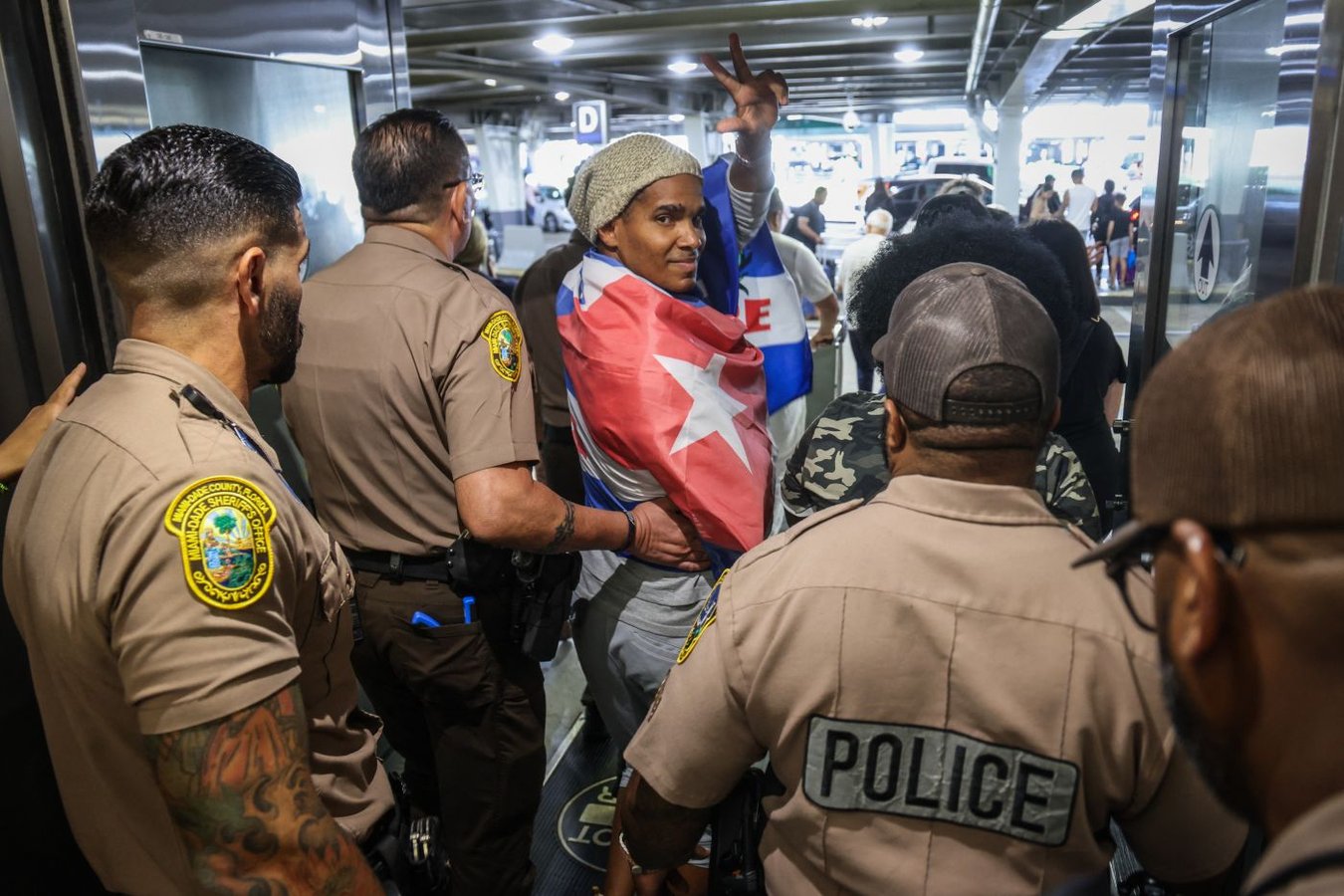

MIAMI – Luis Manuel Otero Alcantara walked out of Cuba’s prison system and onto a plane to Miami on Friday, his arrival at Miami International Airport confirming what five years of imprisonment had tried to prevent: that Cuba’s most prominent dissident artist would be free and heard. Alcantara, 38, co-founder of the San Isidro Movement, landed on July 18. Secretary of State Marco Rubio confirmed his arrival and described it as the journey of a man who had dared to “imagine a free Cuba.”
Cuban authorities had sentenced Alcantara on charges of insulting national symbols, contempt, and disturbing public order. Human rights groups including Amnesty International repeatedly characterized those charges as politically motivated, rooted in his co-founding and leadership of the San Isidro Movement, a coalition of Cuban artists and intellectuals that formed in 2018 to resist government censorship of creative work. He served the full term before being released and permitted to travel.
The Cuban government did not distinguish between artistic expression and political provocation in how it prosecuted San Isidro members. Alcantara’s legal charges centered on symbolic acts: insulting the national flag, expressions of contempt for state authority, conduct deemed disruptive to public order. These were, in Havana’s telling, the crimes of a criminal. In international human rights frameworks, they are the definition of political imprisonment.
The San Isidro Movement emerged in response to Decree 349, a Cuban government regulation that gave authorities broad powers to sanction artists and performers outside state-approved channels. Its members staged hunger strikes, produced work the government sought to suppress, and drew sustained international attention to the limits Havana places on its artists. The movement was, for a period, the most organized public dissent visible in Cuba. Cuba’s unprecedented 2021 protests, the largest in more than sixty years, drew on networks of resistance that movements like San Isidro had spent years building across the island.
Rubio, in confirming the arrival, called on Cuba’s government to “immediately release” the “more than 700 unjustly detained political prisoners” still in Cuban custody. The Trump administration, he said, “remains committed to the Cuban people’s pursuit of freedom.” The statement drew a deliberate line between Alcantara’s release and the hundreds still imprisoned, framing the former as a symbol and the latter as an ongoing obligation that Havana has declined to meet.
Al Jazeera reported the arrival Friday, noting that Rubio’s confirmation offered no detail on the diplomatic circumstances under which Alcantara was released. Cuba has, in recent years, released high-profile political prisoners in ways that do not suggest systematic reform. Whether Alcantara’s release was the result of US diplomatic pressure, a bilateral exchange, or a unilateral decision by Havana to remove a political liability that had drawn sustained international attention was not made public by either government.

The Cuba that Alcantara left behind has changed in form but not in character since the protests that briefly suggested a different trajectory. Hundreds of protesters arrested in July 2021 remain imprisoned. Cuba’s government continues to stage-manage public demonstrations that project popular consent while maintaining the legal and security apparatus that imprisons those who organize without state approval. Alcantara had made his views on that system unmistakable for more than a decade. Havana chose to hold him for five years.
More than 700 political prisoners, by Rubio’s count, remain in Cuban custody. The US-Cuba relationship has been shaped, across multiple administrations, by the gap between those numbers and any durable diplomatic framework capable of addressing them. The Trump administration has consistently positioned itself as hostile to the Cuban government and sympathetic to dissidents and exile communities. Whether that positioning translates into the kind of sustained pressure that produces releases at scale, or whether it remains largely a rhetorical stance, is a distinction that Rubio’s statement this week did not resolve.
Alcantara had not, at the time of writing, spoken publicly about what comes next. His arrival in Miami joins a diaspora of Cuban artists, writers, and activists who have spent years navigating the distance between a country’s culture and its government’s willingness to tolerate the full expression of that culture. He is, by Rubio’s framing, a symbol. Whether his freedom converts into meaningful international pressure on the government that imprisoned him, and whether that pressure produces any outcome for the more than 700 still waiting, is the question that his arrival leaves entirely open.