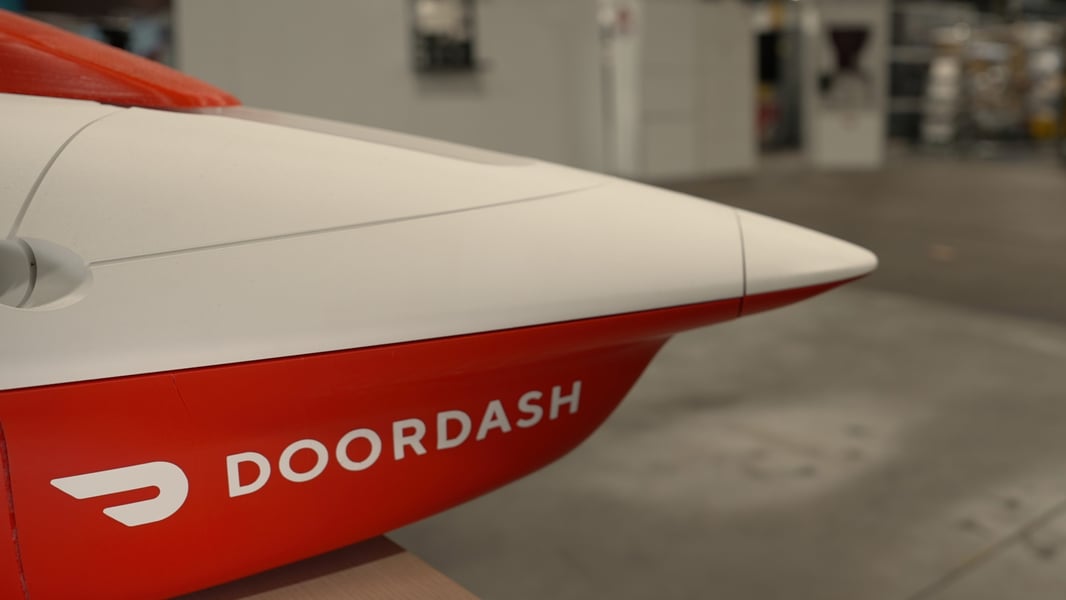

SAN FRANCISCO — The Federal Aviation Administration’s Part 135 air carrier certification is the credential that allows a company to conduct commercial drone operations legally in the United States. DoorDash received one Wednesday, and announced it intends to fly things to your door using aircraft it built itself.
The service is called DoorDash Air. It was developed inside DoorDash Labs, the company’s internal robotics and autonomy research group, without relying on the drone contractors the food delivery sector has used as the standard route to aerial delivery. DoorDash already has partnerships with Wing, the Alphabet subsidiary that operates in Australia and the Dallas-Fort Worth area, and with Flytrex, an Israeli drone operator. DoorDash Air is a different proposition: the company is building its own aircraft, training its own operators, and now holds its own certification to fly them commercially.
Stanley Tang, DoorDash’s co-founder and chief product officer, described the engineering approach in terms of the problem it was trying to solve rather than the technology it was trying to deploy. “We didn’t start with the question, ‘What’s the coolest autonomous tech we could make?’ We started from first principles: What’s the actual customer problem that needs to be solved?” Tang told TechCrunch. The answer the company arrived at is speed: drone delivery eliminates the wait time introduced by human couriers navigating traffic and parking.
The Part 135 certification allows DoorDash Air to begin commercial operations, but the initial phase will be limited. The company will start with line-of-sight operations — meaning a human operator must be able to see the drone during flight — before moving toward Beyond Visual Line of Sight operations, which require a separate FAA authorization. BVLOS approval is the technical threshold that separates limited pilots from scalable autonomous delivery, and DoorDash has not received it yet. The company framed Wednesday’s certification as the starting point of a buildout rather than a mature commercial launch.
The DoorDash Air announcement arrives alongside a description of the company’s broader autonomous delivery infrastructure. DoorDash Labs built what it calls the Autonomous Delivery Platform, described as an operating system that determines in real time which delivery mode — drone, human driver, or sidewalk robot — best serves a given order. The sidewalk robot dimension is not theoretical: DoorDash’s Dot, a 350-pound autonomous ground vehicle, is actively running deliveries in Tempe, Mesa, Gilbert, and Chandler in Arizona’s Phoenix suburbs, and in Fremont, California. DoorDash Air is intended to integrate with this network rather than replace it.
The competitive context for DoorDash Air is a drone delivery sector that has been growing slowly. Wing has been operating commercially in Australia and Texas for several years and recently expanded into new markets. Amazon Prime Air received its Part 135 certification in 2020 and has conducted limited deliveries but has not scaled broadly. Zipline, which focuses on medical supply delivery in Africa and the United States, has achieved the most consistent commercial drone deployment at scale. DoorDash entering with proprietary aircraft rather than a third-party partnership represents a bet that vertically integrated drone delivery — controlling the hardware, software, and operations — is more defensible than relying on contractors whose terms and technology roadmaps are not owned by the delivery platform.
The economic argument for drone delivery rests on labor cost reduction. Human couriers are expensive, and the per-delivery cost of last-mile delivery is the central problem in the food delivery industry’s unit economics. DoorDash, Uber Eats, and Instacart have all operated at thin or negative margins on individual deliveries, subsidized by subscription revenue, surge pricing, and scale. Drone delivery eliminates the human labor component of the delivery — which is most of the variable cost — but introduces capital costs (aircraft, maintenance, certification) that must be amortized across enough deliveries to produce a favorable comparison. DoorDash’s Autonomous Delivery Platform is built around the premise that a mixed-mode fleet — drones where they’re fastest, sidewalk robots where they’re most practical, humans where they’re irreplaceable — optimizes across all three cost structures simultaneously.
The regulatory environment for autonomous machines has been active in 2026, with the FCC acting to restrict imports of foreign-made robots and airlines prohibiting humanoid robots from flights over battery safety concerns. Drone delivery operates under a different regulatory regime — commercial air operations rather than consumer device import rules — but the shared thread is that autonomous machines are moving faster than the frameworks designed to govern them, and companies building the technology are navigating multiple agencies with jurisdiction over different aspects of the same problem.
What DoorDash Air cannot yet answer: how many cities it will initially serve and on what timeline, what the per-delivery cost looks like at its initial scale, and whether the drone hardware it has built achieves the reliability and safety record that BVLOS authorization will require. The FAA’s BVLOS process is slow by design — the agency is calibrating how much risk it is willing to allow drones operating beyond human visual oversight to impose on people and property beneath them. DoorDash has the certification to fly. The geography and the economics of what it will fly where remain the variables that determine whether DoorDash Air becomes a core business unit or an expensive research project.