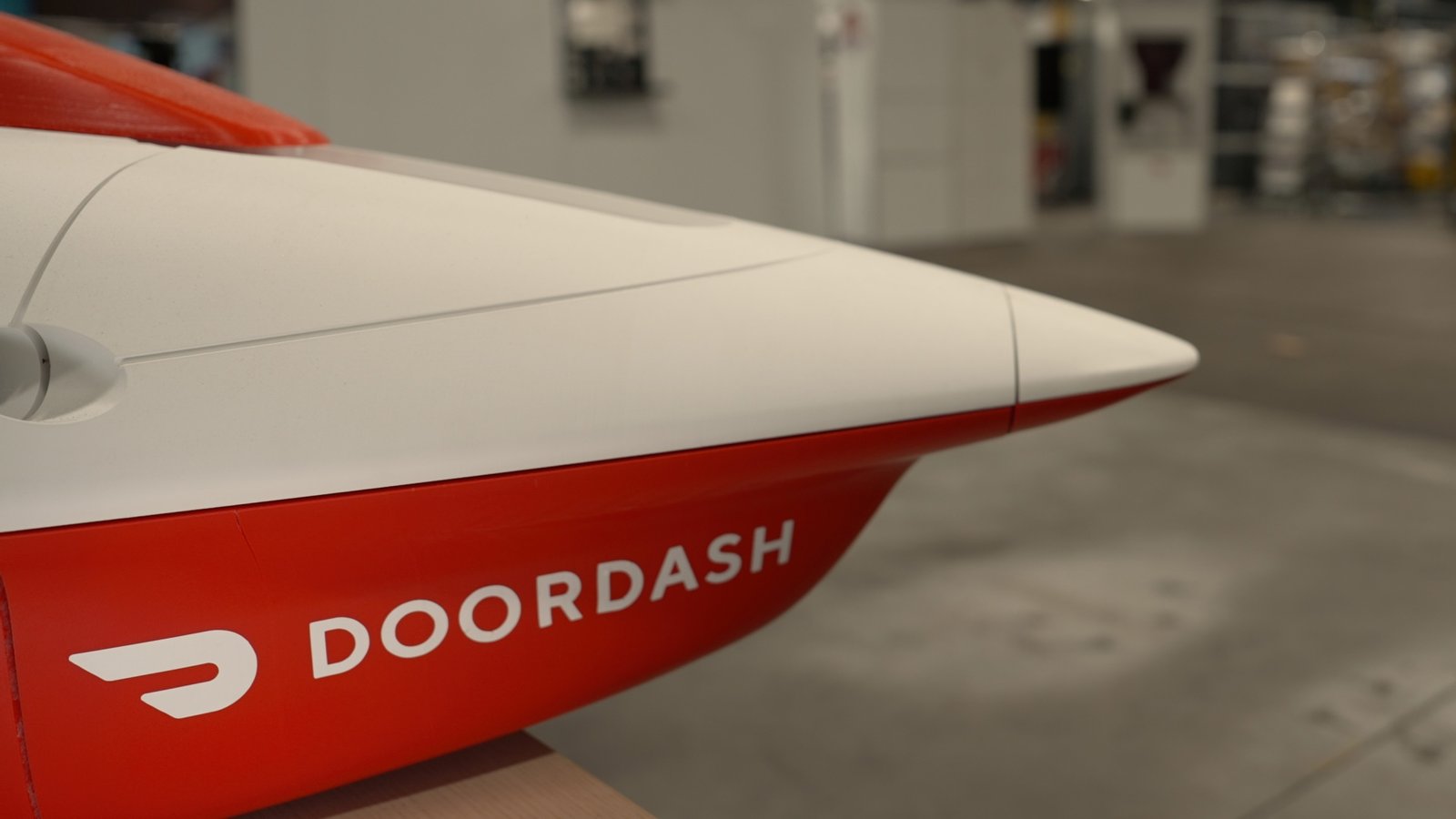

SAN FRANCISCO – Most technology companies building autonomous delivery networks have done it by partnering with specialists. DoorDash went a different route. On Tuesday the company announced DoorDash Air, its own in-house drone delivery business, and confirmed it has received Part 135 air carrier certification from the Federal Aviation Administration, a requirement to operate a commercial air service in the United States.
The announcement from DoorDash Labs, the company’s internal innovation unit, reframes what DoorDash is. The company that spent a decade connecting customers to couriers via a smartphone app is now building the infrastructure to replace those couriers with aircraft it operates itself. The FAA certification, which covers operations within visual line of sight, is a baseline requirement. The commercially meaningful step, beyond visual line of sight operations that would allow unattended autonomous flight across meaningful distances, requires additional certification DoorDash has not yet received.
DoorDash co-founder Stanley Tang described the motivation as customer-first reasoning rather than technology ambition. In a public statement, Tang wrote: “We didn’t start with the question, ‘What’s the coolest autonomous tech we could make?’ We started from first principles: What’s the actual customer problem that needs to be solved?” In practice, that reasoning has led DoorDash to build what it calls an Autonomous Delivery Platform, a system that selects among its DoorDash Air drones, its Dot sidewalk robots, and human couriers based on which mode best serves a given order.
The announcement does not displace DoorDash’s existing partnerships. The company has been testing drone delivery in the Dallas-Fort Worth area and in Australian cities through deals with Wing, Alphabet’s drone delivery subsidiary, and Flytrex. Those partnerships continue. What DoorDash Air adds is a proprietary vehicle and operating certificate that gives DoorDash direct control over delivery hardware rather than depending on third-party operators for capacity and pricing. In the delivery industry consolidation, owning infrastructure rather than accessing it through partnerships represents a meaningfully different competitive position.
The TechCrunch report on DoorDash Air’s launch positions the company against Amazon Prime Air, Alphabet’s Wing, and Zipline, all of which have received or are pursuing beyond visual line of sight certifications. Amazon has the most installed infrastructure in U.S. residential delivery, with Prime Air operations in limited markets. Wing has an FAA Part 135 certificate and BVLOS authorization in several U.S. markets. Zipline, which started in medical supply delivery, has been expanding into consumer goods. DoorDash enters this field with a baseline FAA certificate and without BVLOS authorization, meaning its operational footprint is currently constrained to proximity flights where a human operator can maintain visual contact with the drone.
The business case for drone delivery at scale has been contested for over a decade. Commercial drones have expanded substantially in industrial and healthcare logistics. Last-mile consumer delivery at competitive cost with human couriers remains harder to demonstrate at scale outside specific use cases, particularly areas with low courier density or high delivery frequency in small geographic zones. DoorDash’s argument, implicit in the autonomous platform framing, is that routing intelligence will make drone delivery cost-effective when combined with its existing demand density in U.S. markets.
The regulatory path after BVLOS authorization involves demonstrating reliable fail-safe behavior in complex urban airspace alongside manned aircraft, buildings, and people below. The FAA has approved BVLOS operations for a limited number of operators, and the approvals are market-specific rather than nationwide. How long DoorDash takes to move from limited visual-line-of-sight pilots to broader BVLOS commercial operations will largely determine whether DoorDash Air becomes a material business or an extended research program.
DoorDash has not disclosed the specifications of its drone hardware, the unit cost of the vehicles, or the delivery radius it is targeting with the current FAA certificate. The company also has not said whether DoorDash Air vehicles will be manufactured internally or sourced from an external contractor under DoorDash’s own operator certificate. Those details will matter considerably when the question shifts from whether DoorDash can operate a drone to whether DoorDash can make drone delivery economically viable at scale.
What the Part 135 certificate does establish is that DoorDash has moved beyond a partnership-dependent drone strategy. The Autonomous Delivery Platform concept, if it works as described, would give DoorDash something its competitors do not have in the same form: a single routing system that treats human couriers and autonomous vehicles as interchangeable options rather than separate services. Whether the proprietary route produces better results than the Wing and Flytrex partnerships it supplements is a question the current announcement does not yet answer.