
AMSTERDAM – The rivalry never needed a bracket to give it consequence. India and Pakistan share Pool D of the 2026 FIH Hockey World Cup, assigned to the same group alongside England and Wales as a tournament that begins August 15 across joint hosts Belgium and the Netherlands introduces something new to the competition: for the first time in World Cup history, there are no quarter-finals.
The format change compresses the margin for error to something close to nothing. Sixteen teams divide into four pools of four for Phase 1, running August 15 through 20. Pool finishes from that stage determine entry into one of four crossover pools, labeled E through H, in Phase 2, which runs August 21 through 24. Head-to-head results from Phase 1 carry forward into the crossover phase. Only the top two teams from Pools E and F advance to the semifinals. Phase 3 semifinal play begins August 27. The men’s gold medal match takes place August 30.
India and Pakistan will contest Pool D knowing that the path from third place in their group runs through Pools G and H in Phase 2, crossover brackets that terminate before the semifinals. A pool loss that carries too much arithmetic consequence and a recovery that arrives one fixture too late represents exactly the kind of trap the new format is designed to create. England, one of the sport’s better-organized programs over the past decade, and Wales, in only their second appearance at a men’s World Cup, complete a group that offers no soft fixtures.
The restructured crossover-pool pathway marks the most significant structural change in World Cup history. Quarter-finals had featured in every edition of the tournament since the competition’s modern format was established. Their removal does not alter how teams train, but it changes how programs must calculate risk at the pool stage.
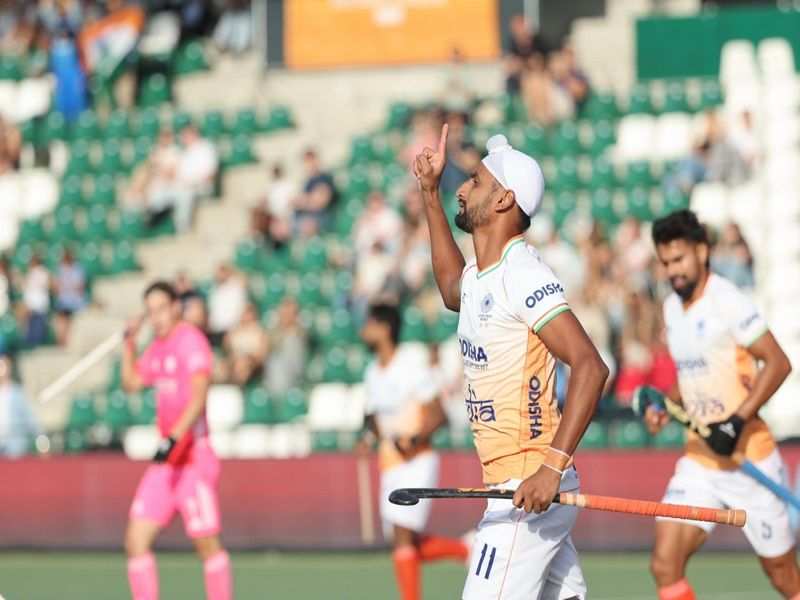
India enters with Harmanpreet Singh as captain, the drag-flick specialist who finished among the tournament’s top scorers at the Paris Olympics, where India claimed bronze, the national program’s best Olympic result in decades. Harmanpreet now leads a side navigating its first major tournament without PR Sreejesh, the goalkeeper who retired from international hockey following the Paris Games.
Sreejesh’s exit created a void that no consensus successor has filled publicly. His commanding presence in the Paris cage defined the defensive shape India built its bronze campaign around. Whoever steps into goal on August 15 will be doing so without a major international record of their own, against opponents who have studied India’s new vulnerabilities.
India and Pakistan have rarely shared a World Cup pool without it becoming the tournament’s most-discussed fixture before a ball is struck. Their meetings at global competition draw viewership across the subcontinent regardless of either team’s standings. Pakistan enters the 2026 cycle having adjusted its coaching infrastructure ahead of the tournament, with changes made at the goalkeeper coaching level, a detail that takes on added significance given India’s own uncertainties between the posts.
The Phase 1 head-to-head rule introduces a layer of consequence to the India-Pakistan pool fixture that would not exist under the previous format. Any team that beats its rival in Phase 1 and then meets them again in a crossover pool carries that head-to-head result into Phase 2. The winner of the India-Pakistan pool match on the August 15-20 schedule may hold a structural crossover advantage before a single Phase 2 ball is played.
India’s women face a comparable draw. Pool D of the women’s tournament places India alongside China, England, and South Africa. India and China contest their pool opener on August 16, one of the early fixtures most likely to define standings in that group. China’s women have maintained their position as one of Asia’s most consistent programs and arrive in Belgium and the Netherlands without having shown signs of regression. The women’s medal matches are scheduled for August 29.
Belgium and the Netherlands host a tournament each genuinely believes it can win. Belgium reached the final of the 2023 World Cup, an appearance that confirmed the program’s standing among the sport’s dominant forces. The Netherlands hold Olympic gold from Paris, making them the defending champions of the sport’s most significant non-World Cup title. Both nations will draw on home support across parallel tournament venues throughout August, giving the FIH Hockey World Cup 2026 its widest physical footprint in the competition’s recent history.
India’s preparation ahead of August 15 has proceeded largely away from public scrutiny. How Harmanpreet’s captaincy performs under World Cup pressure, without Sreejesh behind him to absorb defensive angles, is the question the tournament will answer but has not yet addressed. Crossover hockey, played without the safety net of a quarterfinal round, will identify which programs built their preparation around the right kind of stakes. August 15 will not wait.