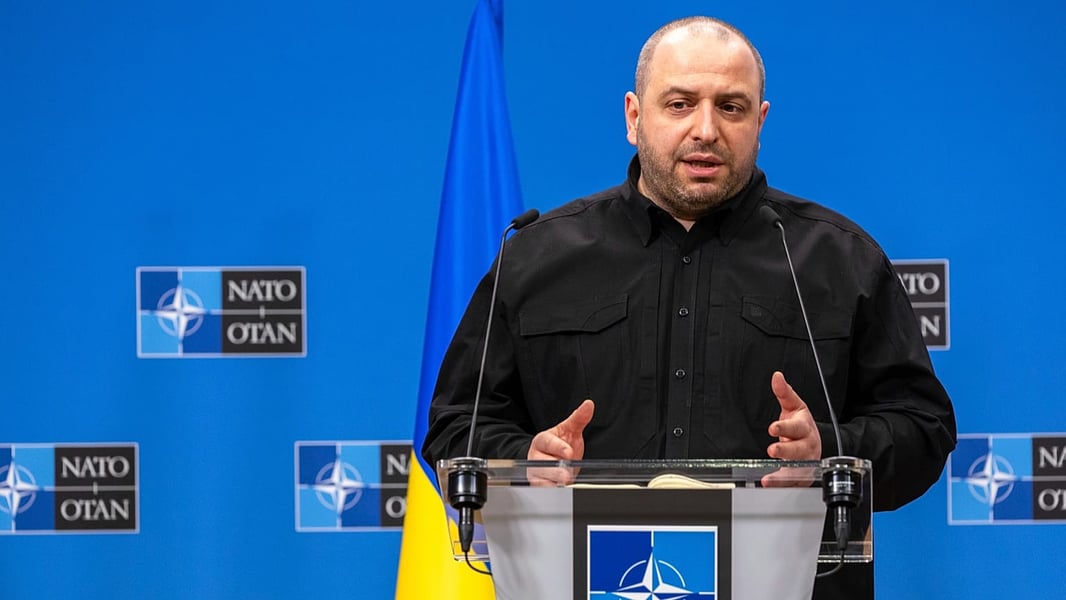

KYIV — The missiles that struck a facility operated by Roscosmos in Samara early Saturday morning flew approximately 560 miles from Ukrainian territory. They were called Flamingo missiles. They were Ukrainian-made. The man who did more than anyone else to develop Ukraine’s capacity to launch them learned about the strike from the sidelines.
Mykhailo Fedorov, the 35-year-old former defense minister who shaped Ukraine’s turn toward drone and robotic warfare, was fired in mid-July following what Zelenskyy described as an irresolvable clash with General Oleksandr Syrskyi, then Ukraine’s top military commander. Zelenskyy removed Syrskyi one week later, after tens of thousands of Ukrainians took to the streets in protest. Both men are out of their positions. The Flamingo program continues.
In his first extended interview with American media since the dismissal, Fedorov told CBS News that what Ukraine is fighting is something distinct from the territorial battles that dominate coverage of the conflict. “We need to defeat Russia in every technological cycle,” he said, “and we have to make decisions 24/7.” The framing is precise: not a war of inches and artillery barrages, but a race in which both sides try to render each other’s weapons obsolete faster than those weapons can be deployed at scale.
He credits the program he built with increasing Ukraine’s capacity for deep strikes inside Russia tenfold. The Flamingo missiles, which struck the Progress Centre Samara on Saturday, are among the results of that program. But Fedorov pointed to a gap that concerns him more than any single weapon: Russia’s ballistic missiles now reach most of their intended targets, he said, and Ukraine lacks a comparable capability. A Ukrainian-made ballistic missile capable of striking Russian launch sites, he estimated, could be operationally available within three to six months.
That estimate would have been significant coming from anyone. Coming from the man who was responsible for the industrial and engineering decisions that produced the Flamingo program, it carries weight. It also raises an obvious question: is Fedorov describing a timeline he helped set in motion, or one he is no longer in a position to influence?
When CBS News reporter Aidan Stretch asked why he was fired, Fedorov declined to answer plainly. “I really don’t want to talk to the American audience about why,” he said. And on his future: “Soon we will see. But in any case, all my work will be aimed at ending the war and rebuilding Ukraine.”
The restraint in those answers stands out from a figure who built his reputation on directness about technology and strategy. The specific nature of the Fedorov-Syrskyi clash has not been disclosed publicly. What is clear is that Zelenskyy chose to remove a defense minister whose removal triggered mass protests — and then removed the general whose conflict with the minister was cited as the reason for the firing. The sequence has never been fully explained.
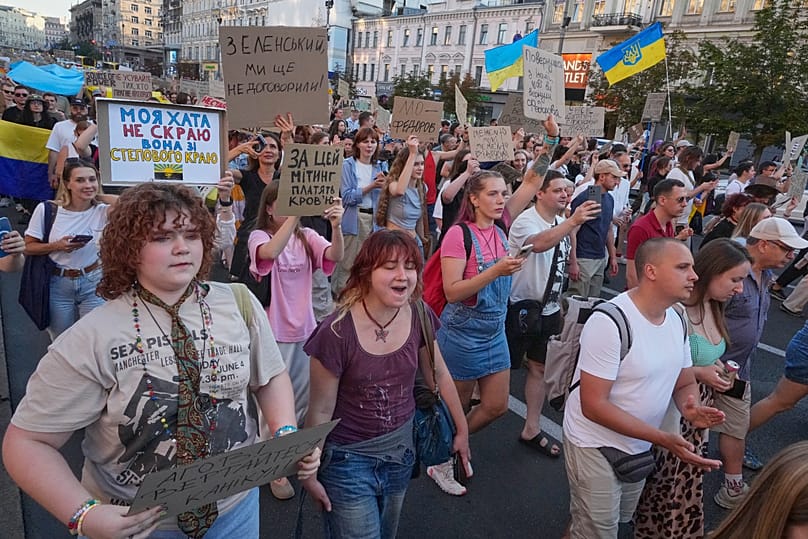
The protests that followed Fedorov’s dismissal drew Ukrainians into the streets across multiple cities. In Kyiv, demonstrators held signs and refused to disperse during air raid alerts. The response reflected how personally invested significant portions of Ukrainian society had become in the specific vision Fedorov represented: a leaner, faster military capability driven by domestic technology development rather than imported Western systems.
The Saturday morning strike on the Progress Centre Samara — one of Roscosmos’s key aerospace manufacturing facilities — demonstrated that Ukraine’s capacity for that kind of reach has not diminished in the weeks since Fedorov’s departure. The strike targeted infrastructure roughly 560 miles inside Russian territory, a distance that would have been beyond Ukraine’s reliable reach for most of the conflict’s duration. That range was the product of exactly the kind of iterative engineering development Fedorov describes when he talks about defeating Russia in every technological cycle.
As the broader regional arms contest intensifies — with US-Saudi nuclear cooperation raising fresh proliferation concerns elsewhere — Ukraine’s version of the problem is already well advanced. Russia’s ballistic missile advantage, which Fedorov explicitly named as the current gap, is not static. Moscow has been expanding its production of Iskander-series missiles and other long-range systems throughout 2026, and the window in which Ukraine can close that gap before Russian capabilities compound further is constrained.
What Fedorov’s interview does not address is the question most relevant to Ukraine’s strategic position: whether the institutional knowledge his team built at the defense ministry is being carried forward by his successors. The Flamingo program has its own momentum. The decisions about which next generation of weapons to prioritise, and at what pace, will be made by others. As Euronews reported in early August, Zelenskyy’s restructuring of Ukraine’s military leadership continues, with Fedorov’s name conspicuously absent from any formal role in the new configuration.
The CBS News interview was published the morning after the Samara strike. The timing was either coincidental or well-chosen. Fedorov did not comment on the strike directly in the interview — it is not clear whether the interview was conducted before or after the strike occurred. But the combination of an exclusive statement on Ukraine’s technological war ambitions and a long-range strike on a Russian aerospace facility in the same news cycle makes one argument that words alone would not: the capacity Fedorov built has not been dismantled. Whether it is still being advanced at the pace he would have set is what nobody can quite answer.