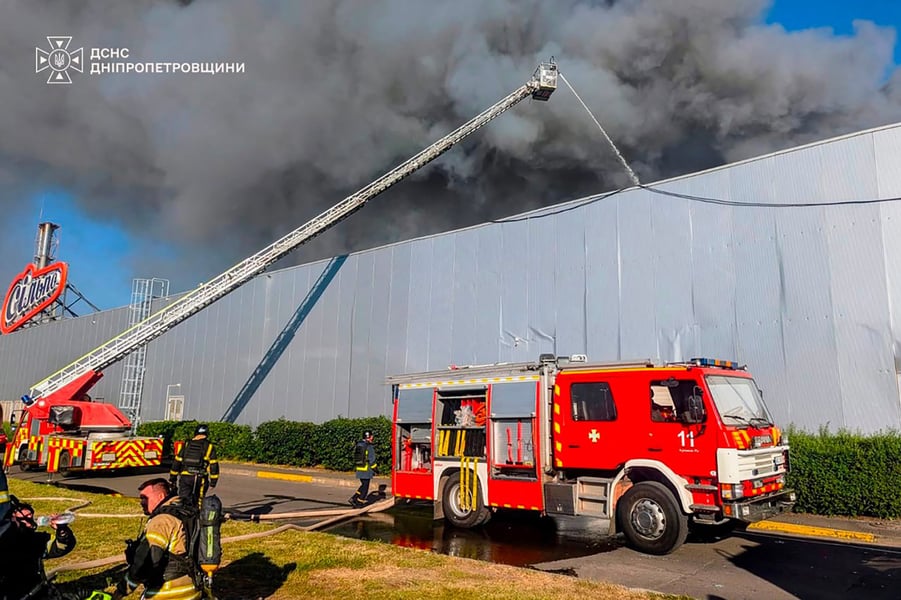

KRYVYI RIH — The first explosion sent shoppers fleeing into the street. Thirty minutes later, with firefighters already moving through the wreckage, a second drone struck the same site. Volodymyr Zelenskyy said Russia knew exactly what it was hitting.
The twin attack on Kryvyi Rih’s largest shopping complex on Friday killed 14 people and injured 121, including 22 children. Twenty-nine of the injured were listed as critical as of 8 p.m. local time, according to Oleksandr Vilkul, the head of the city’s Defence Council. Kryvyi Rih is a southern industrial city of roughly 640,000 people located approximately sixty kilometres from the active front line in the Donetsk direction — close enough to reach by drone, far enough that residents had not entirely given up on ordinary afternoon routines.
Zelenskyy described the strikes as “cynical and despicable” and said they amounted to “nothing less than terrorist acts.” His central accusation — that the second strike was timed specifically to hit emergency responders working the first blast site — raised the attack beyond the familiar pattern of civilian infrastructure strikes that has continued through more than four years of war. “Russia must face real accountability,” he said.
The first strike alone would have registered as a catastrophic incident in any other conflict. The shopping centre, packed on a Friday afternoon, took direct hits that started fires across multiple storeys. The second drone, arriving while firefighters were still evacuating the injured, did something the first could not: it transformed a mass-casualty event into what Zelenskyy was prepared to characterise as a deliberate act of terror. Emergency services responding to a strike site are protected persons under the laws of armed conflict.
A separate Russian drone attack struck Mykolaiv region the same afternoon. Interior Minister Ivan Vyhivskyi reported four people killed there, three of them children. Mykolaiv lies roughly 130 kilometres west of Kryvyi Rih, meaning Friday’s strikes were simultaneous across a broad arc of southern Ukraine — a geographic spread that suggests coordinated operational planning rather than individual opportunistic attack.
The Kryvyi Rih death toll arrives against a baseline the UN Human Rights Monitoring Mission in Ukraine has been measuring every month. The mission recorded 437 civilian deaths across Ukraine in July 2026, the highest monthly figure since May 2022. Friday’s fourteen are not yet counted in that figure, which itself had produced no visible change in the scale or targeting of Russian drone operations. As Al Jazeera reported, the UN data traces a trend that has only moved in one direction.

Kryvyi Rih has been struck repeatedly throughout Russia’s military operation in Ukraine. Its distance from the front — far enough to feel relatively safe, close enough to reach with medium-range drones Russia has deployed in increasing numbers — has made it a recurring target that Ukrainian air defence does not always intercept in time. The city is also the birthplace of Zelenskyy, a biographical detail Russian state media has periodically cited. Whether that association influences targeting decisions has never been confirmed by either side.
Friday’s attack was the most lethal single strike on the city in recent memory. The drone type was not identified in any Ukrainian official statement by Friday evening. Russia’s Ministry of Defence did not publicly comment on the Kryvyi Rih strike. This information asymmetry — Ukraine announcing civilian casualties promptly and precisely, Russia neither confirming nor denying specific strikes on civilian sites — has been a fixed feature of the conflict’s information environment since its earliest weeks.
The attack came days after a significant Ukrainian escalation against Russian logistical infrastructure. Ukraine conducted its largest coordinated drone assault on Moscow-area facilities this week, striking warehouses linked to the online retailer Wildberries and a facility connected to rocket propellant production. Russia publicly claimed to have intercepted the bulk of the attacking drones, though Russia’s air defence interception claims have shifted by an order of magnitude week to week — from 1,478 claimed intercepts in one period to 211 the following Friday — raising persistent questions about what those numbers actually reflect.
Whether the Kryvyi Rih strike is retaliatory signalling, part of an established operational tempo, or simply the result of available target lists is a question Moscow has not answered. The logic of escalation in the drone exchange between Ukraine and Russia has generally not required official explanation from either side: each operation produces a counter-operation at a target selected to demonstrate something about the other side’s vulnerability.
Zelenskyy’s call for “real accountability” invokes an institutional framework — the International Criminal Court has issued warrants related to Russian conduct in Ukraine — that has not yet produced charges directly tied to civilian infrastructure strikes of this kind. The gap between the monthly UN casualty count and actionable legal consequence has been one of the defining frustrations of this conflict’s international dimension. What closes it, and when, the death toll in Kryvyi Rih does not answer.