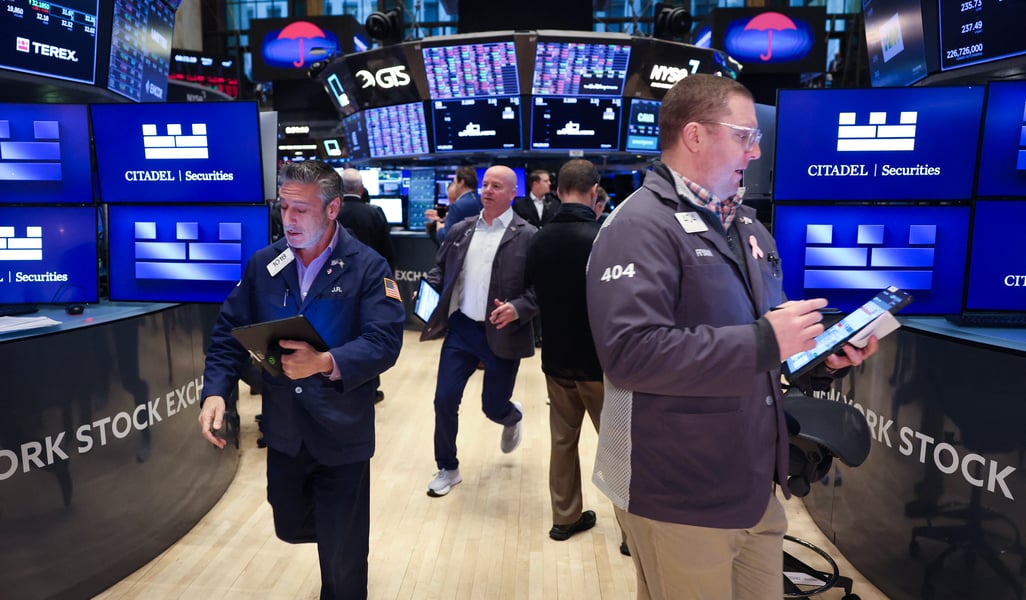

NEW YORK — By mid-session Wednesday the S&P 500 had shed 17 points, trading at 5,618 — a decline precise enough to feel deliberate. It was. Traders across equity desks in Manhattan and Chicago described the same posture: reduce exposure now, reload after NVIDIA reports.
| S&P 500 Session Snapshot — August 26, 2026 | |
|---|---|
| S&P 500 Level | 5,618 |
| Change | -0.3% |
| Information Technology Sector | -1.1% |
| Utilities Sector | +0.6% |
| Consumer Staples | +0.3% |
| Energy | +0.5% |
| Healthcare | +0.3% |
| VIX (Volatility Index) | 17.8 |
| Year-to-Date Return | +15.2% |
| 10-Year Treasury Yield | 4.31% |
| Trailing P/E Ratio | ~22.4x |
NVIDIA Corp. (NVDA), which alone accounts for roughly 6.5% of the cap-weighted S&P 500, releases its fiscal second-quarter results after Wednesday’s close. The consensus expectation calls for $92.2 billion in revenue — a figure that would represent 97% growth from a year earlier — and earnings of $2.09 per share. What the report will actually produce is, by any measure, the most consequential single earnings event of the quarter, and possibly the year. The NVIDIA stock story is inseparable from the S&P 500 story in August 2026.
The benchmark’s 15.2% year-to-date gain — its best first eight months since 2021 — rests on a narrow foundation. Strip out the five largest technology constituents and the index’s 2026 return shrinks to roughly 7%. That concentration is what makes Wednesday’s positioning so uniform and so consequential.
“The S&P 500 is essentially running a single-name risk this week,” a portfolio manager at a large New York asset management firm said, speaking privately. “That’s not a critique. It’s just what the market has become.”
Information technology fell 1.1% as the sharpest sectoral drag. Microsoft Corp. (MSFT) dipped 0.4% despite its own strong recent results — the spillover from NVIDIA nervousness touched every AI-adjacent name. Microsoft’s 40% Azure growth reported earlier this earnings season had drawn the market higher; today’s pull was the mirror image of that momentum.

Meta Platforms Inc. (META) fell 0.4%. Meta’s ad revenue performance and capital spending trajectory remain directly tied to the same AI infrastructure cycle that will either be validated or complicated by NVIDIA’s numbers.
Defensive sectors held. Utilities gained 0.6% and consumer staples added 0.3%, the standard refuge trade when technology swings and volatility climbs. The CBOE Volatility Index — the VIX — rose to 17.8, its highest level since late June, as options desks built protection around an event that could swing the index 1.5% to 2% in a single session regardless of direction.
Market breadth offered a more nuanced picture than the headline loss suggested. Of the S&P 500’s 503 constituents, 241 advanced and 252 declined — a ratio close enough to even that the index’s negative performance was almost entirely a function of size weighting rather than market-wide selling. The equal-weighted version of the index, which gives each constituent the same influence regardless of market capitalization, fell only 0.08%.
That gap — 22 basis points between how the cap-weighted index performed and how most of its members actually traded — is a recurring feature of 2026. The year-to-date divergence between cap-weighted S&P 500 performance and equal-weighted S&P 500 performance has reached 6.2 percentage points, one of the widest spreads in the post-2008 era. Concentration risk is not a future concern. It is the present condition.
Energy stocks added 0.5% after crude oil prices stabilized following a mid-week inventory report that came in below consensus drawdown estimates. Healthcare rose 0.3%. Industrials were flat.
The broader context heading into NVIDIA’s print is one of a market that has largely absorbed the Federal Reserve’s higher-for-longer posture. The 10-year Treasury yield held at 4.31% Wednesday, a level that has proven tolerable for equity valuations as long as earnings growth compensates for the discount rate. At a trailing price-to-earnings ratio of approximately 22.4 for the S&P 500, the index is pricing in continued earnings expansion — a bet NVIDIA’s report will either reinforce or test.
The Nasdaq composite fell a sharper 0.8% Wednesday, reflecting its higher concentration in the same technology names driving S&P 500 volatility. The two indices rarely diverge more than 0.3 to 0.4 percentage points on typical sessions; Wednesday’s 0.5-point gap measured precisely how much of the day’s pressure was a technology story rather than a broad market one.
What the NVIDIA report will say about AI capital expenditure sustainability — from hyperscalers like Microsoft, Amazon, Alphabet, and Meta — is the question the S&P 500 will answer Thursday morning. Every piece of corporate spending data released this earnings season has pointed toward acceleration, not plateau. Whether that trajectory continues, or whether guidance signals a pause, will determine whether 5,618 was a pause in the rally or the beginning of something more prolonged.
The answer arrives after the close.