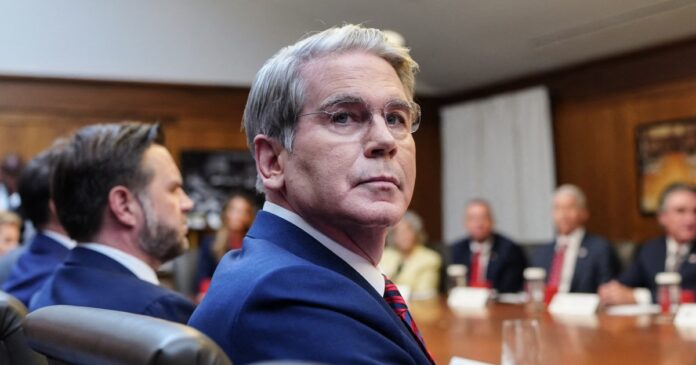

NEW YORK — The NASDAQ Composite didn’t read like a single bad day. It read like a reckoning with an assumption that had grown too comfortable. Federal Reserve Governor Kevin Warsh addressed the Chicago Council on Global Affairs on Wednesday evening, and by Thursday’s close the Composite had shed approximately 2.5%, settling near 17,680 — its worst session in six weeks and the clearest market verdict yet on how unprepared the rate-cut consensus had been for a sustained hawkish intervention.
Warsh did not parse his words. Inflation risks, he said, remain materially underpriced in financial markets. Fiscal policy is running hot enough to complicate the Fed’s return to 2%, and the structural stickiness of services and shelter costs means that headline deceleration should not be read as a signal to ease. The Fed’s credibility, he added, requires it to hold the line. Those arguments, delivered by a voting FOMC member at a public forum before an audience of institutional participants, had a different weight than a standard Fed speech. The market treated them accordingly, as CBS News reported on Warsh’s address.
Among the roughly 3,200 securities in the NASDAQ Composite, fewer than 900 closed higher. The advance-decline ratio of approximately one to three was the worst breadth reading the index had produced since early summer. Volume ran roughly 18% above the 30-day average, confirming that the move reflected genuine repositioning rather than mechanical drift. Sectors with the highest concentration of growth-sensitive names drove the decline: semiconductor companies as a group fell roughly 2.6%, software platforms lost a similar amount, and communication services — heavily weighted toward advertising-model companies like Meta Platforms — retreated 2.5%.
| Stock | Close | % Change |
|---|---|---|
| Palantir (PLTR) | $74.35 | -3.8% |
| Nvidia (NVDA) | ~$220 | -2.7% |
| AMD | $148.32 | -2.9% |
| Meta Platforms (META) | $570.25 | -2.5% |
| Microsoft (MSFT) | ~$467 | -2.1% |
| Amazon (AMZN) | ~$228 | -1.9% |
| Apple (AAPL) | $211.47 | -1.6% |
The Composite’s broader composition — which includes everything from biotech companies to financial technology platforms to retail-facing consumer names — means that a session like Thursday tends to reveal where the real risk concentration sits. It sat, unmistakably, in high-multiple technology and artificial intelligence-adjacent names. Palantir Technologies fell 3.8% to $74.35. Advanced Micro Devices dropped 2.9%. Nvidia slid 2.7%. Meta Platforms lost 2.5%. Microsoft fell 2.1%, Amazon 1.9%, Apple 1.6%. These are not obscure corner-case holdings. They are the market’s central narrative for the past two years, and on Thursday that narrative met an argument it could not immediately refute.
The argument Warsh was making goes beyond individual company fundamentals. The rate-cut thesis that has sustained elevated valuations across the Composite assumes that the Fed’s next meaningful action will be accommodation. If that assumption is revised upward — meaning rates stay higher for longer than the market had priced — then the terminal discount rate applied to long-duration earnings streams rises, and current prices become harder to justify arithmetically. Thursday did not produce a new data point on inflation or economic growth. It produced a credible signal that the Fed’s internal distribution may be more hawkish than the forward curve had been pricing.
The Composite’s weakness was particularly notable given that several of its components had been showing relative strength through August. The rotation into technology that had characterized the post-summer rally stalled completely on Thursday. Even companies with strong near-term earnings visibility and limited debt — which would theoretically be insulated from rate-sensitivity — declined alongside the index, reflecting a broader de-risking impulse rather than any security-specific concern.
What remains uncertain heading into Friday is whether Thursday’s selling represents a one-session repricing or the beginning of a more sustained adjustment. The NASDAQ Composite has historically been capable of recovering quickly from hawkish-Fed episodes when subsequent data argues for accommodation. But the Warsh speech did not raise questions about a single data point — it raised questions about the entire framework through which the market was interpreting the Fed’s intentions. That is a harder argument to walk back, as Fortune analyzed in its coverage of the speech.
The S&P 500 fell broadly on Thursday as well, with technology leading declines across all major equity indices as the Warsh rate shock swept through markets far beyond the NASDAQ.