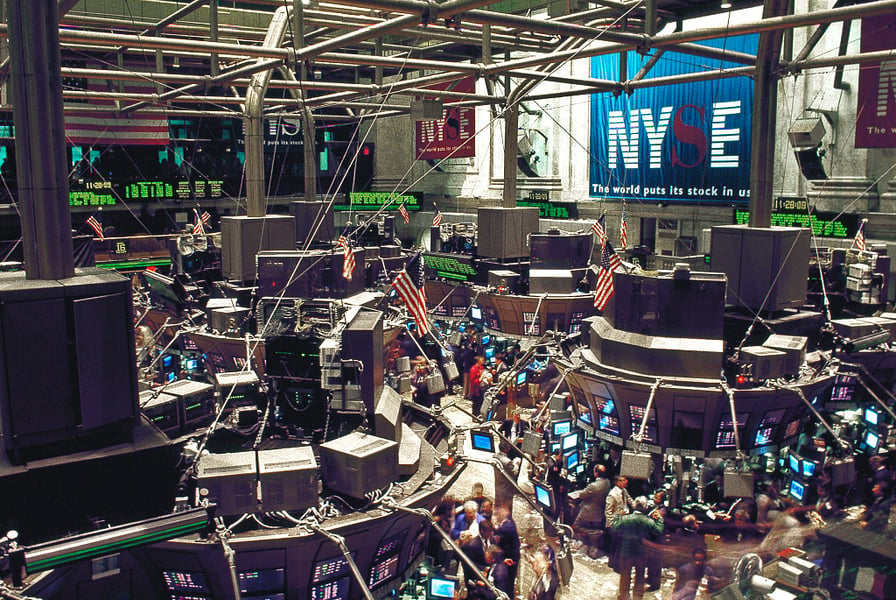

NEW YORK — The NASDAQ index fell 2.3% on Thursday, closing near 19,840, as Federal Reserve Governor Kevin Warsh’s speech before the Chicago Council on Global Affairs triggered one of the most significant single-day reassessments of the rate-cut timeline in months. The sell-off was concentrated in high-multiple technology and artificial intelligence names, which bear the greatest sensitivity to changes in long-duration interest rate expectations.
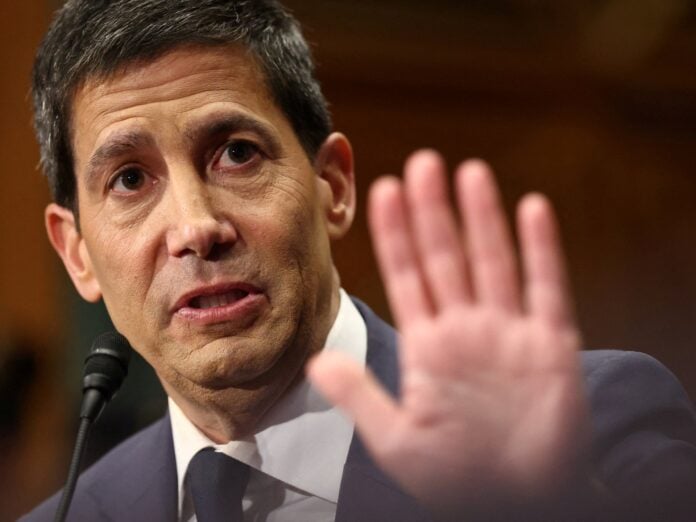
Warsh, a voting member of the Federal Open Market Committee, told the Chicago audience that inflation risks in the United States are materially underpriced by financial markets, according to Fortune’s coverage of the address. His argument was three-pronged: that fiscal policy remains too expansionary to be compatible with the Federal Reserve’s 2% inflation target; that services and shelter inflation are structurally stickier than headline figures suggest; and that the Fed’s institutional credibility requires it to hold rates higher for longer, regardless of market pressure for cuts. The speech arrived at a moment when NASDAQ-listed growth stocks had rallied significantly on the assumption that rate cuts were coming before year-end.
Palantir Technologies fell the furthest among large-cap NASDAQ names, dropping 3.8% to $74.35. The company’s forward price-to-earnings ratio near 90 times makes it among the most sensitive constituents to any revision in the discount rate. Advanced Micro Devices shed 2.9%, Nvidia fell 2.7%, and Meta Platforms lost 2.5%. Microsoft declined 2.1%, Amazon retreated 1.9%, and Apple — which carries comparatively modest forward multiples for a technology company — fell 1.6%, one of the smaller declines among major constituents.
| Stock | Close | % Change |
|---|---|---|
| Palantir (PLTR) | $74.35 | -3.8% |
| Nvidia (NVDA) | ~$220 | -2.7% |
| AMD | $148.32 | -2.9% |
| Meta Platforms (META) | $570.25 | -2.5% |
| Microsoft (MSFT) | ~$467 | -2.1% |
| Amazon (AMZN) | ~$228 | -1.9% |
| Apple (AAPL) | $211.47 | -1.6% |
The NASDAQ index’s composition explains why Warsh’s remarks landed with such force. The index weights heavily toward technology hardware, semiconductor companies, and software platforms that monetize through recurring subscription or advertising revenue models. These businesses have long investment horizons and their valuations are acutely sensitive to changes in the long-term discount rate. When the market’s expected path for interest rates rises, the present value of their future earnings falls, and index-level selling follows almost automatically.
AI-related names felt the pressure with particular acuity. The artificial intelligence infrastructure buildout — one of the primary narratives driving technology sector valuations in 2025 and 2026 — depends on data-center customers who finance capital expenditure with borrowed capital. Higher-for-longer rates raise the cost of that financing, potentially compressing the pace of AI infrastructure deployment and, by extension, the growth trajectory of the semiconductor and hardware companies that supply it. That chain of logic ran through Thursday’s selling in Nvidia, AMD, and their peers.
The breadth of the decline reinforced the severity of the repricing. Within the NASDAQ 100, fewer than 15 of the 100 constituent stocks managed to close in positive territory. Semiconductor names as a group fell roughly 2.6%, while software companies declined a similar amount. Even companies with limited direct exposure to interest rate dynamics — firms with strong balance sheets and near-term earnings visibility — were swept lower by the index-level selling pressure.
For the NASDAQ index specifically, Thursday’s session raises a structural question: how much of the gains accumulated since the start of the year are contingent on the rate-cut thesis remaining intact? The index had risen significantly through August on expectations of Fed accommodation, and a sustained upward revision to the terminal rate would require a commensurate reassessment of valuations across the index. Thursday did not resolve that question. It raised it explicitly.
The September Federal Open Market Committee meeting, scheduled in three weeks, will be the next meaningful inflection point. The S&P 500 also fell 1.9% on Thursday, confirming that the day’s losses extended across all major US equity benchmarks. CBS News reported that Fed officials signaled they have more work to do on inflation, raising the possibility of a September rate adjustment. If the committee’s statement and Jerome Powell’s press conference lean more hawkish than the current market consensus, the NASDAQ is likely to face further headwinds. If they provide reassurance that rates are near their peak, Thursday’s losses could be partially recovered. What the Warsh speech has done, with some certainty, is narrow the range of scenarios in which the NASDAQ’s summer rally continues without interruption.