
NASHVILLE – Nashville GM Chris MacFarland said the quiet part out loud.
“We felt with the depth of the winger market and the depth of our winger prospects, we’re very forward heavy,” MacFarland told reporters Tuesday after shipping Luke Evangelista to the New Jersey Devils for two future draft picks. The sentence was factually true, technically logical, and nearly absurd all at once: Evangelista had just put up 56 points.
The 24-year-old right wing finished last season with 44 assists and 12 goals in 81 games, career bests across every category, on a roster that finished outside the playoff picture. He has one year left on his deal at $3 million, affordable for a contending team and a bargain by the standards of what young forwards are commanding this offseason. The record-setting eight-year extension Cale Makar signed in Colorado reset expectations for what a franchise cornerstone costs. Evangelista is not that kind of player yet. At $3 million with upside untested in a contending environment, he was precisely the kind of player a sharp front office moves to acquire before restricted free agency leverage pushes the price up.
That team is New Jersey.
The Devils get a 24-year-old scorer to place alongside Jack Hughes, Jesper Bratt, and Nico Hischier, three players who proved last season that the offense is real and the ceiling is high, and that what the group is missing is reliable production on the wings. Evangelista’s 56 points ranked second on the Predators last year, behind a veteran core that is aging out of its competitive window. In New Jersey, those same numbers project differently: less like a leading man and more like a complementary piece filling an actual hole.
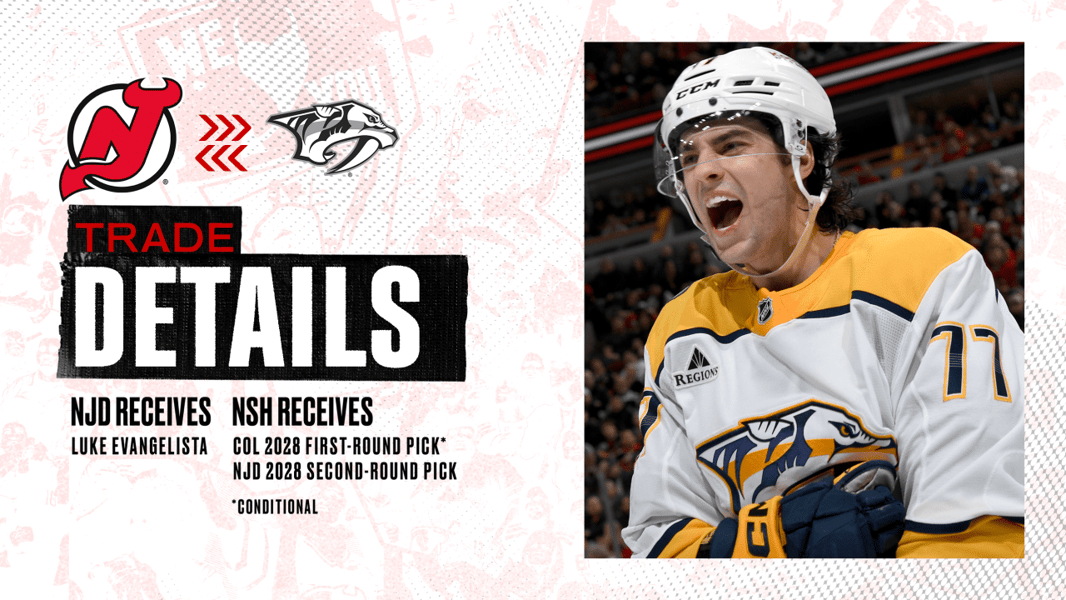
The Devils’ first-year general manager Sunny Mehta signed off on a return that captures both the cost and the timing advantage of moving on a player before the extension market sets his price. Nashville receives a conditional 2028 first-round pick, originally belonging to the Calgary Flames via the Simon Nemec deal, plus New Jersey’s own 2028 second-round pick. As the league’s official announcement confirmed, the first-rounder carries conditions that could shift its delivery to 2029 if it falls in the top ten, a protection clause that benefits Nashville only if the Devils remain good enough to make the pick late.
Nashville avoided the messy alternative. Extension talks between the Predators and Evangelista’s camp had not found traction, with the player entering his final contract year and leverage building. The Predators are not positioned to overpay at forward. Their core centers on Steven Stamkos, Filip Forsberg, and Jonathan Marchessault, veterans built for competitive windows that have already started narrowing. Behind them, Nashville has invested in younger wingers including Brady Martin and Egor Surin, prospects MacFarland publicly cited when justifying the move. The reasoning, as he described it: too many forwards, not enough ice time, and a quiet acknowledgment that this organization is rebuilding without openly calling it that.
Adam Fantilli signed his bridge deal with the Columbus Blue Jackets before their training camp opened, a reminder of how quickly teams move to lock in young forwards before leverage builds. Nashville may have read a similar situation developing with Evangelista and concluded that two 2028 picks were preferable to a standoff that could sour a relationship already under strain, according to CBS Sports.
What this trade leaves open is the harder question for both franchises. For Nashville, MacFarland did not say when competitive hockey returns. Marchessault is 32, Stamkos is 36. The prospect pipeline is real but timelines are uncertain, and trading a 56-point 24-year-old for picks in 2028 requires patience a fanbase may not easily sustain through another year outside the playoffs. For New Jersey, it remains unclear whether Evangelista, who generated most of his production as a top-six winger in Nashville, can replicate those numbers in a reduced role on a deeper lineup. His game skews heavily toward assists. His fit alongside Hughes will be established at training camp, not in any announcement.
Robert Thomas was named captain of the Blues last week without needing to be traded to earn the role. Evangelista leaves Nashville having put up numbers the final standings there never properly reflected. His next chapter starts in a market that believes his best hockey is still ahead of him, and that the gap between what Nashville is building and what New Jersey already has is wide enough to prove it.