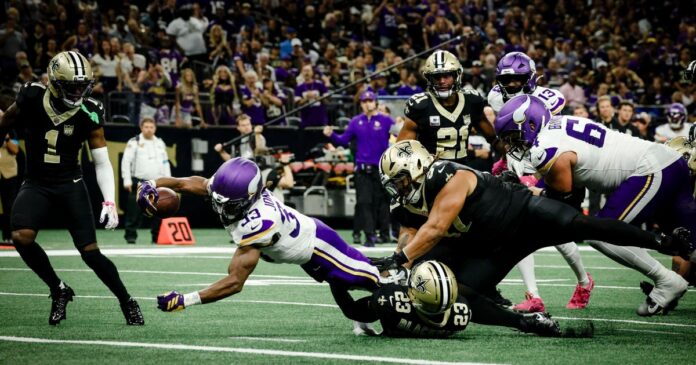

NEW ORLEANS — The Saints watched film from Seattle’s Week 1 opener and circled the same play. Fourth-and-1, Seahawks trailing 10-7 in the third quarter, Drew Lock takes the snap and stands in the pocket. His first read is covered. His second read is covered. Three seconds have passed. And then he finds Jaxon Smith-Njigba wide open on a seam, throws it on time, and Smith-Njigba turns a 45-yard gain into the sequence that won the game.
New Orleans defensive coordinator Joe Woods has had 168 hours to figure out how to make sure that does not happen again.
Sam Darnold’s hip injury has officially sidelined him for Week 2, and what began as an emergency on the sixth snap of the NFL’s opening night has become a scheduled start. Sunday’s game at Caesars Superdome is the first time Drew Lock has lined up as the announced, prepared, acknowledged starting quarterback for an NFL team — a distinction that carries real weight for the defending Super Bowl champions, who structured their roster around the assumption that their quarterback situation was settled months ago.
Lock, 30, spent three seasons as Darnold’s backup in Seattle, absorbing Ryan Grubb’s offensive system, attending every film session, keeping a whiteboard next to his bed for late-night scheme review. He went 16-for-22 against the Patriots, with 187 passing yards, one touchdown, and no interceptions. The decisive play that settled the game came on fourth-and-1 in the third quarter, when Lock found Smith-Njigba as a third read on a coverage the Patriots had not anticipated.
None of those numbers tell the story as cleanly as that single play.
“When 11 is just standing there, you gotta give him the pill,” Lock said. The Saints will be ready for that specific read. The question is whether being ready for it makes any difference.
Jaxon Smith-Njigba is the engine of this offense — the reigning Offensive Player of the Year whose presence demands resource commitments that open space for every other route concept in Grubb’s scheme. He caught eight passes for 122 yards against New England. New Orleans gave up 27 points to Tampa Bay in Week 1, which creates a particular kind of pressure: a defense that already struggled against a mid-tier passing attack now faces the best young receiver in the league, working against a secondary that has had exactly one week to scheme for him.
The secondary choice Seattle would prefer New Orleans to make is Cooper Kupp. The 33-year-old receiver arrived in the offseason carrying two Super Bowl rings and a track record that makes him the most dangerous possession option Lock has worked with at this level. Kupp was quiet in the opener — five catches, 58 yards — partly because New England chose to bracket Smith-Njigba and concede the underneath game. Kupp told reporters this week that “just about everyone on this team has the expectation that we’ll find a way to win.” If the Saints make the same coverage call, he will be open in the intermediate zone for most of the afternoon.
The defensive side of the equation requires less guesswork. Mike Macdonald’s unit delivered three Drake Maye interceptions in the fourth quarter of a game the Patriots had legitimate chances to take. Drake Maye finished with 22 completions and 178 yards but went scoreless on his last three drives as Seattle’s defense closed out the contest. What Derek Carr navigates in Week 2 is structurally different — Carr is older, operates behind a line that allowed three sacks in its season opener, and does not carry the mobility upside that made Maye a containment problem — but the pressure Macdonald’s front generates does not have a film-study antidote.
Julian Love, whose range anchors the back end of Seattle’s coverage scheme at safety, offered the clearest articulation of where this team stands. “The No. 1 thing we have is, we’re just gonna find a way,” he said this week. That confidence is rooted in construction, not circumstance. This roster was assembled to absorb unexpected disruption and hold its form regardless of who is taking snaps.
Sunday’s game tests a second-order question that no film session can fully answer.
Last Thursday, Drew Lock operated on adrenaline and the focused clarity of a sudden, specific assignment. He had spent three seasons as a backup—the latest alongside a young Patriots franchise quarterback who became one of the better stories in the AFC East—and then, over six plays, he was no longer a backup. He made every necessary read without trying to do more than the moment required.
Now he wakes up as Seattle’s designated starter. He has had seven days to absorb that designation and recognise that every defensive scheme New Orleans installed since Monday was designed specifically to stop him. That is a different psychological condition from emergency relief. The preparation may look similar; the weight of ownership does not.
Sam Darnold’s timeline remains unknown. Mike Macdonald confirmed that imaging found no fracture but did not provide a return window. The honest reality is that Lock’s stint in the role could last one game or extend well into October—and no one inside the building knows which.
Seattle does know this: Lock found the third read on fourth down, delivered the ball on time, and gave it to No. 11.
The Saints know it now, too.
Sunday will test whether Drew Lock can find the fourth read.